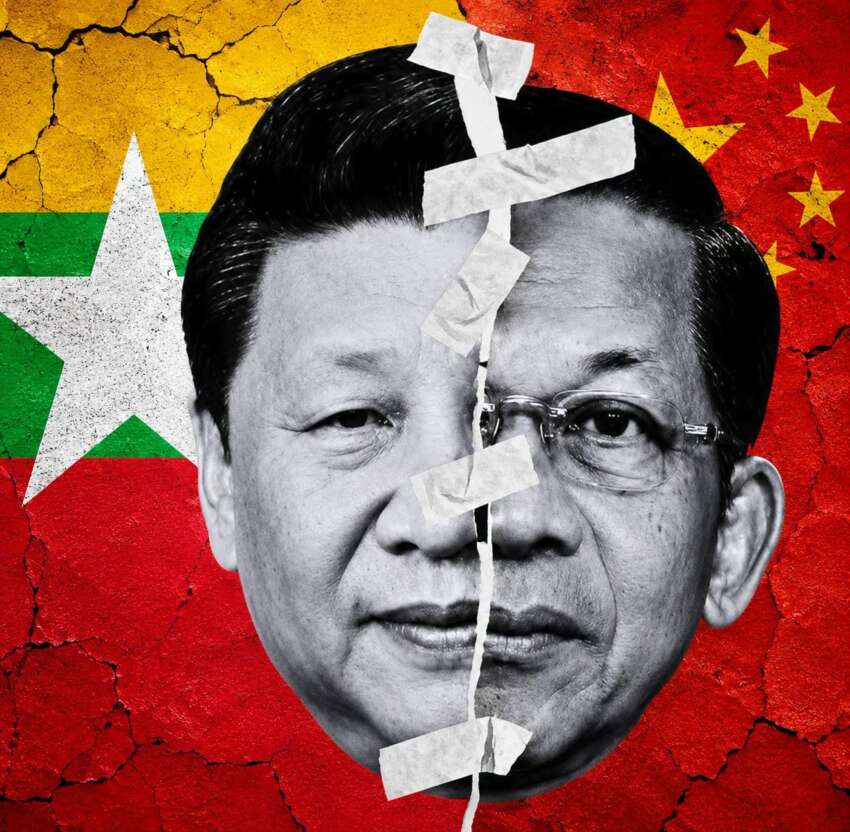
China is strategically subjugating Myanmar, simultaneously controlling the military and ethnic armed groups, and warning that if China can establish a naval base in Kyaukphyu, it could pose a major threat to Indian Ocean security
Infrastructure
2026年7月15日
3
Khit Thit Media
Relations
🇲🇲Myanmar🇨🇳China🇮🇳India

China is strategically subjugating Myanmar, simultaneously controlling the military and ethnic armed groups, and warning that if China can establish a naval base in Kyaukphyu, it could pose a major threat to Indian Ocean security

AI サマリー

Yangon, July 15 China is seeking to transform Myanmar into a subordinate geopolitical client state for its strategic interests, supporting the Myanmar military on one hand while controlling ethnic armed groups through we

Yangon, July 15 China is seeking to transform Myanmar into a subordinate geopolitical client state for its strategic interests, supporting the Myanmar military on one hand while controlling ethnic armed groups through weapons, economy, and border trade on the other, according to an analysis and writing by security and terrorism expert Jaideep Saikia. The article, published on July 14 and titled “The Sino-Myanmar Axis: Strategic Paralysis and Hegemonic Belligerence,” states that China’s strategy towards Myanmar is primarily aimed at resolving its over-reliance on the Malacca Strait, known as the “Malacca Dilemma.” Over 80 percent of China’s energy imports pass through the Malacca Strait, and the potential for this sea lane to be blocked in case of war or geopolitical conflict represents one of China’s biggest strategic vulnerabilities. Therefore, China is attempting to use Myanmar as a land bridge to gain direct access to the Indian Ocean, and while it has directly connected oil and natural gas pipelines to Yunnan Province through the China-Myanmar Economic Corridor (CMEC), it also aims to secure a long-term naval foothold at the deep-sea port of Kyaukphyu in Rakhine State, the analysis suggests. To implement these objectives without direct military intervention, China is employing a “two-pronged strategy,” providing diplomatic protection to the State Administration Council at the state level and supplying advanced military equipment, including fighter jets and drone counter-systems. Simultaneously, it has established close ties with ethnic armed organizations along the 2,100-kilometer China-Myanmar border. The expert notes that China is using the “Brotherhood Alliance” of three groups, particularly the United Wa State Army (UWSA), the Myanmar National Democratic Alliance Army (MNDAA), the Ta’ang National Liberation Army (TNLA), and the Arakan Army (AA), as tools for strategic pressure. He further analyzes that China has arranged for weapons, communication infrastructure, and financial resources to flow to the armed groups in the border region, ensuring that China remains the ultimate decision-maker, regardless of which group controls the territory. However, if the offensives by ethnic armed groups reach a point where they can overthrow the State Administration Council and threaten CMEC projects and China’s economic interests, Beijing has a tendency to intervene and exert pressure immediately, the article states. China has pressured ethnic armed groups by closing border gates and cutting off electricity and commodity supply routes, and has reportedly made the MNDAA and TNLA accept ceasefire agreements. The author points out that Beijing, under the supervision of Chinese Special Envoy Ding Xuexiang, exerted extreme diplomatic and economic pressure to compel the MNDAA to hand over the strategically important city of Lashio, which it controlled, back to the State Administration Council. The article explains that China’s strategy is to keep the State Administration Council from becoming strong enough to reject China’s economic demands, while also preventing the complete collapse of state administration. Meanwhile, it is also ensuring that ethnic armed groups remain dependent on trade and supply routes from Yunnan Province. It is pointed out that dissatisfaction is growing among the military leaders in Naypyidaw regarding China’s dual approach, and Min Aung Hlaing is attempting to strengthen relations with India to reduce his complete dependence on China. The article also notes that although Min Aung Hlaing has pledged to New Delhi that Myanmar’s territory will not be used as a base for attacks by anti-India armed groups, the State Administration Council does not have full administrative and military control over the border areas in Sagaing Region and Chin State. Furthermore, it is known that rare earth minerals in Kachin State in northern Myanmar are a very important strategic resource for China. Specifically, the region of Chipwe-Pangwa contains large quantities of rare earth metals such as Dysprosium and Terbium, used in electric vehicles, green technology, and defense industries, making northern Myanmar China’s main overseas source of rare earth metals. These ores are mined using chemical extraction methods that cause significant environmental damage, are transported directly to Yunnan Province for refining, and this supply chain allows China to dominate the global rare earth metal market, the analysis suggests. The author highlights the coincidence that military operations against the Kachin Independence Army (KIA), which controls important rare earth mining areas, occurred at the same time as the meeting between Chinese President Xi Jinping and Min Aung Hlaing on June 16. The article also recommends that the QUAD, comprising India, the United States, Japan, and Australia, should implement alternative economic and infrastructure projects to counter China’s influence. Specifically, it suggests that China’s CMEC projects can be economically countered by establishing a rare earth metal refining and production hub in Northeast India, implementing the Kaladan Multi-Modal Transit Transport Project, and expediting the India-Myanmar-Thailand Trilateral Highway. Most importantly, the article warns that if the Chinese navy establishes a permanent foothold at the deep-sea port of Kyaukphyu, the People’s Liberation Army Navy (PLAN) will be able to conduct permanent military operations in the Bay of Bengal and the Indian Ocean without needing to pass through the Malacca Strait. This situation could allow China to monitor India’s eastern naval activities, scout missile testing activities near the Odisha coast, and threaten the security of the Andaman and Nicobar Command. Furthermore, it is analyzed that if signal intelligence systems and anti-ship missile systems can be deployed along the Rakhine coast, China will be able to exert military pressure on important global maritime trade routes connecting Europe and the Middle East to East Asia. The conflict occurring within Myanmar is no longer just an internal political issue, but a matter concerning South Asia and the Indian Ocean...

多角的分析

経済的影響

実務協力は短期の投資案件に直結しなくても、人材育成、技術移転、行政能力の底上げにつながる可能性があります。ただし制度透明性が低いままでは、協力の実効性は限定されます。

投資家心理

投資家にとっては、どの国との実務協力が残っているかがリスク評価の材料になります。外交接点の継続はプラス材料ですが、政治的正統性や制裁環境を切り離して見ることはできません。

社会的影響

軍の発表や会談が市民に意味を持つのは、安全の改善として現場に降りた時です。ヤンゴン、7月15日 中国は、自国の戦略的利益のためにミャンマーを従属的な地政学的従属国へと変貌させようとしており、ミャンマー国軍を支援する一…という動きは、外交儀礼よりも、学校・職場・行政窓口で何が変わるかで評価されます。

市民の声

市民にとっては、会談そのものよりも、雇用、教育機会、公共サービスの改善として実感できるかが焦点です。成果が見えなければ公式報道への信頼は高まりません。

背景・歴史的文脈

このニュースは、ミャンマー政府が対外関係を通じて行政分野の協力を維持しようとする動きです。国際的な孤立や制裁圧力が続く中でも、科学技術、教育、金融など実務分野の会談は、政府間チャネルを保つ意味を持ちます。

原文ソース

Khit Thit Media

原文を読む