Jakarta's Sinking Metropolis: Water Scarcity Plagues Millions Amidst PAM JAYA's Expansion Push
Society
2026年7月24日
5
The Diplomat Indonesia

General articles are free for 24 hours after publish.

Jakarta's Sinking Metropolis: Water Scarcity Plagues Millions Amidst PAM JAYA's Expansion Push

Share
AI Summary

Jakarta faces severe land subsidence due to excessive groundwater extraction, leaving millions struggling for safe piped water access. PAM JAYA aims for universal coverage by 2029, but aging infrastructure and water leakage pose significant challenges.

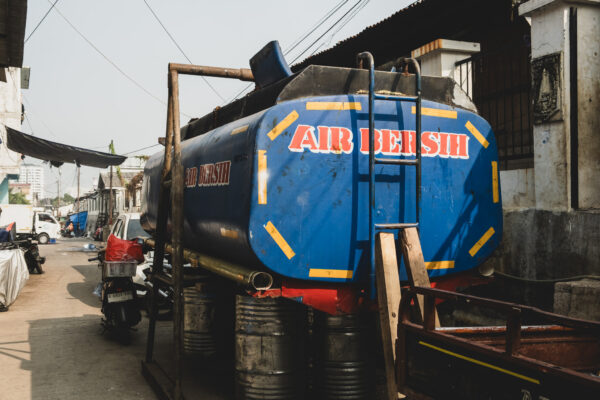
Read The Diplomat, Know The Asia-Pacific Excessive groundwater extraction by households and industry is one of the primary reasons for the city’s subsidence. Thousands of families in Penjaringan, North Jakarta, rely on expensive deliveries from water trucks. The blue water tanker rumbles into the narrow lanes of Muara Angke, a fishing community on Jakarta’s northern coast, every few days. Within minutes, residents emerge carrying hoses and plastic containers. Some connect pipes snaking through the densely packed community. Others wait with buckets. For families here, in one of the poorest neighborhoods in the world’s most populous metropolis, the truck delivers something millions of people in Indonesia’s capital still cannot rely on: clean water. “When the deliveries stop, life quickly becomes impossible,” said Ellah, who runs a small neighborhood water kiosk. “For seven days,” she recalled of one such instance, “people couldn’t wash. They couldn’t cook.” Jakarta’s public water utility, PAM JAYA, says it is trying to change that. Since returning the city’s water system to full public control in 2023, the utility has embarked on its most ambitious expansion in decades, aiming to provide piped water to every household by 2029. It says coverage has already increased from just over 60 percent, when it took over, to about 82 percent of residents this year, with tens of thousands of new household connections installed over the past year as part of a broader effort to reduce dependence on groundwater. But it is more than just about ensuring access to clean water. Home to more than 12 million people in the city proper and 42 million in the wider metropolitan area, Jakarta is also globally known as the world’s fastest-sinking city – one of the prime reasons behind the controversial decision to build a new capital, Nusantara, in East Kalimantan. Scientists say excessive groundwater extraction in Jakarta, rather than rising sea levels, is the primary reason parts of the city are sinking by up to 15 centimeters a year, with some studies recording even faster rates. Some neighborhoods have already subsided by as much as four meters since the 1970s. Reliable piped water is widely regarded as one of the most important long-term solutions. The more households connected to the network, the fewer need to drill wells into the aquifers beneath the city. Yet for millions of Jakartans, that transition remains incomplete. Unlike much of the city, municipal pipes have never reached Ellah’s community of about 200 families living in wooden homes above the tidal waters of the north coast. So in 2016, she built her own miniature distribution system. Every few days, she buys an 8,000-liter tanker of water, stores it in large tanks outside her home, and sells it to around 15 neighboring households through a web of plastic hoses. Even then, clean water comes at a price. For many families, buying enough water for cooking, washing, and bathing can cost up to 600,000 rupiah ($33) a month. Average monthly household salaries in the area are about 1.5 to 3 million rupiah ($80 to $160). “We feel like we are just ignored out here on the sides [of the city],” Ellah said. Nearby, 68-year-old former fisherman Husnin also buys water instead of receiving it through household pipes. Ellah and her husband set up their own water supply network because the city’s piped water service does not yet reach their neighborhood. (Photo by Michael Neilson) His family spends around 40,000 rupiah ($2.20) every three days on water for washing and cooking, while drinking water must be purchased separately from refill stations. Those costs have become harder to absorb as fish stocks decline and incomes shrink. “[Access to water] is our right as citizens,” he said. “And it is the responsibility of the government to provide it.” Nearby in Penjaringan, 46-year-old grandmother Sadiya has no piped connection either. Instead, a hose runs from a nearby mosque, where groundwater is pumped into her home for 150,000 rupiah each month. When the pump fails, she must buy water from vendors, spending as much as 30,000 rupiah a day ($1.70) – a huge burden for a household that sometimes earns less than 1 million rupiah ($56) each month. “I feel sad,” she said. “Sometimes I’m late on the monthly payment because the money has to be divided for everything else.” Meanwhile, just a few kilometers away in Rawabadan Selatan, families were connected to the municipal water network about two years ago. They had previously relied on bore water, which, due to seawater infiltration and pollution, was often too dirty to cook, bathe, and even clean with. “It is so much better,” said Walimah of the piped supply. “Previously [the borehole water] made us itchy. We had to rinse again with [cleaner] water.” The historical dependence on groundwater in Jakarta has created a vicious cycle. As groundwater is pumped from beneath the city, the land sinks. Underground pipes crack and shift, allowing treated water to leak before it reaches customers. According to PAM JAYA, as much as 50 percent of Jakarta’s treated water is lost through leakage, reducing revenue needed to repair ageing infrastructure and extend the network into underserved communities. The result is a cycle that has persisted for decades: limited piped water drives groundwater extraction, groundwater extraction accelerates land subsidence, and subsidence further damages the very network needed to break that dependence. For Universitas Tarumanagara lecturer Wahyu Kusuma Astuti, who recently completed her PhD on Jakarta’s water infrastructure, the roots of the problems began more than a century ago. Jakarta’s piped water network was originally built during the Dutch colonial period to serve European neighborhoods, leaving most native Indonesian communities without access from the outset. “The pipe system was limited in the old colonial enclaves,” she said. “The local communities were not connected from the beginning.” As Jakarta grew into one of the world’s largest cities, the network never kept pace with its rapidly expanding population. Vast areas instead came to depend on groundwater. By the 1990s, city leaders faced mounting pressure to expand water services. Rather than funding the enormous investment themselves, the government turned to private operators. One of many communities in North Jakarta affected by the city’s subsidence and rising sea levels. (Photo by Michael Neilson) In 1997, under President Suharto, Jakarta’s water system was divided between British utility Thames Water and France’s Suez under long-term concession agreements intended to rapidly expand access. Contracts were awarded through political and business networks closely linked to the Suharto family. Coverage was expected to reach almost 98 percent under these agreements. Instead, critics argue, the concessions left Jakarta locked into decades of underperformance. A 2026 research paper

0

Original source

The Diplomat Indonesia

原文を読む