General articles are free for 24 hours after publish.
Himalayan Flood Devastates Nepal's Border Region, Triggering Economic Collapse
A massive glacier collapse in northern Nepal triggered flash floods and landslides along the Trishuli and Bhotekoshi rivers, causing widespread destruction. Infrastructure, hydropower projects, and SMEs were devastated, and the key trade route with China was severed. Economic losses are estimated at over $5 billion, highlighting the urgent need for climate-resilient infrastructure reconstruction.
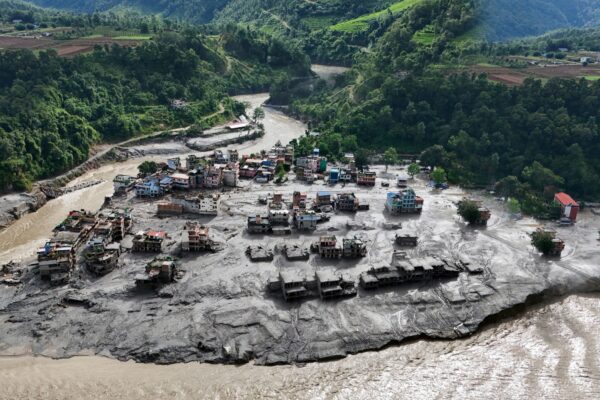
Read The Diplomat, Know The Asia-Pacific The destruction of the Trishuli-Bhotekoshi corridor is a local tragedy with national economic consequences. A drone view shows mud covering buildings and properties in Trishuli, Nuwakot District, Nepal, on Aug. 27, 2026, following devastating floods. On August 26, a massive glacier collapse near Langtang Lirung triggered a chain of flash floods and mudslides along the Trishuli and Bhotekoshi river systems. The event has not only caused damage to what was developed there but also to what was being built in that area, including infrastructure, hydropower projects, and private businesses, primarily small and medium enterprises (SMEs). Losses are estimated at more than $5 billion, which is almost one-third of Nepal’s annual budget. Settlements, roads, bridges, hydropower plants, trade facilities, farmland, and human lives across Rasuwa, Nuwakot, Dhading, and downstream districts were swept away or buried beneath mud and boulders. Early estimates of the damage could be made using the household-level data from these locations and the data from the 2018 economic census. But that could be misleading. The contribution to the GDP from those areas is going to be minimal when looking at the immediate numbers. However, the share could be far more significant if we factor in indirect benefits from the river systems and economic hubs in that corridor. Especially important is the opportunity cost, as Nepal was attempting to build up a vibrant trade link with China in exactly this region. The human toll alone is immense. More than 1,300 people are confirmed dead in Nepal, while over 4,000 people are missing. For those who survived, the loss is not limited to houses and belongings. Families have lost relatives, farmland, livestock, food stocks, shops, vehicles, savings, identity documents, and the means to earn an income. Entire local economies in the peripheral areas of the flood-hit districts have been disrupted, which has a direct impact on key sectors such as tourism and agri-businesses. The Trishuli-Bhotekoshi corridor is more than a river valley. It connects mountain communities to Kathmandu, national markets, tourism destinations, hydropower investments, and cross-border trade with China. Its destruction is therefore a local tragedy with national economic consequences. The complete destruction of the Gyirong Port border complex is especially serious. The port was Nepal’s primary trade and tourism gateway with China. At the moment, Nepal has no fully functional border crossing point with China, which has a high cost for an economy that relies on imports of raw materials and other goods from China. When the flood hit, more than 300 vehicles waiting at the border were swept away. About 42 kilometers of road and 41 bridges were damaged, with road and bridge repairs alone estimated to cost 15 billion rupees ($99.4 million). The estimated cost to repair is one thing; it’s much more difficult to calculate the cost that accumulates when the movement of local people is limited due to the absence of infrastructure, especially in a border region. Sections of the Prithvi Highway are still blocked, delaying relief operations and disrupting the transport of goods, fuel, food, and passengers. The loss of the Gyirong-Rasuwagadhi trade route will affect importers, exporters, freight companies, customs agents, drivers, hotels, warehouses, retailers, and consumers throughout Nepal. Most of the freight companies have been damaged, with their containers being completely wiped out. China has closed the Tatopani customs point following the complete destruction of the Rasuwagadhi border point linking Rasuwa and Gyirong. With no functional border crossing between Nepal and China at the moment, supply chains have been disrupted. This has a direct impact on customs revenue and will raise prices for consumers due to lack of supply. People already suffering from the price hikes due to the Iran-U.S. war, among other global events, will have to face more severe economic hardships. Local economic centers, including Syabrubesi, Betrawati, Trishuli, and Rasuwagadhi had been developing through tourism, trade, transport, agriculture, construction, and hydropower investment. Their destruction risks reversing years of local economic progress. The damage to Nepal’s hydropower system will have consequences beyond the immediate loss. With approximately 431 megawatts removed from the grid and another 470 MW of projects under construction affected, the disruption threatens electricity reliability just as demand is expected to rise during the dry season. In the short term, reduced domestic generation will increase reliance on electricity imports, putting additional pressure on the trade balance and increasing costs for households and businesses. These losses go way beyond repair costs. Nepal faces lost electricity sales, reduced export potential, lower tax revenue, job losses, increased financing risks, and weakened investor confidence. If climate risks are not incorporated into hydropower planning, lenders and investors may consider Himalayan projects more expensive and less secure. The estimated direct damage to Nepal’s infrastructure exceeds 200 billion rupees, or about $1.3 billion. Yet the full cost of restoring homes, schools, hospitals, roads, bridges, power systems, farmland, trade facilities, and livelihoods could reach around $8 billion. The long-term impact is even more worrisome, as the country is again reeling under the burden of long-term rebuilding and rehabilitation. Some of the areas decimated by the flood were still rebuilding from the devastating earthquake of 2015. Nepal cannot afford to rebuild the same infrastructure in the same vulnerable locations. Reconstruction must be financed through a green, resilient, and climate-informed approach. Roads and bridges should be rebuilt using updated flood-risk projections, with stronger foundations, safer alignments, wider river corridors, and improved drainage. Hydropower projects must account for glacier collapse, permafrost thaw, landslides, sediment flows, and glacial lake hazards – not only historical monsoon floods. Investment in forests, wetlands, riverbanks, and degraded slopes can reduce erosion, stabilize watersheds, and protect livelihoods. Decentralized solar systems, battery storage, and local microgrids can keep health posts, schools, water systems, and emergency shelters functioning when major hydropower and transmission systems fail. The government should consider establishing a Himalayan Climate Resilience and Recovery Financing Facility as a permanent platform for post-disaster recovery and long-term climate adaptation. Led by the Ministry of Finance in partnership with sectoral ministries, provincial and local governments, private investors, and development partners, the Facility could mobilize grants, concessional loans, insurance, guarantees, and responsibly structured private inve
Original source
The Diplomat Indonesia