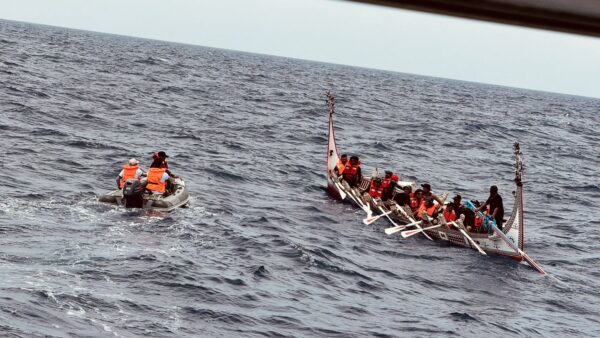
Taiwanese Indigenous Ties Amidst China's Batanes Claims
Taiwan's Indigenous Tao people embarked on a traditional voyage to the Philippines' northernmost Batanes Islands, reaffirming historical and cultural ties. This was followed by outrage in the Philippines after Chinese scholars claimed Batanes as Chinese territory. The incident occurs against a backdrop of regional geopolitical tensions, including China's maritime assertiveness and strengthening Japan-Philippines cooperation.
An Indigenous Tao community from Taiwan's Orchid Island recently completed a traditional voyage to the Philippines' northernmost Batanes Islands aboard the "Ovayan," a wooden plank vessel. The journey, aimed at reviving historical and cultural connections disrupted centuries ago, took approximately 24 hours. Similarities in language and cuisine between the Tao people and Batanes residents highlight their shared roots within the broader Austronesian migration. However, shortly after this cultural exchange, claims made by Chinese scholars at an academic conference asserting Batanes Islands as historically part of China sparked significant outrage in the Philippines. The scholars cited historical administration from Taiwan during the Ming and Qing dynasties as grounds for China to "safeguard its sovereignty." This assertion is seen as a reaction to the growing regional cooperation, including the recent maritime delimitation talks initiated between Japan and the Philippines. The region faces heightened geopolitical tensions, with China's increasing assertiveness in the South China Sea. Both the Philippines and Japan have maritime disputes with China, and coast guard vessels have engaged in confrontations. The Chinese scholars' historical territorial claims represent a clash over historical narratives within this context. Philippine officials have refuted the claims, and the assertions have been met with mockery on social media. Taiwan has also criticized its exclusion from multilateral arbitration mechanisms, particularly regarding the 2016 South China Sea ruling where its claim over Taiping Island was deemed a "rock." On the 10th anniversary of the ruling, Taiwan reiterated its stance, with legislators visiting Taiping Island to emphasize its claims. The warming ties between the Philippines and Japan are driven by concerns over Beijing's regional assertiveness, including potential contingencies involving Taiwan. Both nations share maritime territorial disputes with China, such as the Senkaku/Diaoyu Islands, where confrontations between Chinese and Japanese coast guards are not uncommon. Similarly, China and the Philippines have competing claims in the South China Sea, leading to incidents involving water cannons and floating barriers around features like Scarborough Shoal. The Chinese academics' claims over Batanes echo previous instances where Chinese state media have questioned Japanese sovereignty over Okinawa by emphasizing historical tributary links. This episode underscores the contemporary geopolitical imagination of territorial sovereignty, where premodern antiquity is invoked. In Taiwan, cultural works have explored similar themes of historical identity and territorial claims. Source: The Diplomat Indonesia
多角的分析
この記事は直接的な経済的影響には触れていませんが、バタネス諸島のような地理的に孤立した地域における文化交流の促進は、長期的に観光や地域経済の活性化につながる可能性があります。しかし、領土問題の緊張は、潜在的な投資や貿易関係に不確実性をもたらす可能性があります。
投資家にとって、このニュースは南シナ海周辺の地政学的リスクの高まりを示唆しています。特に、中国の領土主張は、当該地域への直接投資やサプライチェーンの安定性に懸念を生じさせる可能性があります。日本とフィリピンの連携強化は、一部の産業にとっては機会となり得ますが、全体的なリスク評価は慎重に行う必要があります。
バタネス諸島と台湾のタオ族との間の文化的な結びつきの再確認は、地域社会にとって歴史的アイデンティティの再認識という側面を持ちます。一方で、中国による歴史認識を巡る領土主張は、フィリピン社会、特にバタネス諸島の住民のアイデンティティや安全保障への不安を煽る可能性があります。ソーシャルメディアでの反応は、この問題に対する国民感情の強さを示しています。
バタネス諸島の住民にとって、今回の出来事は、自分たちの土地と文化が国際的な地政学的な駆け引きの対象となっていることを実感させるものです。中国の学術的な主張は、彼らの日常生活に直接的な影響を与えるものではありませんが、地域全体の安定性に対する懸念を増大させる可能性があります。また、台湾の先住民との交流は、自分たちのルーツや地域社会の多様性を再認識する機会となります。
背景・歴史的文脈
台湾の先住民とフィリピン・バタネス諸島の住民は、オーストロネシア語族という広範な言語・文化圏に属しており、その起源は台湾にあるとする説(「台湾からの移動説」)が有力視されています。タオ語は、他の台湾先住民言語と異なり、フィリピン・バタン語群に分類されるほど、バタネス諸島との言語的近親性が高いことが知られています。歴史的には、明・清時代にかけて、台湾やフィリピン周辺海域は交易や漁業の活発な地域であり、両地域間の交流も存在しました。しかし、300年ほど前に誤解により途絶えたとされています。近年、中国は南シナ海における海洋進出を強めており、フィリピンや日本との間で領有権や海洋権益を巡る対立が激化しています。特に、2016年の常設仲裁裁判所による南シナ海仲裁裁判で中国の主張が退けられて以来、中国は歴史的根拠を主張する姿勢を強めています。今回の中国学者のバタネス諸島に関する主張は、こうした地域的な地政学的な緊張と、歴史認識を巡る対立が複合的に作用した結果と考えられます。
原文ソース
The Diplomat Indonesia