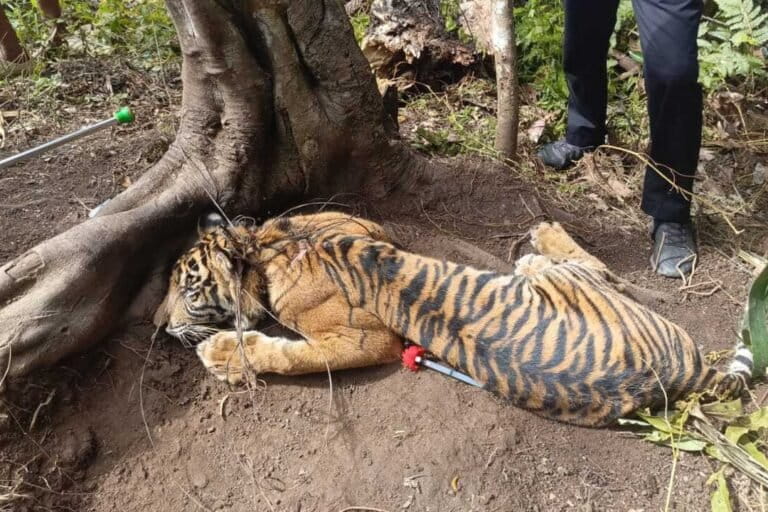
Sumatran Tiger: Forest Guardian or Misunderstood Predator?
The Sumatran tiger, a guardian of Indonesian forests, is often misperceived as aggressive. Habitat destruction and dwindling food sources lead to human-tiger conflict, though the species generally avoids humans.
The Sumatran tiger (Panthera tigris sumatrae) plays a crucial role in Indonesia's forest ecosystems, yet its presence is often misunderstood. Facing threats from deforestation and poaching, its habitat is increasingly fragmented, leading to more frequent encounters with humans. This situation contributes to the stereotype of tigers being "aggressive." However, numerous studies suggest that this endemic species generally avoids humans. Conflicts are primarily attributed to shrinking habitats and reduced food sources within the forests. The Sumatran tiger is the last surviving subspecies of Indonesian tigers, with the Javan and Bali tigers having gone extinct. Physically, the Sumatran tiger is among the smallest of the tiger subspecies. Its dense stripes and darker coat are considered adaptations to its tropical habitat. Research by Fathoni (2022) indicates that male Sumatran tigers are larger than females, weighing between 100-140 kg and measuring 140-280 cm in length, while females of similar weight are typically 80-90 cm long. These physical characteristics are not coincidental but are a result of evolutionary adaptation to their tropical environment. The existence of the Sumatran tiger is a symbol of Indonesia's rich biodiversity, and its conservation is vital for maintaining ecological health.
多角的分析
スマトラトラの生息地の破壊は、その生息域に依存する地域経済、特にエコツーリズムや持続可能な森林資源の利用に長期的な悪影響を与える可能性があります。森林の減少は、水資源や土壌の保全にも影響し、農業生産性にも間接的な影響を及ぼすと考えられます。
スマトラトラの生息環境の悪化は、インドネシアの自然資本への投資リスクを示唆しています。森林破壊を伴う開発プロジェクトは、生物多様性への影響を無視した場合、国際的なESG投資基準からの批判や、ブランドイメージの低下を招く可能性があります。
スマトラトラと人間との衝突が増加することは、地域住民の安全への懸念を高め、トラに対する恐怖や敵意を増幅させる可能性があります。これは、保護活動への地域社会の協力を得にくくする要因となり、トラの密猟や違法取引を助長するリスクも孕んでいます。
スマトラトラとの遭遇が増えることで、特に森林周辺に住む住民は、農作物への被害や家畜への襲撃、さらには人身被害への不安を抱えています。この恐怖心から、トラを排除すべき対象と見なす意見も生まれる可能性があります。一方で、トラを地域の誇りや自然遺産と捉え、保護の重要性を訴える声も存在します。
背景・歴史的文脈
インドネシアにおけるスマトラトラの絶滅危機は、数十年にわたる急速な森林伐採に起因します。1970年代以降、パーム油、紙パルプ、ゴムなどのプランテーション開発が拡大し、トラの生息地を分断・縮小させてきました。これに加え、密猟や違法取引が個体数をさらに減少させています。ジャワトラとバリトラが既に絶滅した事実は、スマトラトラに対する保護の緊急性を浮き彫りにしています。
原文ソース
Mongabay Indonesia