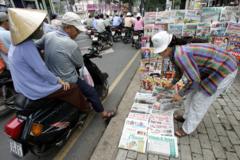
Ho Chi Minh City's media outlets shut down, sparking quiet dismay
Several major media outlets in Ho Chi Minh City have been shut down, prompting expressions of regret from journalists and some experts. While seen as part of a government consolidation of media, questions have arisen about the decision-making process and concerns about media independence have been raised.
Several major media outlets in Ho Chi Minh City, long familiar to the public, have successively ceased their print publications, bringing their operations to an end. A journalist from Tuổi Trẻ newspaper expressed their feelings on social media, stating their heart sank at the demise of the print medium with its scent of ink. A reporter from Pháp Luật TP.HCM newspaper posted photos of the final editorial work, writing "With many memories." A reporter from Người Lao Động newspaper shared their packing from the editorial office on social media, which garnered many sympathetic and sorrowful comments. Dr. Lê Hồng Giang, an economics and finance expert, questioned the decision-making process behind the closure of an economics newspaper, stating, "Why the closure? Neither the editorial department nor we know. No one has been asked for their opinion." He expressed disbelief that the newspaper's business model or the demand for an economics specialist publication had disappeared, noting that these media organizations do not receive any funding from the state budget. A quiet yet profound sense of disappointment and regret has spread across social media regarding the closure of these media outlets. Many stakeholders appear to question the rationality of the authorities' decision to consolidate and centralize media organizations. However, no open voices of opposition have been raised. Since the end of the Vietnam War in 1975, Ho Chi Minh City (formerly Saigon) has maintained a vibrant media scene within the framework of the Vietnamese Communist Party. In the past, in addition to the tradition of free press that existed during the Republic of Vietnam era, newspapers led by intellectuals and religious leaders known as the "third force" were also temporarily permitted after reunification. However, in recent years, the space for press freedom has gradually narrowed, and the current closures symbolize the end of an era for Saigon's media. Following the fall of Saigon on April 30, 1975, two newspapers from the Republic of Vietnam era were permitted to continue operating: the daily Tin Sáng, run by Ngô Công Đức, Dương Văn Ba, and Lý Quí Chung, and Đứng Dậy, the new name for the magazine Đối Diện before 1975, overseen by priests Chân Tín and Nguyễn Ngọc Lan. These were intellectuals, politicians, and religious figures who had opposed the war and the policies of the Republic of Vietnam government before 1975, some sympathizing with the National Liberation Front, while others maintained a neutral stance. They were referred to as the "third force" and were expected to serve as a bridge for reconciliation, harmony, and the gathering of intellectuals after 1975. The government's decision to allow the republication of two newspapers from the "third force" had a clear objective: to use familiar newspapers and journalists from Saigon to communicate the revolutionary government's policies to the people of Saigon and the South. In his memoir, Lý Quí Chung—former Minister of Information during the final period of the Republic of Vietnam and later known by the pen name Chánh Trinh after 1975—recounted: "In early September 1975... the daily Tin Sáng was republished. The reappearance of a newspaper familiar to Saigon residents before 1975 clearly had a positive impact in a new context where many things were very new and strange to the people of Saigon, now named Ho Chi Minh City." This was a period when the new government established several newspapers in the city just as the guns fell silent. First were Sài Gòn Giải Phóng and Phụ Nữ Sài Gòn—launched in May 1975. They were followed by Tuổi Trẻ (September 1975), Công Nhân Giải Phóng, later renamed Người Lao Động. Upon their establishment, the newspapers of Ho Chi Minh City immediately participated in the revolutionary government's propaganda efforts. In an article published in Tuổi Trẻ, Trần Bạch Đằng vehemently condemned: "One of the heinous crimes of American imperialism and its lackeys" was "denying true beauty, beauty of content, spiritual beauty" and "promoting superficial beauty, false beauty, and purely material beauty." In another article on Tự Do Street—renamed Đồng Khởi after 1975—published in Tuổi Trẻ on January 13, 1979, author Trần Bạch Đằng acknowledged the city's hardships while criticizing the "artificial prosperity" of the past: "[...] We only object to three aspects of any prosperity. First, does that prosperity truly represent our country's productive capacity...; second, what is the price paid for that prosperity—is it the diligent and honest labor of our people, or has our dignity and freedom been robbed or curtailed in pursuit of it; third, for whom is that prosperity—for a few gluttons or for everyone?" Amidst a city that was once prosperous but is now extremely difficult, he instilled confidence in readers: "Surely, soon we will be prosperous, a prosperity that does not challenge the conscience or self-respect of any of us." He concluded: "In this city and at this time, as the elegant, pleasure-seeking facade fades a little, the spiritual height, the deep inner self of the city's people, will rise a level." The staff of Tin Sáng and Đứng Dậy quickly integrated into the fervent "post-liberation" journalistic atmosphere. The newspapers enthusiastically participated in promoting the revolutionary government's programs, such as re-education, resettlement in new economic zones, industrial and commercial reform, the elimination of decadent cultural products, short haircuts, shaven beards, and youth conscription, and criticizing the old regime. Journalist Chánh Trinh-Lý Quí Chung, as deputy editor-in-chief of Tin Sáng, had the opportunity to travel to Hanoi to cover a National Assembly session, experiencing for the first time the parliament of a communist Vietnam after being accustomed to the parliamentary atmosphere of the Republic of Vietnam. Author Lý Quí Chung wrote: "Tin Sáng made no small contributions to the way information was disseminated and journalism was practiced in Vietnam after 1975. In reality, the novelty of Tin Sáng was merely the application of journalistic practices from pre-1975 Saigon, selectively adapted to the journalistic framework of the time." Individuals like Ngô Công Đức and Lý Quí Chung, accustomed to reporting under the Republic of Vietnam when they could frankly criticize the government in the press—and when their editorial offices were shut down by the government, they could at least challenge the authorities—now found themselves constrained.
多角的分析
ホーチミン市の報道機関の閉鎖は、ベトナムにおけるメディアの経済的持続可能性と、政府の統制下でのビジネスモデルの課題を浮き彫りにしている。これらの報道機関は政府からの財政支援を受けていないとされており、市場原理に基づいた運営が求められる一方で、報道内容への制約も存在する。経済専門家が指摘するように、有料購読や広告収入といった従来の収益モデルだけでは、運営が困難になっている可能性が高い。これは、ベトナム経済の成長に伴う広告市場の拡大という側面と、政府による情報統制という側面が複雑に絡み合っていることを示唆している。特に、経済紙のような専門性の高いメディアでさえ、独立した収益モデルの構築が難しい現状は、ベトナムのメディア産業全体が抱える構造的な問題を反映していると考えられる。
今回の報道機関閉鎖は、ベトナムのメディア投資環境におけるリスク要因を再認識させる。政府の意向によって、独立採算制で運営されていたメディアであっても、予告なく事業継続が困難になる可能性がある。これは、メディア分野への新規投資、あるいは既存メディアへの追加投資を検討する投資家にとって、不確実性の高さを意味する。特に、外国からの投資家にとっては、ベトナムのメディア規制や、当局の意思決定プロセスが不透明である場合、投資回収のリスクを慎重に評価する必要がある。長期的な視点では、メディアの統合・集約化は、市場の競争を抑制し、多様な情報発信の機会を減少させる可能性があり、これは経済全体の活性化という観点からも、投資環境の健全性を損なう要因となりうる。
ホーチミン市の報道機関閉鎖は、市民の知る権利と情報アクセスに影響を与える。SNS上での静かな落胆は、多くの市民がこれらのメディアに親しみを感じ、その存在を失うことに寂しさを感じていることを示している。特に、経済専門家が指摘したように、意思決定プロセスが不透明なまま、メディアが一方的に閉鎖される状況は、市民の間に不信感や無力感を生じさせる可能性がある。また、報道機関の統合は、政府のプロパガンダ機能の強化に繋がり、多様な意見や批判的な視点が社会に届きにくくなる懸念がある。これは、ベトナム社会が直面する、経済成長と情報統制のバランスという課題を浮き彫りにしている。
ホーチミン市で報じられた主要報道機関の閉鎖は、一般市民、特に長年これらのメディアに親しんできた層に静かな動揺を与えています。SNSでの「心が沈んだ」「惜しい」といった声は、市民が単なる情報源としてだけでなく、文化的な一部として、あるいは過去の記憶を共有する媒体として、これらのメディアに愛着を持っていたことを示唆しています。経済専門家が指摘するように、これらのメディアが政府からの財政支援を受けていないにも関わらず、突如として閉鎖される事態は、市民の間に「なぜ」「どうして」という疑問とともに、将来への不安感を抱かせます。特に、経済成長を続けるベトナムにおいて、情報へのアクセスが限られること、あるいは政府の意向に沿った情報しか得られなくなる可能性は、市民の生活実感や社会への関わり方に影響を与える可能性があります。例えば、地方の経済状況や、都市部での生活コストに関する率直な報道が減ることで、市民が自身の生活設計や社会問題への関心を深める機会が失われる、といった影響が考えられます。
背景・歴史的文脈
ベトナムにおける報道機関の統制は、一党体制下の共産党の指導が根幹にある。1975年のベトナム統一後、旧体制下のメディアは再編され、党のイデオロギー伝達の役割を担うようになった。サイゴン・ホーチミン市においては、統一後も一時的に「第三勢力」と呼ばれる、旧体制下で反戦運動などに携わった知識人によるメディアが活動を許された時期もあったが、次第に党の統制下へと組み込まれていった。近年、インターネットやSNSの普及により、市民の情報アクセス手段は多様化したが、同時に政府による情報統制や検閲も強化される傾向にある。今回の報道機関の閉鎖は、こうした長年の情報統制の流れの中で、メディアの集約化を進める当局の意向が反映されたものと見られる。
原文ソース
BBC Vietnamese