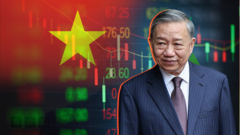
Vietnam's Economic Growth Amidst Stagnant Global Capital Inflow
Economy
2026年8月2日
5
BBC Vietnamese

General articles are free for 24 hours after publish.

Vietnam's Economic Growth Amidst Stagnant Global Capital Inflow

Share
AI Summary

Despite Vietnam's robust economic growth, its stock market remains sluggish and foreign direct investment is facing headwinds. Observers point to foreign ownership limits, an outdated financial system, and capital controls as key deterrents. Party General Secretary and President To Lam appears keen to address these issues.

Despite Vietnam's robust economic growth, its stock market remains sluggish, and global capital inflow has not met expectations. According to the General Statistics Office, Vietnam's per capita GDP is projected to reach approximately USD 5,026 in 2025, a nearly 40% increase from USD 3,550 in 2020. Exports have also surged by 60% over the past five years, benefiting from the "China+1" diversification trend, which sees international companies shifting or expanding production to Vietnam instead of solely relying on China. Giants like Apple have expanded production of AirPods, iPads, and MacBooks in Vietnam, while Samsung Electronics has invested billions of dollars, making Vietnam a major phone production hub. Nike and Adidas suppliers are also moving significant orders to Vietnam. However, the VanEck Vietnam ETF, a proxy for Vietnamese equities, has seen its value decline by 15% during the same period, according to Barron's. This is attributed to foreign ownership limits and an underdeveloped trading and settlement system, which keeps Vietnam classified as a frontier market, outside the investment scope of many global funds. In this context, Party General Secretary and President To Lam is seen as aiming to dismantle the "iron curtain" in the financial sector and improve the situation. Public investment was increased by 40% last year to around USD 36 billion annually, with plans to mobilize double that amount from the private sector. Public investment in 2026 is expected to exceed VND 1 quadrillion (approximately USD 39-40 billion), reflecting a significant expansion in state spending. The government is also promoting policies to develop the financial market, aiming for a more balanced structure and reduced reliance on bank credit, as outlined in Prime Minister's Decision No. 1728/QD-TTg dated July 27, 2026. Observers suggest that To Lam prioritizes attracting substantial foreign direct investment (FDI) for the development of seaports, railways, and data centers. These areas are expected to be crucial for Vietnam's transformation from a "developing tiger" to a developed economy, according to Barron's. Johannes Loefstrand, manager of T. Rowe Price's Frontier Markets Fund, was quoted by Barron's as saying, "Vietnam has never been as attractive as it is now in my career." While FTSE Russell is expected to upgrade Vietnam to a second-tier emerging market in September, following the removal of pre-funding requirements for foreign investors and other reforms, a more influential upgrade by MSCI might not occur until around 2030. Foreign experts note that many Vietnamese companies have strong fundamentals but their stocks trade below their potential. Challenges such as foreign ownership limits, capital flow controls, and the non-fully convertible Vietnamese Dong remain significant hurdles. These are key criteria for market rating agencies like MSCI and FTSE Russell when assessing foreign investor access. The financial foundation inherited by To Lam and his colleagues is not entirely robust, according to experts. The lingering impact of the 2024 scandal involving Truong My Lan, who was convicted for embezzling USD 12.4 billion from a bank she controlled, also casts a shadow on financial system confidence. Furthermore, last year, the Government Inspectorate discovered that three banks had misused funds raised from corporate bond issuance. To address these limitations, the Vietnamese government is promoting the establishment of the Vietnam International Financial Center (VIFC) with a unique legal framework and operational mechanism to attract international financial institutions. Experts believe the VIFC is designed to provide international financial entities with the legal framework, dispute resolution mechanisms, and clear operating rules they expect. Established last year, the VIFC is still in its construction phase. Meanwhile, Vietnamese stocks have fallen 9% year-to-date, partly attributed by some financial experts to To Lam's large-scale infrastructure investment program limiting liquidity. The appeal for foreign investors lies in Vietnam's potential as an alternative to highly valued AI stocks, with Vietnamese companies in banking, retail, and steel expected to benefit from the economy's projected growth of around 8%. However, investors worldwide still find it difficult to buy in easily. If To Lam can remove Vietnam's financial "iron curtain," the growth potential will be immense, according to Barron's. © 2026 BBC. BBC is not responsible for the content of external sites. Learn how we approach linking to external websites. Information Source: BBC Vietnamese

0

Original source

BBC Vietnamese

原文を読む