Cave-Dwelling Fish Loses Eye Sockets, A Mystery of Evolution in Darkness
Technology
2026年7月26日
4
Mongabay Indonesia

General articles are free for 24 hours after publish.

Cave-Dwelling Fish Loses Eye Sockets, A Mystery of Evolution in Darkness

Share
AI Summary

A newly discovered fish species, Barbodes klapanunggalensis, found in Bogor, West Java, has adapted to complete darkness by losing not only its eyes but also its eye sockets. This remarkable evolution suggests adaptation strategies for survival in extreme environments.

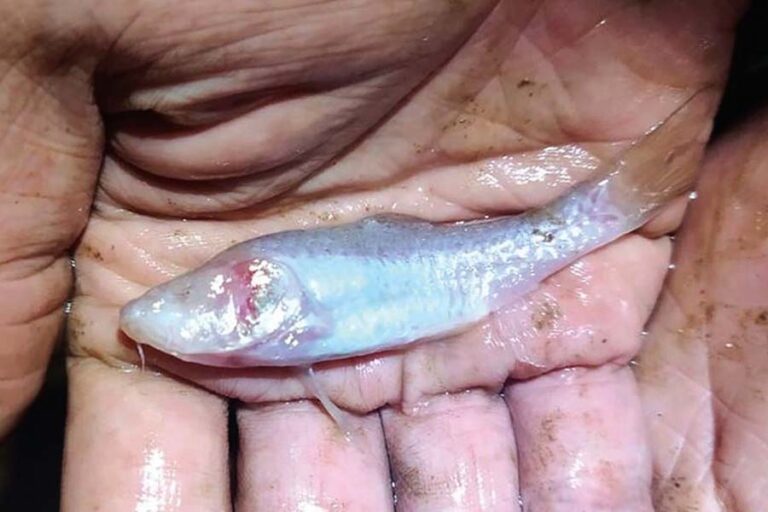
Deep within the Klapanunggal karst cave in Bogor Regency, West Java, lives a small fish that has never seen light. Named Barbodes klapanunggalensis, this endemic wader species has undergone such extreme adaptation that it has lost not only its eyes but its entire eye sockets. The fish inhabits small pools of clear water that seep from the cave floor. Its fins are transparent, while its body has a silvery hue with red streaks. In the water, the fish tends to swim calmly. However, when it detects disturbances, it can move quickly, indicating that losing its eyes has not meant losing sensitivity to its environment. In total darkness, vision no longer provides any benefit. Through evolution, B. klapanunggalensis instead relies on other senses to recognize movement, vibrations, water waves, and changes around it. The species was first spotted by cave explorers in 2020. Two years later, a research team returned to the site and collected two specimens, one male and one female. After three years of research, the fish was officially introduced as a new species in the journal ZooKeys in February 2025. Interestingly, both specimens were found in two different pools not connected by water flow, raising questions about how they moved and reproduced. Many mysteries about the fish's life still remain. The cave where it lives serves as a natural laboratory for studying evolution. Environments without light and with limited energy sources force organisms to develop special strategies for survival. Almost all cave-dwelling species also have a high degree of endemism; some are found only in specific caves or passages. This uniqueness also means that organisms like B. klapanunggalensis are highly vulnerable to extinction due to their restricted habitats.

0

Original source

Mongabay Indonesia

原文を読む