General articles are free for 24 hours after publish.
US-China Summit: Strategic Competition Beneath the Surface of Overt Conciliation
Presidents Donald Trump and Xi Jinping exchanged friendly words at a White House state dinner, but strategic competition between the two nations continues beneath the surface. Deep disagreements on economic and foreign policy remain unresolved, and future relations will be tested by developments in the coming months.
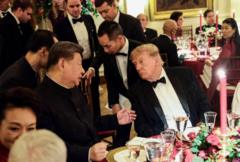
At a state dinner held at the White House, US President Donald Trump and Chinese President Xi Jinping exchanged friendly words. President Trump stated, "We have never had a better relationship," welcoming President Xi's visit to the US. President Xi, in turn, expressed gratitude for the "meticulous care and attention" received in the United States, acknowledging that they are making history in bilateral relations together. President Trump mentioned a "special gift" of an invitation to the new White House dining room, which was still under construction, noting that President Xi and his wife were the first guests to step into a "clean, orderly, and gleaming construction site." He also presented President Xi with a sculpture of a bald eagle, symbolizing the United States, representing the "spirit of freedom and soaring high." President Xi referenced the history of bilateral relations, stating that it was "forged by blood and fire" during the fight against Japan in World War II and further promoted through "ping-pong diplomacy" under President Richard Nixon. He emphasized that the goals of the US and China can "complement each other" and that both sides need to act responsibly. Beneath these friendly words, the meeting is seen within China as an opportunity for President Xi to strengthen his image as a leader on par with President Trump. However, according to BBC Vietnamese, despite the overt conciliation, strategic competition between the two nations remains intense. In particular, the true measure of bilateral relations will be tested by concrete developments in the coming months, such as the maintenance of the trade truce, arms sales to Taiwan, and President Xi's attendance at the G20 summit. The state dinner menu featured a subtle blend of American ingredients with Chinese influences, and the dessert included ice cream made with honey harvested at the White House. The chosen wine was intended to recall President Nixon's "Toast to Peace" with Premier Zhou Enlai in 1972. Prominent American business leaders, including Jeff Bezos and Mark Zuckerberg, were among the attendees. Notably, unlike President Trump's previous visit to Beijing, no Chinese business executives were present this time. This is analyzed as a move to avoid the risks associated with Chinese companies' presence in the US, which could raise concerns about business practices, government subsidies, and industrial overcapacity. Source: BBC Vietnamese
Original source
BBC Vietnamese