General articles are free for 24 hours after publish.
Armed groups taking advantage of internal conflicts to produce and sell narcotics, buy weapons and recruit new members, says Union Minister
Armed groups are taking advantage of the ongoing internal conflicts to produce and sell narcotics, as well as to purchase weapons and ammunition and recruit new members, said Union Minister for Home Affairs, Lt-Gen Nyont
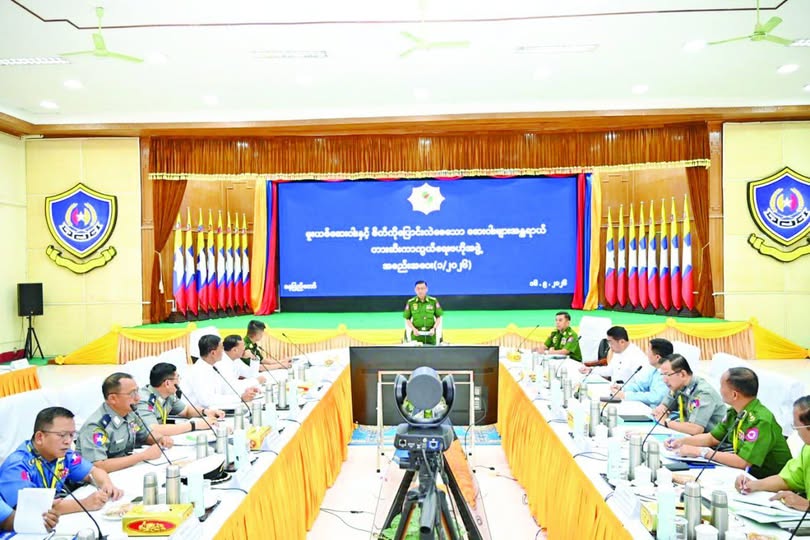
Armed groups are taking advantage of the ongoing internal conflicts to produce and sell narcotics, as well as to purchase weapons and ammunition and recruit new members, said Union Minister for Home Affairs, Lt-Gen Nyont WIn Swe. He made these remarks at the 1/2026 meeting of the Central Committee for the Prevention of Dangers of Narcotic Drugs and Psychotropic Substances, held at the Ariyadhama Hall of the Myanmar Police Force Headquarters on September 16. Union Minister for Home Affairs, Lt-Gen Nyont WIn Swe, who also chairs the Central Committee for the Prevention of Narcotic Drugs, stated that drug problems are significantly impacting the social, economic, health, national stability and peace, and development of most countries worldwide. According to UNODC statistics, there were approximately 316 million drug users globally in 2025, and Myanmar is increasingly facing the problem of synthetic drugs. He added that the Central Committee for the Prevention of Dangers of Narcotic Drugs and Psychotropic Substances and its working committees, along with regional drug prevention committees at various levels from the Nay Pyi Taw Council Territory, regions/states down to wards/village tracts, have been formed in stages. He stated that armed insurgent groups are taking advantage of the ongoing internal conflicts to produce and sell narcotics, as well as to purchase weapons and ammunition and recruit new members. Chemical substances and related materials used in drug production are being transported from foreign countries and produced within their territories. The eradication of drugs is being pursued as a national duty, and a steering committee for the review and amendment of the "National Drug Control Strategic Plan" has been formed to carry out the amendment process. Based on the successes of Operation 42, a special operation to combat drugs in Myanmar, operations will continue, and it is necessary to prevent the entry of not only drugs but also chemical substances, related materials, and chemists. Blockades and arrests are necessary in coordination with the Tatmadaw (Navy), Marine Police Force, and Port Authority at maritime exit points. In the Nay Pyi Taw Council Territory, regions, and states, strict inspections are needed to prevent the use and sale of narcotics in KTVs, bars, clubs, entertainment programs, hotels, motels, and guesthouses, followed by investigation and arrest. From 2025 to August 2026, 58 fugitive drug offenders who were on the run for drug offenses were arrested within Myanmar and are being handed over to the respective countries. In connection with drug offenses, over 4.285 billion kyats were confiscated as public revenue from 685 cases in 2025, and over 3.585 billion kyats were confiscated as public revenue from 356 cases up to August 2026. Rewards and honorary titles and medals are being awarded to individuals from the Tatmadaw, Myanmar Police Force, and partner organizations and informants who have made sacrifices in drug eradication efforts. If weapons and ammunition are seized along with drugs, additional rewards are being granted under the Anti-Terrorism Law. To reduce and eradicate opium cultivation, relevant regional/state drug prevention committees need to conduct prior awareness activities. It is also necessary to plan and implement income-generating activities for opium farmers, as well as the cultivation of crops suitable for the region and market access, the Union Minister said. At the meeting, attendees discussed their efforts in drug prevention and control, future plans, and operational activities. The meeting was attended in person by Vice Chairman Union Minister for Border Affairs Lt-Gen Phone Myint, Secretary Myanmar Police Force Chief Commissioner Lt-Gen Soe Hlaing, Joint Secretary, Commander of the Anti-Narcotic Police Force, members of the Central Committee for Drug Prevention, chairmen and secretaries of working committees, responsible officials from the Myanmar Police Force, and representatives from related ministries. Chairmen, vice chairmen, secretaries, and joint secretaries of regional/state drug prevention committees participated via video conferencing.
Original source
Eleven Media