General articles are free for 24 hours after publish.
One Year After Thai Border Conflict, Banteay Ampil District Bears Lasting Scars
A year after the 2025 conflict with Thailand along the border, Banteay Ampil district in Cambodia grapples with unexploded ordnance hindering reconstruction, leaving many residents displaced and struggling. Infrastructure remains severely damaged, casting a long shadow over the path to a peaceful recovery.
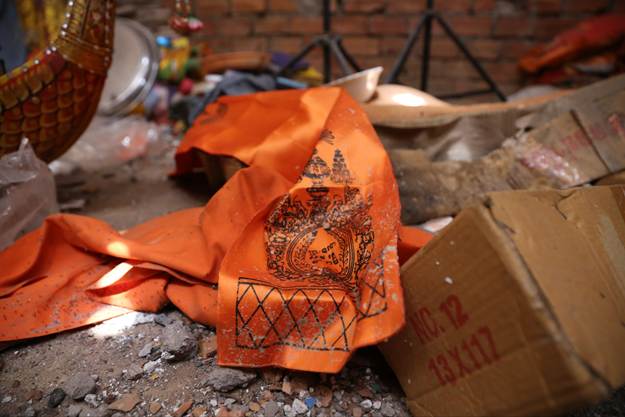
A year after armed attacks along the Cambodia-Thailand border devastated communities in Oddar Meanchey province, local authorities say the conflict continues to cast a long shadow over daily life. Hundreds of families remain unable to return to their homes, unexploded ordnance (UXOs) delay reconstruction, and key public infrastructure sits in ruins, despite a year of ceasefire. Officials in Banteay Ampil district say that although the sound of artillery faded once the ceasefire was reached, the humanitarian and economic consequences of the 2025 conflict remain far from over for residents living near the border. Among the most visible reminders is Wat Kiri Rangsay Thma Daun in Thma Daun village, Kok Mon commune, located about one kilometre from the Thai border. The Buddhist temple was heavily damaged by drone strikes and artillery shelling during the second wave of fighting in December 2025. Its roof remains torn open, murals have been scarred by explosions, Buddha statues lie broken across the temple floor, and religious objects remain buried beneath rubble, serving as enduring evidence of the destruction inflicted on a sacred place of worship and the lasting impact of the conflict on Cambodia’s cultural and religious heritage. Khen Doeun, deputy governor of Banteay Ampil district, said the second round of fighting caused significantly greater destruction than the initial clashes. “The first round of fighting caused some damage, but the second round in December was far more severe,” he said during an interview at the damaged temple. “Temples, schools, health centres and homes were heavily destroyed. In this area alone, nearly 90 per cent of residents’ houses were damaged,” he noted. According to district authorities, 823 houses across Banteay Ampil were damaged during the two rounds of fighting. So far, only 114 houses have been repaired, as they are in areas deemed safe for residents to return. The remaining 709 houses remain empty and shattered, because they lie in high-risk areas close to the border. Authorities say 115 families from Thma Daun village alone are still unable to return to their homes and have instead been relocated to government-built temporary housing in Bat Kao village. At its peak, the conflict displaced 15,399 households across the district. Doeun explained that the greatest obstacle to recovery is the large quantity of unexploded ordnance left behind. “Most people here depend on farming, but many cannot safely return to cultivate their land because UXOs are still being cleared,” he said. “More than 7,000 shells fell across Banteay Ampil district, including cluster munitions. CMAC teams are working every day to locate and destroy them,” he said. Beyond private homes, the war also left widespread damage to public infrastructure. Authorities recorded severe destruction at three Buddhist temples — Wat Thma Daun, Wat Tmat Paoy and Wat Chub Koki — as well as three health centres and six school buildings, several of which remain unusable. Doen acknowledged that authorities have not yet been able to complete damage assessments in some areas because they remain too close to the border and continue to pose security risks. Although one year has passed since the fighting subsided, he said the impact on residents remains profound. “Even though the ceasefire has been in effect for a year, people are still suffering from the consequences of the war,” he noted. “Many families cannot return because homes near the border have not yet been repaired, while others continue living in difficult conditions because reconstruction cannot begin until the areas are safe,” he added. He highlighted that the government has continued providing food assistance, healthcare and temporary shelter to displaced families while longer-term recovery efforts continue. Reflecting on the conflict, Khen described the attacks as a tragedy that had devastated local communities and appealed to the international community to support justice and lasting peace. “I deeply regret that the Thai side launched attacks that destroyed homes, public infrastructure and people’s livelihoods,” he said. “I hope the international community will help ensure justice for the Cambodian people so they can safely return to their homes,” he added. He also expressed hope that peace would permanently return to the border. “As someone who has lived here for decades, I do not want to see war along the border again,” he said. “We want development, cooperation between neighbouring countries and peaceful border communities, not destruction that separates families and ruins livelihoods,” he added. The Ministry of Interior reported that, as of July 25, 20,281 displaced people, including 10,331 women and 6,066 children, remained unable to return home, despite the December 27, 2025, ceasefire. More than 640,000 people were displaced during the conflict, while authorities said schools, health centres and other essential public services in several border provinces remain closed because of the lingering security situation. Preliminary government assessments also showed extensive destruction to civilian infrastructure caused by the conflict. Authorities recorded damage to 1,558 houses, 26 schools, 14 hospitals and health centres, 74 public buildings, 19 pagodas, four ancient temples, 87 road sections, five bridges, 39 mobile phone towers and three electricity transmission lines, while assessments are continuing in affected border areas.
Original source
Phnom Penh Post