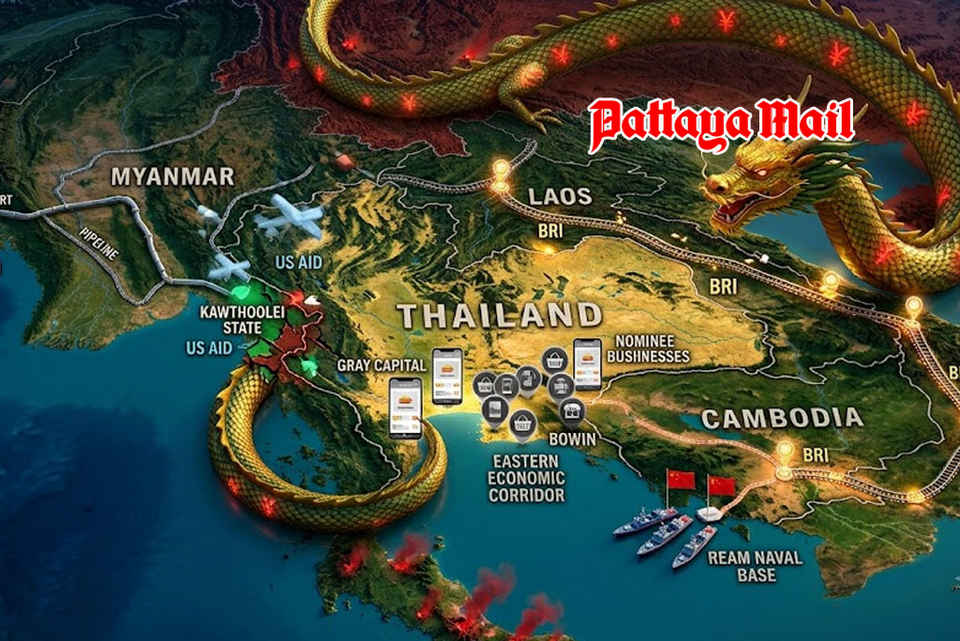
China's Geopolitical Squeeze: Thailand Faces 'Encirclement' Concerns
Diplomacy
2026年7月2日
5
Pattaya Mail
Relations
🇹🇭Thailand🇲🇲Myanmar🇰🇭Cambodia🇨🇳China🌐United Nations / ASEAN

China's Geopolitical Squeeze: Thailand Faces 'Encirclement' Concerns

AI サマリー

An analysis suggests that China's expanding influence in Thailand's neighboring countries is placing Thailand in a geopolitical 'encirclement.' Concerns are raised that Cambodian ports, Myanmar's economic corridors, and internal economic infiltration could threaten Thailand's autonomy.

PATTAYA, Thailand – If we look at the broad map of Thailand at this moment, what is happening is not just a series of coincidences involving individual neighboring countries. Instead, it is a calculated geopolitical squeeze radiating from Beijing, forming a dragon’s encirclement that is closing in on Thailand from all directions by leveraging the vulnerabilities of our neighbors. The ultimate endgame of this strategy would leave Thailand in a position devoid of leverage and make it extremely difficult to navigate independently in the future. (adsbygoogle = window.adsbygoogle || []).push({}); The encirclement board: When neighbors become pawns of the dragon Imagine Thailand’s major economic arteries and strategic spaces being handed over one by one. To our east, Cambodia has completely fallen under China’s sphere of influence. The establishment of the Ream Naval Base and the backing of the Funan Techo Canal project are not merely internal economic matters for Phnom Penh. They represent the institutionalization of Chinese military power right at the doorstep of the Gulf of Thailand, Thailand’s primary maritime trade gateway and security zone. Should Thailand ever make a move that displeases China, Cambodia could serve as the vanguard to pressure Thailand by both land and sea. Meanwhile, to our west, a Myanmar deeply scarred by civil war has little choice but to sacrifice everything to appease Beijing. Naypyidaw has cleared the path for Chinese investments and the China-Myanmar Economic Corridor to cut straight through to the Indian Ocean. Even as the United States attempts to disrupt China’s strategy by backing ethnic armed organizations seeking to establish an autonomous Kawthoolei State along the Thai border, this interference only drags Thailand deeper into a proxy conflict. If Thailand allows the United States to use its territory to counterbalance China, we could immediately face the wrath of Beijing and the Myanmar military junta. But if Thailand refuses, we must shoulder the endless burden of refugees, border clashes, and prolonged instability. This encirclement is further compounded by the unrest in Thailand’s Deep South, which remains a chronic security vulnerability that major powers continue to monitor. The situation acts like a shackle, preventing Thailand from fully mobilizing its resources to counter external strategic threats while leaving a permanent opening for international organizations or foreign powers to use humanitarian or human rights pretexts to pressure Bangkok at any time. (function(w,q){w[q]=w[q]||[];w[q].push(["_mgc.load"])(window,"_mgq"); Infiltration from within: A state within a state cloaked in gray economies Even more alarming than the military encirclement at our borders is the internal encirclement being executed through hybrid warfare. The industrial zones of Bowin, Chonburi, and Rayong serve as the clearest reflection of this reality. Chinese gray-market syndicates forced out of Cambodia and Myanmar due to recent crackdowns have not vanished. Instead, they have systematically flowed into Thailand’s grassroots economy through networks of Thai nominees, taking over local logistics, retail businesses, and food delivery platforms. This is not merely a search for livelihoods; it is the construction of a closed Chinese economic ecosystem. Every baht spent by Thai consumers is siphoned out of the country while bypassing the Thai tax system. Simultaneously, nominee networks linked to other geopolitical blocs, including Israel and Western interests, are entering the real estate and technology sectors, using Thailand as a safe haven for capital amid escalating tensions in the Middle East. Consequently, Thailand’s domestic economy risks becoming increasingly dependent on foreign capital networks with ties to their respective governments. Thailand’s destination when neutrality becomes isolation When all the pieces on the board are finally set, Thailand may wake up to find that moving forward independently has become nearly impossible. Politically, Thailand’s long-cherished bamboo diplomacy—bending with the wind while maintaining neutrality—could become increasingly difficult to sustain. As our immediate neighbors align more closely with China, Thailand’s influence within ASEAN could diminish, reducing its ability to shape regional policy without Beijing’s support. Militarily, Thailand could face growing strategic isolation. Surrounded by a Chinese naval presence in Cambodia, a Myanmar junta dependent on Beijing, and a Thai-Myanmar border influenced by Western-backed ethnic forces, Thailand’s military posture could become increasingly defensive, with fewer reliable partners to depend upon. Economically, Thailand could be reduced to little more than a transit route and consumer market within supply chains dominated by China. This extends from macro-level infrastructure, such as high-speed railways, to micro-level services, including food delivery platforms. Local Thai businesses could face mounting competitive pressures, while the national economy becomes increasingly tied to the Chinese yuan and policies originating from Beijing. This, according to this perspective, is the essence of the encirclement. China would not need to deploy troops to conquer Thailand. Instead, it could use neighboring countries to apply strategic pressure while employing gray-market capital to weaken Thailand from within. The objective would be to gradually erode Thailand’s strategic autonomy until the country ultimately finds itself with few viable options beyond following the path drawn by the Dragon.

多角的分析

経済的影響

中国の近隣諸国への経済的・軍事的影響力拡大は、タイ経済の構造的脆弱性を露呈させている。特に、カンボジアやミャンマーとの経済回廊整備、そしてタイ国内での中国系資本による「グレーマーケット」の拡大は、タイの国内産業やサプライチェーンにおける中国への依存度を高める。これは、タイが中国の経済圏に組み込まれるリスクを示唆しており、タイ・バーツの国際的地位や、中国経済の動向への過度な連動性を招く可能性がある。過去のASEAN諸国における中国系資本の流入事例と比較しても、その規模と戦略性は異質であり、タイ経済の自律性を巡る深刻な課題を提起している。

投資家心理

タイへの投資家は、地政学的なリスクの高まりを注視する必要がある。特に、中国が主導するインフラ開発や、カンボジア・ミャンマーにおける中国の軍事的プレゼンスの拡大は、タイの安全保障環境に直接的な影響を与える。また、国内における中国系資本の浸透は、競争環境の歪みや、タイ国内経済の中国への依存度上昇を通じて、投資リターンの不確実性を増大させる可能性がある。過去の東南アジアにおける地政学リスクが資本逃避を招いた事例を踏まえ、投資家はポートフォリオの分散と、リスクヘッジ戦略の強化が求められる。

社会的影響

タイ社会は、近隣諸国からの中国の影響力拡大と、国内における「グレーマーケット」の拡大という二重の圧力に直面している。カンボジアやミャンマーからの難民流入は、タイの社会インフラや地域社会に負担をかける可能性がある。また、国内の物流、小売、配食といった生活に密着した分野への中国系資本の浸透は、タイの小規模事業者や雇用市場に影響を及ぼし、社会的な摩擦を生む可能性がある。タイ市民の生活実感として、物価への影響や、地域経済の外国資本への依存度の上昇が懸念される。

市民の声

タイ国民、特に国境付近の住民や地方の小規模事業者は、近隣諸国からの不安定化や、国内経済への外国資本の浸透による直接的な影響を受けやすい。難民の流入は、社会サービスへの負荷を増大させ、地域社会の緊張を高める可能性がある。また、国内の物流や小売業における中国系組織の台頭は、タイの雇用機会や、地元経済の自律性を脅かす。タイ国民の不安としては、将来的な経済的自立性や、生活環境の安定性が問われている。

背景・歴史的文脈

タイは伝統的にASEAN内での中立的な立場を維持し、主要国とのバランスを取る「竹の外交」を展開してきた。しかし、近年、中国は東南アジアにおける経済的・軍事的影響力を急速に拡大させている。カンボジアにおける中国の港湾インフラへの投資と軍事拠点化、ミャンマーでの経済回廊建設は、タイの安全保障環境に直接的な影響を与え始めている。また、タイ国内における中国系資本の流入は、過去にも見られたが、近年はより組織的かつ広範な「グレーマーケット」の形成として顕在化しており、タイの経済的自律性を脅かす要因となっている。タイ南部における長年の紛争も、外部勢力による介入の可能性を常に内包している。

原文ソース

Pattaya Mail

原文を読む