Conservationist Fights for Siamangs' Wild Future on Sumatra's Lake Toba
Abdul Rahman Manik, a conservationist near North Sumatra's Lake Toba, is striving to end the practice of gibbons begging for food on roads. Inheriting his father's legacy, he also prioritizes the safety of both primates and road users.
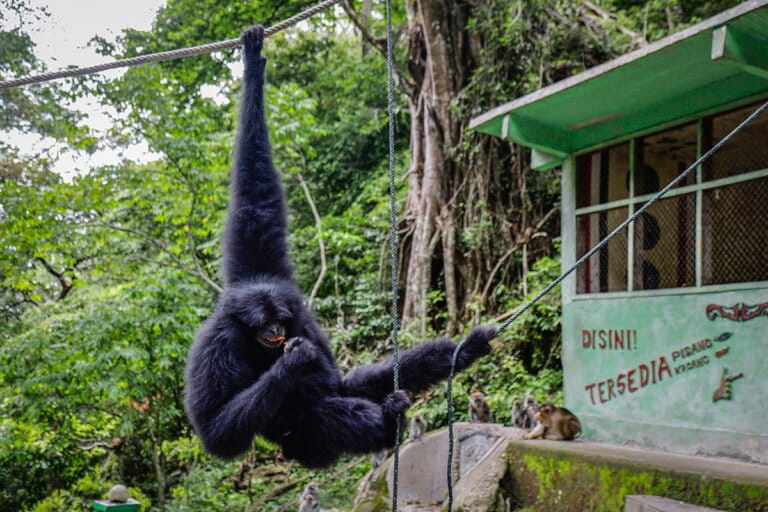
On the edge of Lake Toba, specifically in Monkey Forest Sibaganding, Girsang Sipangan Bolon District, Simalungun Regency, North Sumatra, the sound of rustling leaves is often accompanied by the chirps of primates. Amidst the dense trees, a man stands holding bananas. He calls out to the forest's "inhabitants" one by one. For him, these are not just wild animals, but family. "My wish is for no more primates to beg on the streets," said Abdul Rahman Manik on Sunday (10/12/26). Furthermore, the safety of road users is also important. The road along Lake Toba is steep, narrow with sharp turns, and has many cliffs. "When a driver's focus is disturbed by feeding primates, it can be dangerous for themselves and other road users." Abdul Rahman Manik cares about the life of siamangs and hopes they live wild in the forest. Photo: Junaidi Hanafiah/Mongabay Indonesia. The man, familiarly known as Detim Manik, is not new to this. He is the son of Umar Manik, a 'parherek,' the local term for a monkey keeper, who had been caring for the small forest in Sibaganding since 1984. This tradition was passed down to him, albeit in a different way. When he took over the management of the area at the age of 22 in 2013, Detim faced a disturbing reality. Herds of primates descended onto the highway, scavenging for food from passing motorists. "The monkeys here also often conflict with residents, some even get electrocuted by electric fences in residents' agricultural areas." Four types of primates inhabit this area: macaques, long-tailed macaques, siamangs, and kiak-kiaks. However, limited food sources cause them to leave their habitat. Siamangs face the greatest risk. These arboreal primates are vulnerable to being hunted or captured if they descend to the road. "If siamangs come down, they can be taken... This article was originally published on Mongabay
多角的分析
シアンマンが道路で餌を求める現状は、観光客からの直接的な経済的支援に依存する地域経済の側面を浮き彫りにしている。しかし、これは持続可能ではなく、野生動物の生態系や地域住民の安全を脅かす。長期的な視点では、生態系観光(エコツアー)の振興や、地域住民が野生動物保護に貢献することで経済的恩恵を得られる仕組みの構築が求められる。例えば、保護活動への寄付や、野生動物観察ツアーの収益の一部を地域に還元するモデルなどが考えられる。現状のままでは、観光資源としての魅力も損なわれかねない。
このニュースは、直接的な投資機会を示すものではないが、インドネシアにおけるエコツーリズムや持続可能な開発への潜在的な関心を示唆している。投資家は、地域社会との連携、環境保護、そして持続可能なビジネスモデルを重視するプロジェクトに注目する可能性がある。トバ湖周辺の自然環境は観光資源として魅力的であり、インフラ整備やエコツーリズム関連事業への投資は、長期的なリターンをもたらす可能性がある。ただし、地域社会の合意形成や環境への影響評価が不可欠となる。
アブドゥル・ラフマン・マニク氏の活動は、地域社会と野生動物との共存という、インドネシア、特に自然豊かな地域が抱える普遍的な課題を象徴している。シアンマンが道路に降りてくる背景には、生息地の破壊や餌不足といった環境問題がある。また、住民との衝突や交通事故のリスクは、野生動物保護が単なる環境問題にとどまらず、地域住民の生活の安全や経済活動とも密接に関わっていることを示している。マニク氏のような個人の献身的な活動が、地域社会全体の意識変革や、より包括的な保護策の必要性を訴えかけている。
トバ湖畔の住民にとって、道路を横切るサルや、時には農作物を荒らすサルは、日常的な問題である。特に、狭くカーブの多い道路での交通事故のリスクは、住民や観光客双方にとって深刻な懸念事項だ。アブドゥル・ラフマン・マニク氏のような保護活動家が、サルに餌を与えないよう呼びかけ、道路利用者の安全を訴えることは、住民の生活の安全を守る上で重要な役割を果たしている。しかし、サルが道路に降りてくる根本的な原因である餌不足や生息地の問題が解決されない限り、住民とサルとの間の緊張関係は続く可能性がある。
背景・歴史的文脈
シバガンディング地区における霊長類の道路への出現は、単なる個別の事象ではなく、インドネシア全土で進行する森林破壊と生息地の断片化という構造的な問題と関連している。1980年代から続くウマル・マニク氏の保護活動は、地域レベルでの草の根的な取り組みの重要性を示している。しかし、経済発展に伴うインフラ整備(道路建設など)は、しばしば野生生物の移動経路を分断し、生息地を縮小させる。これにより、サルたちは餌を求めて人間社会に近づかざるを得なくなり、住民との衝突や交通事故のリスクが増大する。アブドゥル・ラフマン・マニク氏の活動は、この世代を超えた課題に立ち向かう、地域住民の強い意志の表れである。
原文ソース
Mongabay Indonesia