Vietnam's Reference Exchange Rate Edges Up Amid Mixed Economic Signals
Economy
2026年7月23日
5
VietnamPlus English
Relations
🇻🇳Vietnam🇨🇳China🇺🇸United States

General articles are free for 24 hours after publish.

Vietnam's Reference Exchange Rate Edges Up Amid Mixed Economic Signals

Share
AI Summary

Vietnam's State Bank raised its reference exchange rate by VND 12 on July 23, signaling a delicate balance between inflation control and economic growth amidst global economic shifts. This move reflects the nation's proactive monetary policy.

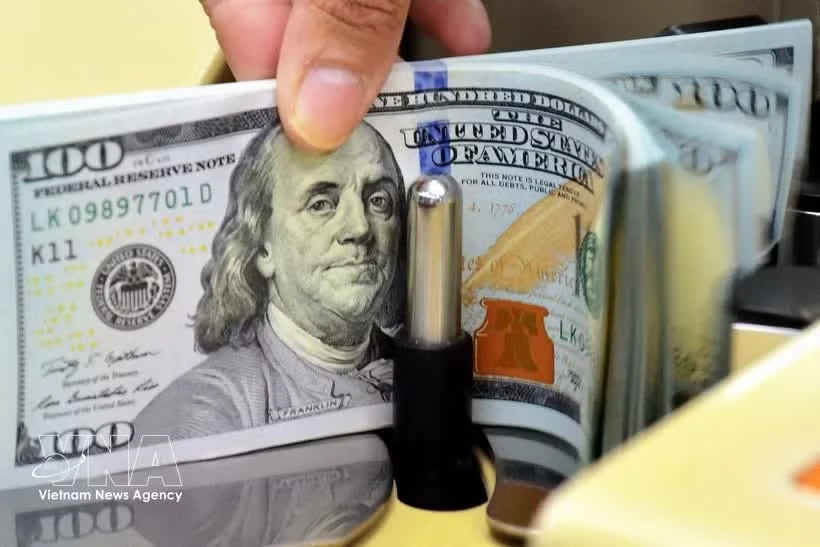
Vietnam's State Bank (SBV) on July 23 adjusted its daily reference exchange rate for the US dollar up by VND 12 to VND 25,272 per USD. This move underscores the nation's cautious approach to monetary policy, balancing inflation control with economic growth amid global economic uncertainties. The current trading band for commercial banks is set at +/- 5%, allowing rates to fluctuate between VND 23,989 and VND 26,515 per USD. On July 22, major banks like Vietcombank and BIDV listed their buying and selling rates at VND 26,110 and VND 26,490 per USD, respectively, while the SBV had maintained the reference rate at VND 25,260 the previous day. Despite the currency adjustments, various sectors of the Vietnamese economy continue to show robust performance. Fertilizer exports, for instance, saw significant year-on-year increases of 52% in volume and 107% in value in the first six months of the year, totaling 1.7 million tonnes worth $933 million. The aviation sector is also expanding, with fleet growth bolstered by 10 aircraft from SMBC Aviation Capital, four from Avolon Aerospace Leasing Limited, and five from Phoenix Aviation Capital. Paul Geaney, President and Chief Commercial Officer of Avolon, highlighted Vietnam's extraordinary aviation market growth, noting it recorded the fastest expansion among the region's top 10 aviation markets over the past decade, with a remarkable 121% increase. Furthermore, Vietnam is positioning itself as a hub for renewable energy. Khanh Hoa province is establishing itself as an industrial and service hub for renewable energy in the south-central region, building on its marine economy. Messer sees significant potential in Vietnam’s industrial plants for producing low-emission hydrogen from solar power, contributing to the development of Vietnam’s hydrogen economy. However, the increasing digitalization and global integration also bring challenges. Vietnam's high adoption rate of crypto assets presents opportunities for innovation but also demands greater oversight and risk management, according to Chainalysis' ASEAN Regional Director. The CPTPP, evolving beyond tariff reductions, now covers goods, services, investment, and digital trade, with its success contingent on businesses' ability to translate commitments into new investments and stronger supply chains. Vietnam, under its one-party system, prioritizes economic growth and actively seeks foreign investment. Its economic ties with China are significant due to geographical proximity, though geopolitical tensions, particularly concerning the South China Sea, add complexity. These domestic and international dynamics are expected to continue influencing exchange rate fluctuations and future economic policies.

0

Original source

VietnamPlus English

原文を読む