General articles are free for 24 hours after publish.
Philippines Expands Fuel Subsidy for Public Transport, Allocates P400M
The Philippine government has increased its fuel subsidy for public utility vehicle (PUV) drivers to P12 per liter, allocating P400 million. This assistance will continue as long as transport workers require support. Separately, a bill proposing P1,000 in monthly digital aid for minimum wage families has been filed in the House of Representatives.
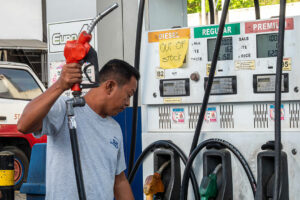
MALACAÑANG on Thursday said the government has initially allocated P400 million for its P12-per-liter fuel discount program for public utility vehicle (PUV) drivers, with the assistance set to continue as long as transport workers require support. Palace Press Officer Clarissa A. Castro said the Department of Transportation (DoTr) would provide details on how the P12-per-liter subsidy was determined. “As of now, P400 million has been allocated for fuel discounts, and the DoTr will provide full details on how the P12 fuel subsidy for our drivers was determined,” Ms. Castro told a news briefing in Filipino. The government on Wednesday raised the fuel discount for public utility jeepney and UV Express drivers by P2 to P12 per liter starting Aug. 15. The amount is lower than the P20-per-liter assistance earlier proposed by the Land Transportation Franchising and Regulatory Board. Ms. Castro said the program has no fixed end date and would continue for as long as transport workers need government assistance. “At this time, there is no definite timeframe,” she said. “The government will continue providing assistance for as long as our countrymen in the transport sector need support.” Transport group Manibela described the expanded fuel discount as “temporary relief,” saying the limited number of participating gasoline stations still forces many PUV drivers to pay the full pump price. Ms. Castro said the government is working to address concerns raised by transport operators, including expanding the number of accredited gasoline stations where drivers could avail themselves of the subsidy. “The areas that still need to have gasoline stations providing fuel subsidies must be attended to immediately,” she said. She said the government expects the increase from P10 to P12 per liter to provide additional relief by letting drivers realize higher fuel savings under the program. The additional P2-per-liter discount could increase the maximum weekly savings of eligible drivers to as much as P1,800, according to the Office of Executive Secretary Ralph G. Recto. The initial P10-per-liter discount has benefited more than 93,000 public utility vehicle drivers since its rollout in April, it said on Wednesday. The increase was approved during a Cabinet meeting in Malacañang on Tuesday chaired by Mr. Recto and attended by other Cabinet officials amid concerns over higher fuel costs linked to the war in the Middle East. The Department of Energy (DoE) earlier warned that fuel prices could remain volatile in the coming weeks despite recent domestic pump price reductions. Data from the DoE Oil Industry Management Bureau showed gasoline prices fell by P0.73 per liter from Aug. 4 to 10, while diesel and diesel plus prices declined by P0.60 per liter. Kerosene prices also dropped by P2.09 per liter. The lower fuel prices were partly offset by higher liquefied petroleum gas prices in August, which rose by P3.67 per kilo. Meanwhile, lawmakers have filed a bill in the House of Representatives proposing P1,000 in monthly assistance for minimum wage families through a digital wallet linked to the Philippine Identification System. House Bill No. 10648 or the Pambansang Agapay sa Pamilya at Maliliit na Negosyo (PAMANA) Act seeks to help low-income families that are not members of the Pantawid Pamilyang Pilipino Program (4Ps). “PAMANA recognizes that having a job does not always mean having economic security,” Party-list Rep. Jude A. Acidre said in a statement. “It provides targeted assistance to working families who are not covered by 4Ps but continue to face serious financial pressure.” Under the measure, self-employed workers earning below the minimum wage may also qualify for the program. The bill’s proponents said beneficiaries could use the subsidy only to buy products from micro, small and medium enterprises, including public market stalls, eateries, neighborhood groceries, pharmacies, and other qualified community businesses, to prevent misuse. “When a beneficiary buys from a sari-sari store, a market vendor, or a neighborhood food business, the assistance becomes income for a local entrepreneur and continues circulating within the community,” La Union Rep. Paolo Francisco V. Ortega, who is among the authors of the measure, said. — Erika Mae P. Sinaking and KPBG
Original source
BusinessWorld Nation