The Secret of Flamingo's One-Legged Stance: Energy Saving and Thermoregulation Mechanism
Politics
2026年7月27日
3
Mongabay Indonesia

General articles are free for 24 hours after publish.

The Secret of Flamingo's One-Legged Stance: Energy Saving and Thermoregulation Mechanism

Share
AI Summary

Flamingos can stand on one leg for extended periods, even while sleeping, thanks to a locking joint mechanism that supports their weight with minimal muscle effort. This not only conserves energy but also aids in thermoregulation.

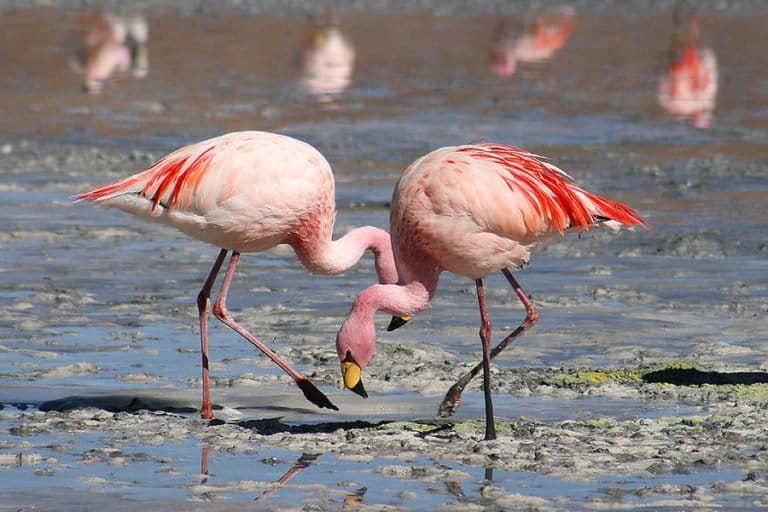
With their long necks, vibrant pink plumage, and slender legs, flamingos are among the most recognizable birds. However, one behavior that continually sparks curiosity is their ability to stand on one leg for extended periods, even while sleeping. For humans, maintaining such a posture requires muscular effort and concentration. For flamingos, it's quite the opposite. Standing on one leg turns out to require less energy than standing on two. The secret to this remarkable ability lies in their body structure. Research led by Young Hui Chang from the Georgia Institute of Technology and Lena H. Ting from Emory University found that flamingo leg joints have a resting position that can be "locked." This mechanism allows their body weight to be supported on one side without the need for continuous muscular activity to maintain balance. The findings were obtained through observations of both living and deceased flamingos. From footage of juvenile flamingos at the Atlanta Zoo, researchers observed that their body movements decreased when they slept standing on one leg. Another experiment yielded even more surprising results. Two deceased flamingos from the Birmingham Zoo could be placed in a one-legged standing position without any support. Their bodies remained upright even though no muscles were working. This phenomenon is called a passive gravitational resting mechanism. In addition to saving energy, standing on one leg is also thought to help flamingos maintain their body temperature. Legs are one part of the body that can rapidly release heat, especially when in water. By lifting and tucking one leg behind their feathers, flamingos can reduce the amount of body surface exposed to cold air or water.

0

Original source

Mongabay Indonesia

原文を読む