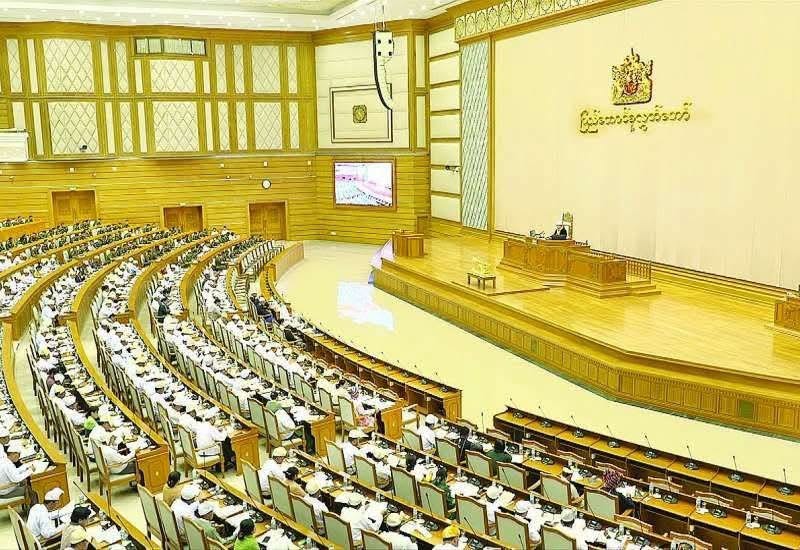
Despite military escalation, extension of martial law areas submitted to interim parliament
Following the coup, martial law has been imposed in townships where the military has suffered defeats and lost control due to resistance movements. Despite escalating military operations and airstrikes, only two township
Following the coup, martial law has been imposed in townships where the military has suffered defeats and lost control due to resistance movements. Despite escalating military operations and airstrikes, only two townships have been recaptured, leading the military leadership to submit a request to the interim parliament to extend the martial law period, acting on behalf of the interim president. There are a total of 60 townships nationwide under the 90-day martial law declared by the interim government. As the designated period is nearing its end, Dr. Htain Lin Oo, the Deputy Minister of Legal Affairs and Deputy Attorney General under the junta, submitted the proposal to their interim parliament (Pyidaungsu Hluttaw) on July 14. Previously, martial law was declared in 63 townships. Upon the formation of the interim government, the period was extended, and martial law was imposed on 60 townships from April 23 to July 21, accompanied by intensified military operations, troop reinforcements, offensives, airstrikes, and heavy artillery attacks. However, as only two townships, Tonzang and Falam in Chin State, have been recaptured by the junta, they have stated that it is necessary to continue implementing measures for regional stability and peace in the remaining 58 townships, thus submitting this proposal to extend the period by 90 days on behalf of the interim president. Interim MPs elected in the fraudulent 2025 elections who wish to participate in the discussion on this proposal have been announced to register their names by July 16, and it is understood that the proposal will be deliberated in the interim parliament (Pyidaungsu Hluttaw) when it reconvenes on July 21. The townships where martial law will continue to be enforced include: in Kachin State, Sumprabum, Shwegu, Injangyang, Sawlaw, Chephe; in Kayah State, Hsa To, Phasaung, Me Se; in Kayin State, Kawkareik, Kyainseikgyi; in Chin State, Kanpetlet, Thantlang, Paletwa, Mindat, Matupi; in Sagaing Region, Kalay, Penlwebu, Kin-U, Weklet, Kani, Dipayin, Pale, Indaw. Furthermore, in Magway Region: Pauk, Myay, Saw, Htilin, Yesagyo; in Mandalay Region: Ngazun; in Rakhine State: Ramree, Pauktaw, Ponnagyun, Yathedaung, Gwa, Maungdaw, Buthidaung, Kyauktaw, Minbya, Myebon, Mrauk-U, Thandwe, Ann, Taungup; in Shan State: Namtu, Hseni, Hsenwi, Lashio, Kunlong, Namhsan, Mantong, Hopang, Laukkai, Koncharn, Mogok, Kyaukme, Thibaw, Mongla. These areas are under the control of ethnic armed organizations (EAsOs) such as MNDAA, TNLA, and AA, which carried out Operation "1027" in northern Shan State, as well as UWSA, NDAA, KIA, KNU, and also PDF forces and revolutionary groups under the NUG. Fierce battles are ongoing with the interim government's forces, it is reported. Photo: Interim Parliament Post: Despite military escalation, extension of martial law areas submitted to interim parliament
多角的分析
クーデター後、抵抗勢力による反撃で軍事的に劣勢に立たされ、支配が及ばない地域に戒厳令が発令されている。 軍事作戦を強化し、爆撃による攻撃を行っているにもかかわらず、奪還できたのは2地域にとどまっているため、軍事指導者は、暫定大統領の名代として、戒厳令の延長を暫定議会に提出したことが分かった。この動きは直接の経済指標ではなくても、行政運営、地域の信頼、公共サービスの質を通じて企業活動や生活コストに波及する可能性があります。
投資家にとっては、個別ニュースの背後にある制度の安定性、情報公開、地域社会の反応が判断材料になります。短期の見出しだけでなく、継続的な変化を見る必要があります。
このニュースの重みは、生活上のリスクを感じている人々が「次に何をすればよいか」を理解できるかにあります。チン州の現場で説明、支援、監視の回路が生まれるかを追いたいところです。
市民にとっては、このニュースが安全、雇用、教育、行政サービスなど身近な領域にどうつながるかが焦点です。生活者目線で具体的な影響を追う価値があります。
背景・歴史的文脈
Ayeyarwaddy Timesが伝えたこのニュースは、ミャンマーの行政運営や地域社会の変化を読むための小さなシグナルです。個別の発表や事件でも、制度、生活、対外関係のどこに影響するかを分けて見ることで、ニュースの意味が見えやすくなります。
原文ソース
Ayeyarwaddy Times