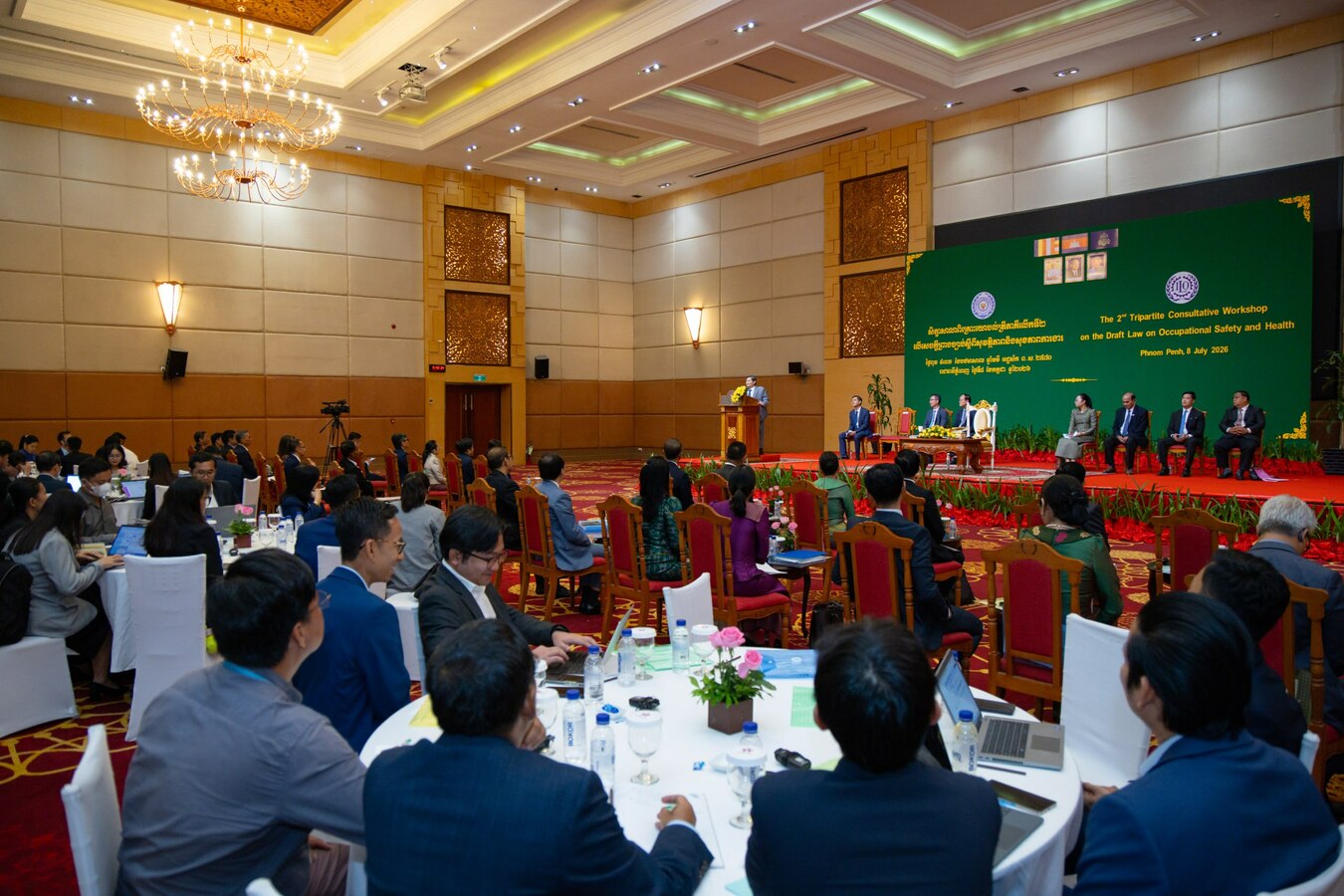
Cambodia Advances Draft OSH Law with ILO Tripartite Consultations
Politics
2026年7月8日
5
CPP Cambodia

Cambodia Advances Draft OSH Law with ILO Tripartite Consultations

AI サマリー

Cambodia's Ministry of Labour and Vocational Training, in collaboration with the ILO, held its second tripartite consultation on a draft law concerning Occupational Safety and Health (OSH). Over 200 stakeholders participated, exchanging views to enhance the draft's comprehensiveness and alignment with international standards. The law aims to boost labor productivity and economic growth.

The Ministry of Labour and Vocational Training, in collaboration with the International Labour Organization (ILO), convened the second tripartite consultation on the draft law concerning Occupational Safety and Health (OSH) at the Sokha Phnom Penh Hotel on the morning of July 8, 2026. Presided over by H.E. Heng Sour, Minister of Labour and Vocational Training and President of the National Committee for Occupational Safety and Health, the workshop gathered approximately 200 participants, including representatives from relevant ministries and institutions, national and international partner organizations, employers, and employees. The objective was to consult and gather further input to ensure the draft law is comprehensive and aligns with Cambodia's context and ILO standards, thereby promoting OSH and fostering sustainable labour market development. H.E. Heng Sour emphasized the Cambodian government's high commitment to enhancing OSH, referencing the Ministry's "Strategic Development Plan for the Labour, Social Security and Vocational Training Sector 2024-2028" and the "3rd Master Plan on Occupational Safety and Health 2023-2027." These plans aim to build a culture of safety in the workplace, moving towards the vision of "having a proper OSH management system in all workplaces to eliminate occupational accidents and diseases." The Minister explained that the draft law consolidates over 20 existing declarations and legal instruments. The creation of this law is a direct and timely response to the government's commitment to achieving high labour productivity, enhancing economic competitiveness on the international stage, and driving national economic growth. He added that this law aligns Cambodia with other ASEAN countries that have already adopted similar legislation. For Cambodia, the upcoming adoption and implementation of this law signifies a commitment to ensuring OSH compliance in line with global trends and international labour standards, particularly in promoting the monitoring of human rights and environmental due diligence (HREDD) related legal implementations. Highlighting the importance of the tripartite mechanism, H.E. Heng Sour stated that good and comprehensive laws emerge from tripartite dialogue characterized by equal, open, and honest participation. He noted that this second national consultation represents a significant step forward in reviewing key points that have been amended and jointly agreed upon, assessing whether the revised provisions are in sync with economic changes, strike a balance between worker protection and the burden on businesses, and conform to international standards set by the ILO, especially Conventions No. 155 and No. 187. He appealed to the workshop participants to be open to constructive criticism and to engage in discussions based on data, evidence, and technical expertise to find common ground acceptable to all parties. To achieve the strategic objectives, he recommended reviewing specific articles and legal language, defining inter-ministerial responsibilities, and delegating detailed provisions to sub-decrees, while the law itself should focus on fundamental principles, main obligations, and the general framework. He expressed strong confidence that the spirit of cooperation and the rich experience from the workshop would yield historic results, establishing a solid foundation to ensure that Cambodia's economic development does not come at the cost of workers' health. Concurrently, Mr. Tun Sophann, National Coordinator of the ILO in Cambodia, H.E. Sok Kinnal, Vice President of the Garment Manufacturers Association in Cambodia (GMAC), and Mr. Ly Vichetr, President of the Happy Workers Union and Vice Chairman of the National OSH Committee, expressed their support and gratitude to the government and the Ministry of Labour for initiating this crucial draft law and providing a platform for multi-stakeholder discussions. They acknowledged the increased focus on worker safety and health, reflecting ILO values, and its role in boosting international competitiveness and promoting the movement for "a safe enterprise is a happy community."

多角的分析

経済的影響

カンボジア政府は、労働生産性の向上と国際競争力の強化を経済成長の鍵と位置づけている。労働安全衛生(OSH)法の制定は、職場での事故や疾病を減らし、労働者の健康を守ることで、結果的に生産性の低下を防ぎ、長期的な経済発展の基盤を強化する狙いがある。ILO基準への適合は、国際市場におけるカンボジア製品の品質と信頼性を高める要因となり得る。また、法整備は外資誘致においても、企業がより安全で安定した操業環境を期待できるという点でプラスに働く可能性がある。

投資家心理

投資家にとって、労働安全衛生法の整備は、事業運営におけるリスク管理の観点から重要である。明確な法的枠組みは、予期せぬ事故による操業停止や賠償リスクを低減させる。特に、製造業や建設業など、労働災害のリスクが高い産業では、投資判断の重要な要素となる。ILO基準への準拠は、国際的なサプライチェーンへの参加や、ESG投資の観点からも有利に働く可能性がある。ただし、法案の具体的な内容や執行体制が、事業主の負担を過度に増加させないかどうかも注視されるだろう。

社会的影響

この法案は、カンボジア国内の労働者の生活実感に直接影響を与える。これまで十分な安全基準が整備されていなかった職場での事故や職業病が減少すれば、労働者の健康と生活の安定に大きく貢献する。特に、縫製業など労働集約型産業で働く多くの労働者にとって、安全な労働環境は基本的な権利であり、その保障は社会的な安定にも繋がる。一方で、法案の施行に伴い、雇用主側のコスト増加が懸念され、それが労働者の雇用機会に影響を与える可能性も考慮する必要がある。市民代表からは、中小企業への影響や、法執行の透明性に対する疑問の声も上がる可能性がある。

市民の声

カンボジア市民、特に労働現場で働く人々にとって、この法律は生活の質に直結する重要な進展である。これまで、多くの労働者が劣悪な労働環境や安全対策の不備による健康被害に苦しんできた。新しい法律が施行されれば、職場での事故や病気が減少し、より安全で健康的な労働環境が期待できる。これは、家族の生活を支える労働者にとって、安心して働き、収入を得られる基盤となる。しかし、法案が雇用主の負担を過度に増やす場合、それが賃金や雇用の安定に影響しないか、また、法が公平に、そして効果的に実施されるかどうかが、市民の関心事となるだろう。

背景・歴史的文脈

カンボジアにおける労働安全衛生(OSH)の法整備の動きは、同国の経済発展と国際社会からの期待の高まりを背景としている。特に、縫製業を中心とした製造業の拡大に伴い、労働災害や職業病のリスクが増大した。2010年代以降、ILOはカンボジア政府に対し、労働者の権利保護と安全な労働環境の確立を支援しており、OSHに関する国際基準の導入を奨励してきた。今回の草案法は、既存の関連法規を統合・強化し、ILO条約第155号(労働安全衛生及び労働環境に関する条約)や第187号(労働安全衛生促進枠組条約)への準拠を目指すものである。これは、カンボジアが国際的な労働基準を満たし、持続可能な開発目標(SDGs)の達成に貢献しようとする姿勢の表れと言える。

原文ソース

CPP Cambodia

原文を読む