General articles are free for 24 hours after publish.
Vietnam's Development Drive Sparks Land Seizures and Inadequate Compensation Concerns
In Vietnam, a surge in land seizures for large-scale development projects is forcing residents to relocate with inadequate compensation. Concerns are rising that upcoming land law amendments may further accelerate these expropriations.
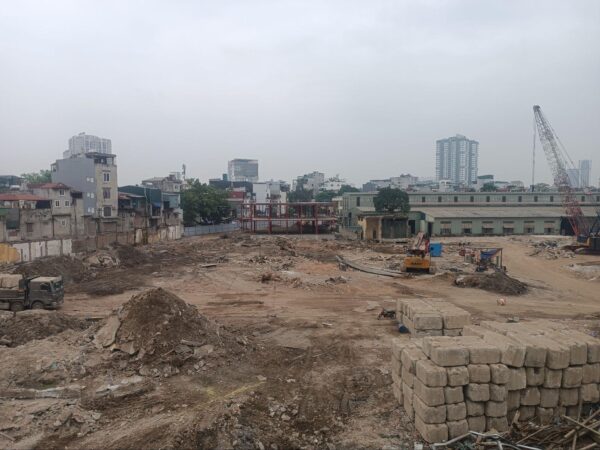
Read The Diplomat, Know The Asia-Pacific More and more Vietnamese are being forcibly displaced to make way for development. Many are reluctant to speak out, because “between a victim and a criminal lies only a fragile line.” A plot of land in Hanoi under construction after the site was cleared. Born into a family with a passion for the arts, 68-year-old Thanh spent her younger years enjoying stage dramas at Hanoi’s theaters in the 1980s. Such entertainment was a luxury in post-war Vietnam – theater tickets were scarce, accessible only to families with wealth or political connections. Thanh was among the fortunate few. Today, however, she views the imminent $520 million Pearl Theater with bitterness. The megaproject – covering a total floor area of 40,980 square meters and potentially accommodating 2,000 people – is slated for completion by 2030. But the giant theater’s construction displaced her whole neighborhood. “I lost my home,” Thanh said in her trembling voice. She spent the past weeks inviting friends and family to her two-story house, a 230-square-meter property near West Lake that she completed in 2020, for what may be their last visit. The house, valued at over 300 billion Vietnamese dong (around $11.5 million) in the current market, was demolished at the end of August. The compensation she received was 3 billion dong – just 1 percent of her home’s estimated valued – plus a monthly allowance that is barely enough for a modest rent. The financial toll extends beyond the compensation gap. Thanh and her neighbors have spent considerable time and money petitioning local authorities, along with paying unofficial fees to expedite bureaucratic processes – efforts that yielded no concessions. Authorities have designated resettlement areas for Thanh and her neighbors but they remain far from ready to move. Thanh has scrambled for months to secure alternative housing for her family of seven, unsure when she will officially move to the resettlement residential areas. Nonetheless, Thanh refuses to join any protest with some of her neighbors nor air her discontent online, though she is an active user of Facebook and Zalo, a local messaging application. “Nowadays, between a victim and a criminal lies only a fragile line,” said Thanh. “We have to be careful.” Thanh is not alone in facing the dilemma brought about by the capital’s 100-year multibillion dollar master plan, which is poised to displace 860,000 people or more than 10 percent of the capital’s population. The haste to demolish hits the communities hard. Thanh said she and her neighbors were never consulted during planning and were coerced to leave their homes without access to resettlement areas – and, most importantly, received inadequate compensation. To make matters worse, authorities are forcibly accelerating displacement even as resettlement infrastructure remains unfinished. Yet, this practice is bound to gain legal sanction in the upcoming amended Land Law. On July 28, the National Assembly’s Standing Committee announced that an extraordinary session would be held in August to deliberate on several draft laws. Among those high on the agenda is the amended Land Law, which is scheduled for approval in October. Since To Lam became chief of the Communist Party of Vietnam in 2025 – and, in 2026, president – the slogan of the “era of national rise” has become a mantra across Vietnam. Much of this agenda revolves around a money-driven model of development: policymakers pursue double-digit GDP growth and the ambition of transforming Vietnam into a high-income country by 2045. Land, in particular, has been seen as a launching pad for national growth. Large-scale real estate developments continue to proliferate across the country. Amid the rush to develop, one of the government’s most aggressively pursued – yet quietly contested – initiatives in recent months has been land confiscation. Land Rights at the Mercy of the Party-State The draft legislation, prepared by the Ministry of Agriculture and Environment, was released for public consultation on July 21, leaving citizens less than a month to submit feedback – assuming they were even aware that the consultation was taking place. Notably, on the online portal to provide input, there is no option to do so anonymously. The Land Law was passed two years ago, so it’s surprising that it already needs amendments – despite the fact that in 2024 and 2025, two resolutions were issued to guide its implementation. But in today’s Vietnam, laws are being issued with unprecedented speed and scale. 2025 was a record legislative year, with 86 laws passed – more than half of the 150 total laws approved by the National Assembly from 2021 to 2026 – as well as 371 legal documents of varying types. China and Vietnam share a socialist land-tenure system that does not recognize private land ownership. But their legal ownership structures differ. In China, urban land is state-owned, while most rural land is owned by peasant collectives. In Vietnam, all land is legally owned by the entire people, with the state acting as the representative and granting land-use rights to individuals, households, and organizations – and reclaiming those rights when it sees fit. Hanoi is currently carrying out land acquisition and site clearance for 1,428 projects across the city. According to a master plan approved in March 2026, Hanoi has set a goal becoming one of the 10 happiest capitals in the world, a city of “prosperity, harmony, civility, and character.” Yet, experts inside the country has expressed concerns about the speed of the transformation. Tô Kiên, an architect and professor at the University of Economics Ho Chi Minh City, wrote in an opinion piece on Vnexxpress: The Hanoi master plan was meticulously prepared, comprising more than 1,000 pages of explanatory documents and dozens of large-scale maps. Yet the public was given only 10 days to become aware of it, read and understand it, and provide feedback. Expert consultation workshops had only just taken place, and within days, the plan was approved. This shows that the consultation process has not fulfilled its intended role and should have been conducted more thoroughly and cautiously, with more time allowed for review and feedback. The 12th and 13th provisions of the current Land Law allow the state to expropriate land to build headquarters for the Communist Party of Vietnam, state agencies, the Vietnam Fatherland Front, political and socio-political organizations, and other organizations established in accordance with the law and assigned state functions. They also allow land to be expropriated to build offices or representative offices for public service units affiliated with CPV agencies, state agencies, and socio-political organizations. The final provision goes further. It states that if land must be expropriated for a project or facility deemed to serve the national or public interest but does not fall under any
Original source
The Diplomat Indonesia