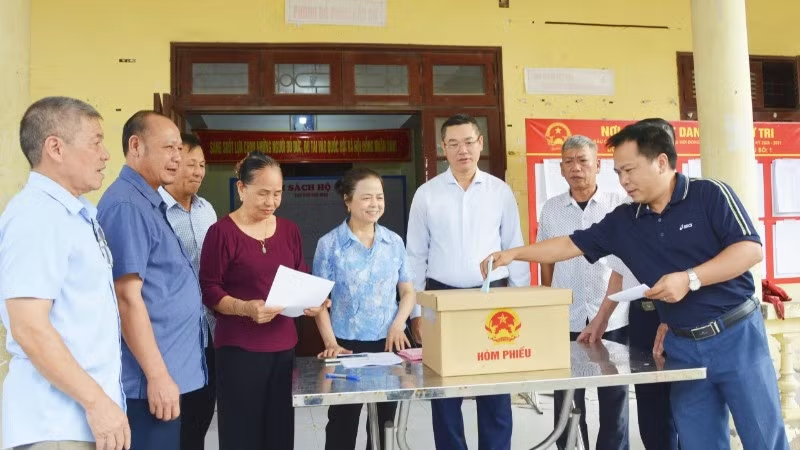
Bac Ninh Province Residents Largely Support Proposal to Establish Central-Governed City
Bac Ninh Province in northern Vietnam has conducted a public consultation on a proposal to elevate the province into a centrally-governed city and its urban development plan until 2050. High approval rates were recorded in many areas, indicating widespread public support for the initiative.
Bac Ninh Province in northern Vietnam launched a province-wide public consultation on July 11 regarding two critical issues: the proposal to establish Bac Ninh as a centrally-governed city and the urban development plan with a vision extending to 2075. As of 4 PM, 46 out of 99 communes and wards had completed the opinion gathering, with a high rate of public consensus observed. This initiative is seen as part of a broader national strategy to reorganize local administration and accelerate urban development across Vietnam. Elevating Bac Ninh to a centrally-governed city is expected to expand the local government's authority and strengthen its financial base, aiming to further boost economic growth. Bac Ninh Province is a key economic driver, hosting numerous industrial parks with major high-tech manufacturers like Samsung Electronics. Enhancing its administrative functions is anticipated to improve the province's international competitiveness. Under its one-party system, Vietnam has prioritized economic growth, actively pursuing urban development and infrastructure improvements. In recent years, the development and elevation of provincial cities, beyond major metropolises like Hanoi and Ho Chi Minh City, have gained momentum. This reflects the government's intention to address economic disparities and foster balanced regional development. Furthermore, it serves to strengthen the domestic foundation and achieve economic self-reliance amidst complex relations with China. The case of Bac Ninh exemplifies Vietnam's administrative approach of advancing national development plans while incorporating the will of local residents. Similar moves are anticipated to accelerate in other provinces, potentially reshaping Vietnam's administrative landscape significantly.
多角的分析
バクニン省の中央直轄市への昇格は、単なる行政区分の変更に留まらず、経済的インセンティブの強化を狙っている。中央直轄市となることで、予算配分や開発プロジェクトにおける裁量権が増大し、インフラ投資や産業誘致が加速する可能性がある。特に、同省は既にハイテク産業の集積地であり、行政機能の強化は、さらなる外資誘致やサプライチェーンの高度化に繋がるだろう。これは、ベトナムが掲げる「製造業ハブ」としての地位を確固たるものにするための戦略的な一歩と言える。
バクニン省の中央直轄市への昇格は、投資家にとってポジティブなシグナルとなる。権限強化による迅速な意思決定や、インフラ整備の加速は、事業展開のリスクを低減し、投資環境の魅力を高める。特に、製造業やテクノロジー分野への投資は、より安定した成長が見込まれるだろう。ただし、昇格に伴う新たな規制や税制の変更がないか、詳細な動向を注視する必要がある。
バクニン省での住民意見聴取は、ベトナムの一党体制下における住民参加の形式を示している。中央直轄市への昇格は、行政サービスの向上や雇用機会の増加といった恩恵をもたらす可能性がある一方、都市化の進展に伴う土地利用の変化や、伝統的なコミュニティ構造への影響も懸念される。特に、農村部から都市部への人口流入が増加した場合、住宅問題やインフラの逼迫といった課題が顕在化する可能性がある。
バクニン省の住民は、中央直轄市への昇格という変化に対して、高い賛同を示している。これは、昇格による行政サービスの向上や、経済発展に伴う生活水準の向上への期待が大きいことを示唆している。しかし、都市化の進展は、土地の価格上昇や、伝統的な生活様式からの変化を伴うため、一部の住民にとっては不安要素となる可能性もある。特に、土地の権利や、将来的な住環境の変化に対する懸念は、今後も表面化する可能性がある。
背景・歴史的文脈
ベトナムは、1986年のドイモイ(刷新)政策以降、市場経済を導入し、急速な経済成長を遂げてきた。この過程で、地方行政の再編と都市開発は、経済成長を支える重要な柱と位置づけられてきた。特に、ハノイやホーチミン市といった大都市への人口集中と経済機能の集積が進む中、地方都市の振興や、行政区分の見直しによる権限強化は、地域間の均衡ある発展を目指す上で不可欠な政策となっている。バクニン省のような工業集積地を中央直轄市へ昇格させることは、経済特区的な位置づけを強化し、さらなる投資を呼び込むための戦略であり、過去の他の地方都市の昇格事例(例:ダナン市)とも共通する構造を持つ。
原文ソース
Nhan Dan