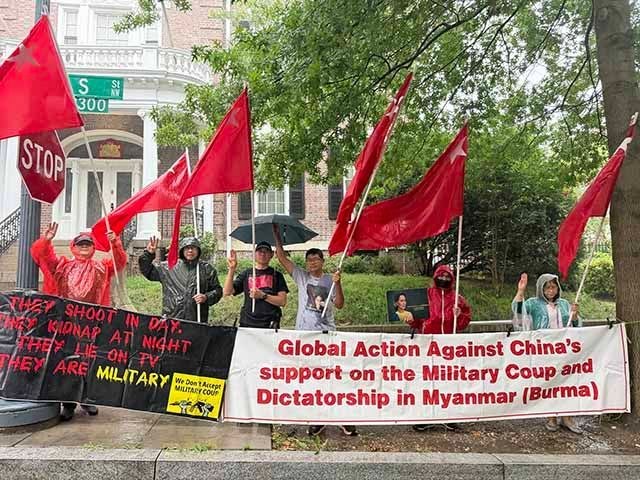
Protests outside Lao, Chinese Missions in US on anniversary of Student Uprising in Myanmar
Myanmar pro-democracy activists in the United States staged a series of protests across the nation’s capital on July 9, gathering outside the Embassies of Myanmar and Laos, as well as the residence of the Chinese ambassa
Myanmar pro-democracy activists in the United States staged a series of protests across the nation’s capital on July 9, gathering outside the Embassies of Myanmar and Laos, as well as the residence of the Chinese ambassador. The demonstrations were held to commemorate the 64th anniversary of the historic “7 July Student Uprising” and to condemn neighboring countries for their continued support of the military regime in Naypyidaw. The protests highlight growing frustration among the Myanmar diaspora regarding international engagement with regime leader Min Aung Hlaing. Following his inauguration as Myanmar’s president by a pro-military parliament on April 10, Min Aung Hlaing has embarked on a series of high-profile state visits to bolster diplomatic ties. Frustration over international complicity Activists specifically targeted the diplomatic missions of Laos and China due to their recent engagements with the regime leader. “We oppose Laos and China for supporting the Myanmar military,” Dr. Tun Wai, an activist at the Washington D.C. protest, told DVB. The diplomatic visits in question include: India (May 31 – June 3): Min Aung Hlaing met with Prime Minister Narendra Modi during his first overseas trip since assuming the presidency. China (June 15 – 19): He held talks with Chinese President Xi Jinping in the capital Beijing. Laos (July 3 – 5): He conducted a state visit at the invitation of Lao President Thongloun Sisoulith. The trip marked Min Aung Hlaing’s first official state visit to an Association of Southeast Asian Nations (ASEAN) member state as president, culminating in agreements on tourism and a joint feasibility study for a Mekong River hydropower dam. For the protesters, these diplomatic receptions grant unwarranted legitimacy to a regime responsible for ongoing violence against civilians. “Min Aung Hlaing is not a real president,” said Myat Yin Chaw, a Myanmar activist participating in the U.S. protests. “People are dying because of him and his troops. We condemn everyone and every government that supports him.” Honoring the 7 July Student Uprising The timing of the protests coincided with the 64th anniversary of the ‘7 July Student Uprising’ in 1962. The historical event is a cornerstone of Myanmar’s pro-democracy movement. On July 7, 1962, students at Rangoon University (now University of Yangon) held mass demonstrations against severe campus restrictions imposed by General Ne Win, who had seized power in a military coup earlier that year. The regime responded with brutal force, killing dozens of unarmed students. The following day, military authorities dynamited the historic Rangoon University Students’ Union building to physically crush the symbol of student resistance. Today, activists globally continue to invoke the spirit of the 1962 protests as a symbol of defiance against the current military dictatorship, linking the historical struggle for democracy to the ongoing resistance against the Feb, 1, 2021 military coup. The post Protests outside Lao, Chinese Missions in US on anniversary of Student Uprising in Myanmar appeared first on DVB.
多角的分析
直接の経済ニュースではありませんが、治安と司法の信頼は地域経済の土台です。職場での暴力や未成年者保護への不安が強まると、夜間営業、観光、雇用、地域サービス業のリスク認識が高まります。
投資家目線では、個別事件よりも法執行の予見可能性が焦点です。加害者への対応が曖昧になれば、ローカルビジネスの統治リスクや従業員保護の弱さとして評価されやすくなります。
ミャンマーで問われるのは、加害者個人だけでなく、雇用主、警察、近隣社会が被害のサインをどう扱ったかです。学生が声を上げたことで、事件は噂話ではなく、記録され検証される公共問題に変わります。
市民にとっては、自分や家族が被害に遭った時に公正な手続きへアクセスできるのかが最大の関心です。地域団体が声を上げることで、事件の風化を防ぎ、被害者側の孤立を和らげる意味があります。
背景・歴史的文脈
このニュースは、ミャンマーの地域社会で法の支配と弱者保護がどこまで機能しているかを映す事案です。暴力事件そのものに加え、女性団体や市民社会が司法手続きを求めて声を上げている点が重要です。軍政下では警察・司法への信頼が揺らぎやすく、個別事件が地域の不安や統治への不信に直結します。
原文ソース
DVB