General articles are free for 24 hours after publish.
India Enhances South Asia Surveillance with New EOS-05 Satellite
India's ISRO has launched its first Earth observation satellite, EOS-05, into geostationary orbit. This significantly enhances India's Intelligence, Surveillance, and Reconnaissance (ISR) capabilities, allowing continuous monitoring of military activities across South Asia. The development could also heighten tensions between India and Pakistan.
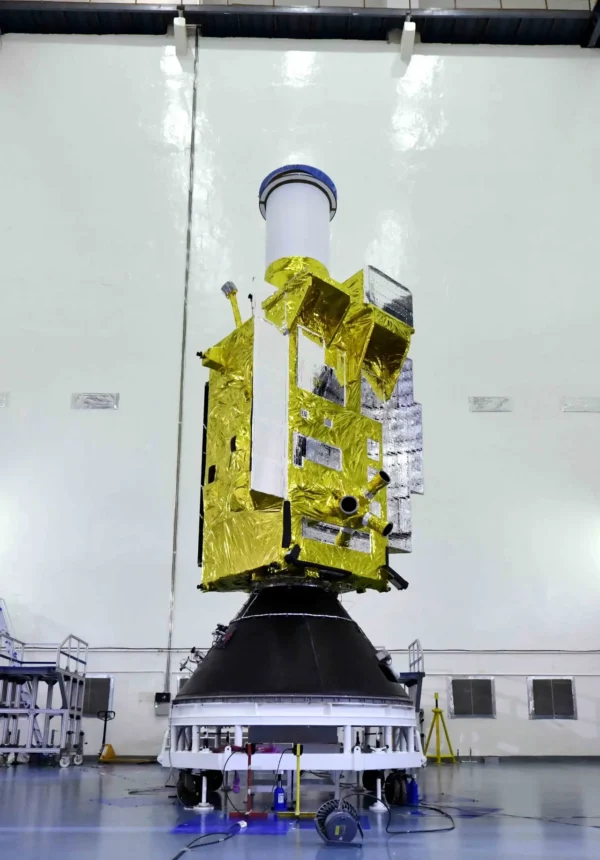
India's space agency, the Indian Space Research Organization (ISRO), has successfully launched its latest surveillance satellite, EOS-05, into geostationary Earth orbit (GEO). The launch, conducted using the GSLV-F17 rocket, marks the deployment of India's first Earth observation satellite in GEO. EOS-05 will provide India with the capability to continuously observe the Indian subcontinent from an altitude of approximately 35,000 kilometers. "EOS-05 will become India's first dedicated imaging satellite from the geo orbit providing important strategic data for the country," stated ISRO Chairman V. Narayanan. The satellite's launch is part of India's long-term plan to strengthen its Intelligence, Surveillance, and Reconnaissance (ISR) capabilities. This will enable persistent tracking of military movements in the subcontinent, particularly Pakistan's naval warships, aircraft, strategic assets, and force mobilization during times of crisis. India's current space architecture comprises navigation, communication, ISR, and scientific satellites. In the ISR domain, India operates the CROSAT series for optical observation, the RISAT and NISAR series for Synthetic Aperture Radar (SAR) observation, and the EMISAT satellite for electronic ISR. However, EOS-05 will be India's first ISR satellite capable of providing real-time and persistent observation of the subcontinent. In 2024, India's Cabinet Committee on Security (CCS) approved the Space Based Surveillance Phase-III (SBS-III) program, which aims to deploy 52 defense satellites into Low Earth Orbit (LEO) and geostationary orbit for surveillance purposes. Under this project, ISRO will develop 21 satellites, and the private sector will develop 31. The deployment of EOS-05 enhances the persistent surveillance layer of India's ISR architecture. While India's existing LEO satellites can provide high-resolution imagery, they have observational limitations due to their rapid movement across the Earth's surface. EOS-05, being in geostationary orbit, will allow for prolonged observation, thereby strengthening India's precision-strike capabilities. Precision-strike missiles rely not only on range and accuracy but also on timely information regarding target locations. Furthermore, the satellite will contribute to India's defensive objectives. It will bolster preparedness for potential counterstrikes by Pakistan, with potential integration with advanced missile defense systems. Continuous monitoring of Pakistan's troop movements will allow India to enhance its defensive readiness. However, this capability enhancement could impact South Asian deterrence dynamics. Faster detection, enhanced targeting information, and improved precision-strike capabilities will shorten decision-making timelines during crises. Given the territorial proximity between India and Pakistan, decision-making timelines are already very short. Increased vulnerability of strategic assets to detection may prompt Pakistan to undertake early dispersal, mobilization, and further concealment of its military assets. This could create a "use-it-or-lose-it dilemma," further increasing the risks of miscalculation and inadvertent escalation. Therefore, while enhanced space-based ISR capabilities will improve situational awareness, they will also present new challenges for crisis stability and escalation management in South Asia. EOS-05 is part of a broader initiative under the SBS-III program to bolster India's ISR capabilities. The satellite's launch signifies India's strategic shift from intermittent snapshots to persistent watch, and this capability enhancement could influence how future crises between India and Pakistan unfold. Islamabad will need to further strengthen the survivability of its conventional and strategic assets through concealment, deception, and mobility practices. Information Source: The Diplomat Indonesia
Original source
The Diplomat Indonesia