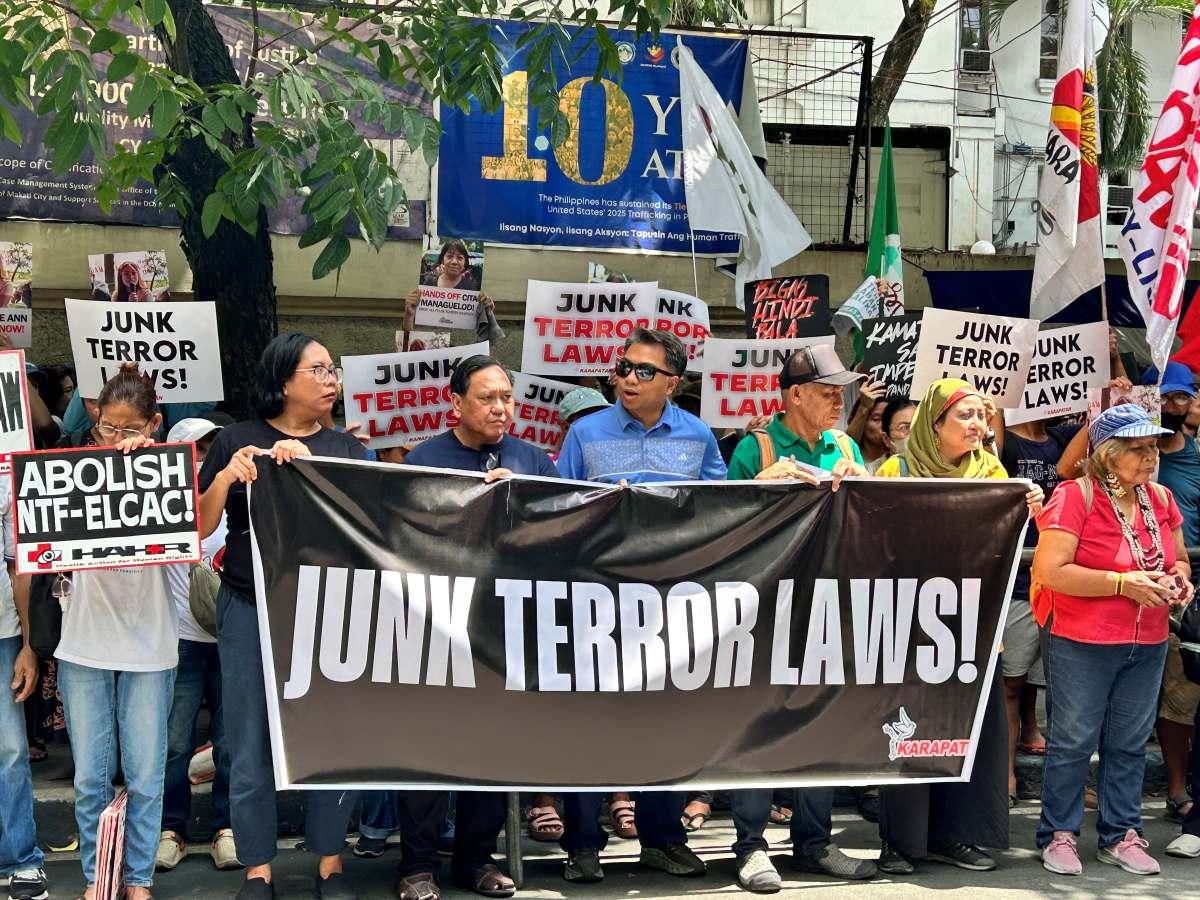
Human rights groups renew calls to junk terror laws, citing unconstitutionality and rights violations
Philippine human rights groups have renewed their call to junk the Anti-Terrorism Act of 2020 and the Terrorism Financing Prevention and Suppression Act of 2012, arguing they are unconstitutional and violate human rights and civil liberties. Despite a 2021 Supreme Court ruling declaring parts of the law unconstitutional, the groups assert that many citizens continue to suffer unjust repression.
Human rights groups on Friday trooped to the Department of Justice (DOJ) to reiterate their call to junk the Terrorism Financing Prevention and Suppression Act of 2012 and the Anti-Terrorism Act of 2020, noting that it has been six years since its enactment. In her speech during the rally, Karapatan Secretary General Cristina Palabay told the Supreme Court “we told you so." “Anim na taon po ang nakakaraan. Ayaw po sana namin sabihin sa Korte Suprema, pero sasabihin ko na rin. We told you so, Supreme Court,” Palabay said. (Six years have passed. We did not want to say this to the Supreme Court, but I will say it anyway. We told you so, Supreme Court.) “Sinabi na po namin anim na taon na ang nakakaraan, unconstitutional. Lumalabag sa karapatang pantao at civil liberties, tatamaan ang mga aktibisa, ang mga nagpapahayag, ang mga ordinaryong mamamayan sa ilalim ng terror law,” she added. (We already said six years ago that it was unconstitutional. It violates human rights and civil liberties, activists, those expressing their views, and ordinary citizens will be affected under the terror law.) In December 2021, the High Court upheld the majority of the Anti-Terror Law as it declared two parts of the act as unconstitutional. Palabay alleged that more than 256 individuals were charged with fabricated cases and were arbitrarily detained due to the laws. “Marami po sa mga naging biktima ng terror law na ito ay mga magsasaka, mga katutubo, mga manggagawa, mga kababaihan, at mga kabataan,” she said. (Many of those who have become victims of this terror law are farmers, indigenous peoples, workers, women, and the youth.) Palabay said that the twin laws are being used to suppress individuals who resist. “Dalawang batas na ginagamit para supilin ang mga lumalaban, ang mga nag eehersisyo ng ating mga karapatan, ang mga rebolusyonaryo para manaig ang mga kurakot, ang mga mamamatay tao, ang mga nagsasanla ng ating bansa sa mga dayuhan,” she said. (Two laws are being used to suppress those who resist, those who exercise our rights, and revolutionaries, so that the corrupt, the murderers, and those who mortgage our country to foreigners can prevail.) — RSJ, GMA News
多角的分析
テロ対策法は、その広範な定義と適用可能性から、国内外からの投資家心理に悪影響を与える可能性がある。特に、活動家や反対意見を持つ人々を標的とする可能性は、ビジネス環境の不確実性を高め、新規投資を躊躇させる要因となり得る。過去には、治安不安や法制度の不安定さが経済成長の足かせとなった事例もフィリピンで見られる。
投資家は、法制度の安定性と予測可能性を重視する。テロ対策法が恣意的に適用され、人権侵害につながるという人権団体の主張は、法治国家としての信頼性に疑問符を投げかける。これは、特に外国からの直接投資(FDI)や、BPO(ビジネス・プロセス・アウトソーシング)産業のような、安定したビジネス環境に依存する分野への投資リスクを高める要因となる。
人権団体が指摘するように、テロ対策法は農民、先住民、労働者、女性、若者といった社会的弱者を不当に標的にする可能性がある。これは、社会的不平等を悪化させ、異なる意見を持つ人々に対する弾圧を助長する恐れがある。例えば、土地紛争に関わる農民運動家や、環境保護を訴える先住民リーダーが、テロリストと見なされるリスクが懸念される。
市民、特に活動家や政府に批判的な人々にとって、テロ対策法は表現の自由や集会の自由を脅かすものとなっている。過去の事例では、この種の法律が反対意見を封じ込めるために利用され、多くの人々が不当な逮捕や拘留に苦しんできた。最高裁判決で一部違憲とされたものの、残りの条項の運用次第では、依然として市民の権利が侵害される可能性が残る。
背景・歴史的文脈
フィリピンにおけるテロ対策法を巡る議論は、2001年の9.11同時多発テロ以降、世界的に高まったテロ対策の機運と連動して、国内でもテロ組織の脅威への対応として強化されてきた。2012年のテロ資金供与防止・抑制法に続き、2020年にはより広範な定義と強力な権限を持つテロ対策法が制定された。しかし、制定当初から、この法律が政治的反対意見や社会運動を抑圧するために利用されるのではないかという懸念が、人権団体や市民社会から強く表明されてきた。2021年の最高裁判決は、一部の条項の違憲性を認めつつも、法律の大部分を支持したことで、この問題は依然として継続している。
原文ソース
GMA News Philippines