General articles are free for 24 hours after publish.
AI Transforms China's Short-Film Industry, Impacting Jobs and Censorship
In China's short-film industry, AI is increasingly integrated into the production process, beginning to replace the roles of actors and production staff. The surge in AI-generated content leads to significant cost reductions and increased productivity, but also raises challenges such as job displacement and enhanced content regulation.
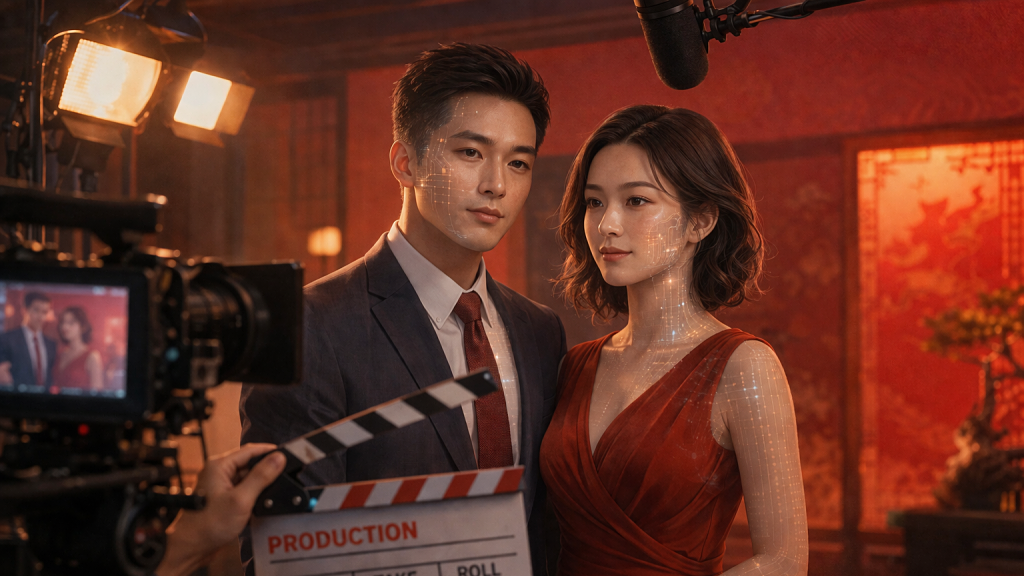
AI is increasingly integrated into China's short-film industry, particularly in the realm of micro-dramas, often dubbed "television for the TikTok generation." This format has flourished in recent years due to its rapid production speed, low cost, and suitability for mobile viewing habits. Episodes are typically short, revolving around themes like romance, revenge, identity swaps, or family conflicts, designed to retain viewer attention. According to market research firm DataEye, over 220,000 AI-generated short films appeared on the Douyin platform in the first half of this year, garnering approximately 500 billion views. AI is employed across various genres, including animation and the recreation of real human characters. In the first quarter, Chinese filmmakers released around 128,000 short films, more than triple the total for the entire previous year, with approximately 95% of these created using artificial intelligence. The technology significantly shortens the production process, enabling content creation teams to operate at a low cost. The micro-drama model prioritizes speed and high-volume content production, and with the development of AI filmmaking tools, this process has been further streamlined. AI can assist from character and background generation to motion graphics, saving teams time and increasing output. CNN reports that with new-generation video creation tools, a project of about 120 minutes can be completed by a team of five in roughly one week for approximately 15,000 yuan (over 58 million VND), a fraction of the minimum budget for a live-action production in China. AI adoption allows for the reduction or replacement of many stages, such as actor casting, set construction, filming, costuming, and post-production, with digital processes. This enables producers to undertake more projects with the same investment. The emergence of new tools like ByteDance's Seedance 2.0 exemplifies this trend. This application can simultaneously process four types of input data: images, video, audio, and text. From a few commands or reference data, it can generate a 60-second video with multiple camera angles, physically plausible movements, and synchronized audio. While AI makes filmmaking easier, it also intensifies the production race. DataEye indicates that out of 221,900 AI-generated short films and comic dramas on Douyin in the first half of the year, only 1,055 works surpassed 100 million views, a mere 0.48%. As hundreds of thousands of works compete for attention, the advantage lies not in speed or cost, but in the ability to craft compelling stories. The reduced production cost has led some filmmakers to shift from live-action shooting to using technology, shrinking employment opportunities for actors and crew. Financial Times reports that in Hengdian, a major film production hub in China, many actors have lost their jobs or transitioned to other professions following the adoption of new-generation video creation tools. Furthermore, AI's deep involvement in the short-film sector imposes new requirements for content management, placing this genre under strict scrutiny in China. The National Radio and Television Administration mandates that platforms actively control potentially harmful content, and videos that do not meet requirements may be removed. Since April, China has intensified regulation of short-film production and distribution, especially for AI-generated works. New regulations expected to take effect in September will further tighten censorship, requiring content and storylines to meet standards set by authorities. Actor Jun Lin, working in Hengdian, told CNN that AI is unlikely to replace humans entirely due to its formulaic nature and inability to fully convey emotional nuances. On the Hongguo viewing platform, films with real actors frequently appear in the top 10 most-watched content alongside AI and animated productions, suggesting that demand for live-action films persists despite technology reshaping content creation and distribution. However, Jun Lin notes that young actors who have not yet established a firm footing in the industry are the most vulnerable to this wave. "AI certainly cannot replace real people, but it can take away my job," she stated.
Original source
VnExpress