General articles are free for 24 hours after publish.
Cambodia Prepares for UNCLOS Conciliation Meeting with Thailand on Maritime Border Dispute
Cambodia is actively preparing its arguments and documentation for the second meeting of the UNCLOS Conciliation Commission with Thailand. Deputy Prime Minister and Foreign Minister Prak Sokhonn stated this process aims to find a new solution after Thailand unilaterally abrogated the 2001 Memorandum of Understanding mechanism for maritime border dispute resolution.
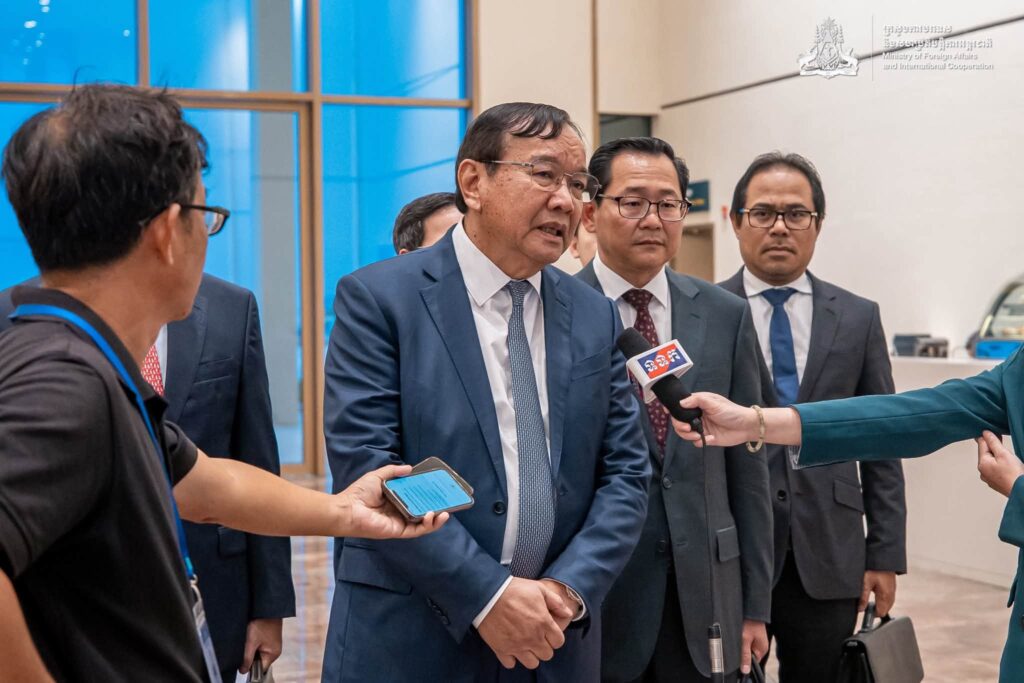
Cambodia is continuing to prepare its arguments and documentation for the second meeting of the Conciliation Commission under the United Nations Convention on the Law of the Sea (UNCLOS) between Cambodia and Thailand, scheduled to take place from October 14 to 18, 2026, in The Hague, Netherlands. This was disclosed by Deputy Prime Minister and Minister of Foreign Affairs and International Cooperation, Prak Sokhonn, at Techo International Airport on September 17, 2026, following the conclusion of the first meeting of the Conciliation Commission, which was held for three days from September 14 to 16 in Singapore. According to Mr. Sokhonn, the first meeting included both open and closed sessions. Following the open session, Cambodian and Thai parties participated in joint meetings with the Conciliation Commission, after which each party had the opportunity to hold separate meetings with the Commission. He clarified that the closed-door meetings were considered confidential, and thus, detailed content discussed during these sessions could not be publicly disclosed. In the separate meetings, each party was allocated approximately three hours to further present the history of the dispute, their arguments, their positions, and their objectives from the conciliation process. Mr. Prak Sokhonn stated that during the meeting, the Cambodian side further elaborated on the history of the dispute, its arguments, and its positions, as well as its objectives from the Commission's mediation. Concurrently, the Commission raised numerous questions, to which the Cambodian working group, along with international legal counsel, provided responses. He added that the Conciliation Commission also reviewed a draft press statement regarding the work over the past three days. Neither the Cambodian nor the Thai side provided further commentary or input on this draft. Regarding Cambodia's objective in initiating the conciliation process under UNCLOS, Mr. Prak Sokhonn explained that Cambodia desires a mechanism that can replace the maritime border dispute resolution mechanism that previously existed between Cambodia and Thailand under the 2001 Memorandum of Understanding (MOU), after this mechanism was unilaterally abrogated by Thailand in May 2026. He emphasized that the conciliation process aims to create a pathway for peacefully resolving maritime border disputes between the two countries based on international law. According to Mr. Prak Sokhonn, a just and sustainable solution, guided by international experts and in accordance with international law, can bring mutual benefits to both countries and contribute to building peace and stability in the region. He further stated that a resolution to this issue is also crucial for protecting sovereignty, strengthening trust between the two countries, harnessing benefits from energy resources, supporting development, and creating new employment opportunities for the people of both countries, both currently and for future generations. Concerning the subsequent meetings, Mr. Prak Sokhonn informed that the second meeting of the UNCLOS conciliation process between Cambodia and Thailand is scheduled to be held from October 14 to 18, 2026, in The Hague, Netherlands. The third meeting is planned for November 2026, while the fourth meeting might take place in late January or late February 2027. The fifth meeting is scheduled for late March, and the sixth meeting for April 2027. However, the specific times and locations of further meetings will be confirmed later. Mr. Prak Sokhonn also affirmed that the Cambodian working team has made thorough preparations since Cambodia decided to initiate the conciliation process and will continue to work closely with experienced international legal experts in this field, who were involved since the negotiation phase of the 2001 MOU.
Original source
Kampuchea Thmey Local