General articles are free for 24 hours after publish.
Mentilin, Rare Nocturnal Primate, Faces Crisis in Mount Menumbing
The population of the rare nocturnal primate, the Mentilin (a subspecies of tarsier), in Mount Menumbing, Bangka Island, Indonesia, is declining due to habitat destruction from illegal tin mining. The IUCN lists the species as 'Vulnerable,' making conservation urgent.
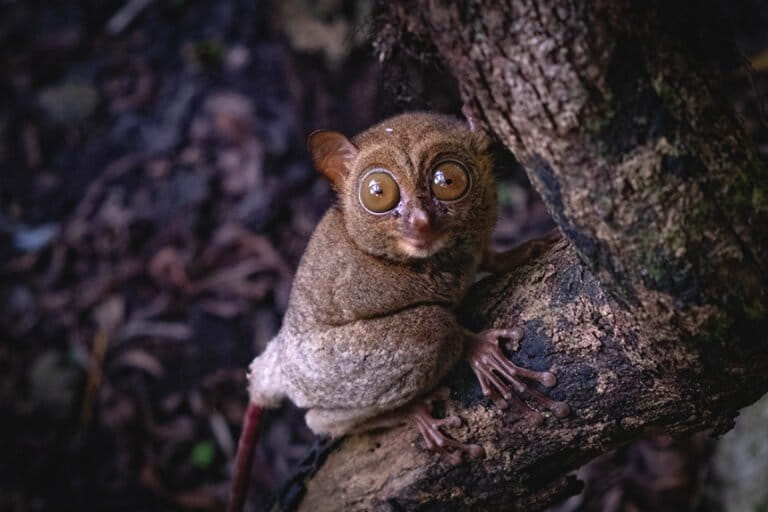
Mount Menumbing, located on Bangka Island, Indonesia, is historically known as a place of exile for former President Sukarno and Vice President Mohammad Hatta. However, its lush greenery also serves as a crucial habitat for the Mentilin (a subspecies of tarsier, scientific name: Cephalopachus bancanus bancanus), a rare nocturnal primate. The Mentilin is characterized by its large eyes that aid nocturnal activity and its long hind limbs enabling vertical leaps. While the exact population of Mentilin within the Mount Menumbing Grand Forest Park is unknown, forest guards estimate that several dozen to a hundred individuals inhabit the area. Approximately 57% of the park, or 1,898 hectares, is assessed as having high habitat suitability for the Mentilin. Across Bangka Regency, densities are estimated to range from 2.22 to 17.78 individuals per square kilometer, yet globally, their numbers are declining. The Mentilin is a nocturnal predator, heavily reliant on insects like moths, crickets, and grasshoppers for sustenance. Occasionally, they also prey on small vertebrates such as birds, bats, and snakes. However, this vital ecosystem faces a severe threat. An estimated 50% of the park area has been degraded due to illegal tin mining. Abandoned mining pits and river dams used for separating tin from soil are encroaching upon the Mentilin's hunting grounds and food sources. The International Union for Conservation of Nature (IUCN) classifies Cephalopachus bancanus, along with its subspecies C. b. bancanus, as 'Vulnerable,' making the conservation of the Mentilin an urgent priority.
Original source
Mongabay Indonesia