India's 'Cockroach Party': Digital Generation's Political Entry and Future Prospects
Politics
2026年8月4日
5
The Diplomat Indonesia

General articles are free for 24 hours after publish.

India's 'Cockroach Party': Digital Generation's Political Entry and Future Prospects

Share
AI Summary

Emerging from a judicial insult, India's 'Cockroach Janta Party' (CJP) is rapidly expanding as a new form of political participation for the digital native generation. Its AI-driven growth and cross-religious/caste support base challenge traditional political structures.

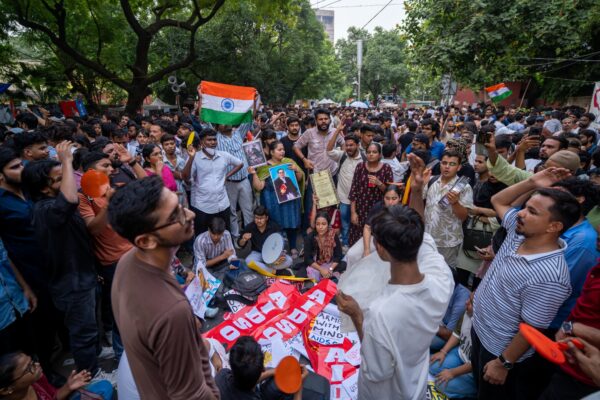
Read The Diplomat, Know The Asia-Pacific The Cockroach Janta Party reflects every hallmark of modern decentralized leadership theories, but is set to leave a lasting imprint on Indian politics. People gather during a protest organized by the Cockroach Janta Party (CJP) at Jantar Mantar in New Delhi, India, demanding accountability over alleged examination irregularities and education reforms, July 19, 2026. When Indian Supreme Court Justice Surya Kant compared certain unemployed youth and activists to cockroaches and parasites in May, he gave a generation searching for a shared identity the charge required to build one. Within days that slur became a rallying cry. Millions of young Indians declared “Main Bhi Cockroach” (‘I too am a cockroach’), turned the insult into memes, and launched a political party in the same breath. Some framed this as Prime Minister Narendra Modi misreading the political environment – after all, his own government gave India’s marginalized and unemployed youth the spark they needed to organize. But that top-down classic political framing overlooks emerging leadership theories, the mechanics of peer-to-peer digital communication, and global trends already underway. Gen Z uprisings had toppled or shaken governments in Nepal, Bangladesh, Kenya, and Madagascar over the previous two years. And each one built from the same digital scaffolding comprised of user digital trace creation, reproduction, and platform scalability. India’s administration either assumed it was immune from that global pattern or lacked the tools to recognize the trend at all. The failure, then, was its blindness to a new form of political organizing. The Cockroach Janta Party (CJP) reflects every hallmark of modern decentralized leadership theories. Digital traces left by one user become stimuli that guide the next user, producing coordination without any central command. Three more granular properties define this process: independent individual acts, reproducibility by peers who copy and adapt what they see, and platform architectures that scale those traces far beyond the original digital trace and network. The CJP displayed all three within its first week of existence. Its origins trace back to urban, globally educated, and digitally native figures – the same traits seen in other Gen Z-led movements. Abhijeet Dipke, who holds a master’s in public relations from Boston University, founded the “party” through a simple website and sign-up form built around a short, provocative question he posted online. He then built the CJP’s manifesto and branding using AI. Saurav Das, a New Delhi-based investigative journalist who began filing Right to Information requests at 18, became the movement’s public voice, using digital media updates to amplify protest messaging. Sign-ups passed 100,000 within two days and reached 350,000 soon after. The party’s social media followers climbed toward 18 million in a few days, briefly outpacing the official accounts of both Modi’s Bharatiya Janata Party (BJP) and Congress. The “cockroach” movement grew exponentially in a short period, like similar movements across the globe, because it tapped into deep grievances among a significant share of the country’s native digital society. India’s Periodic Labor Force Survey put unemployment among those aged 15 to 29 at 15.2 percent in March 2026, against 3 to 5.6 percent overall. Azim Premji University estimated more than 40 percent of college graduates under 25 were unemployed, roughly 11 million people. The cancellation of a medical entrance exam, the National Eligibility cum Entrance Test, following leak allegations turned an abstract grievance into an immediate one. 2.3 million exam-registered students saw themselves losing a concrete shot at a government-recognized medical career. Education and employment failures function as fertile ground for collective meaning making because they touch nearly every young household, regardless of religion or caste. That is why the movement drew Hindu and Muslim families to pray and eat side by side at protest sites, with a Muslim cook feeding demonstrators daily and Sikh gurdwaras running community kitchens. Online, the movement leverages memes as its central mode of communication and dissemination. Memes carry a distinct advantage over other digital objects. They can be created in seconds, convey essential information creatively, and let any user grasp the core message quickly and playfully. Memes are also powerful because their format invites recreation. A user does not simply view a meme and move on. They copy its structure, replace its content, and repost it, multiplying the original trace across many variations. Declaration memes, campaign poster parodies, exam leak satire reels, and crocodile versus cockroach power imbalance imagery each carry their own function. Each variation modifies the shared digital environment further, prompting the next round of recreation. Once this accumulation crosses a threshold, an autonomous individual act converts into cumulative and scalable collective coordination. Kant’s original insult itself, it could be argued, functioned as that threshold trace. It carried enough affective charge, given existing grievances around unemployment and exam integrity, to convert millions of isolated frustrations into a shared, recognizable identity within days. Some national observers are skeptical that a movement built on emotional reaction and algorithmic amplification can last. I would argue otherwise. The CJP stands a stronger chance of durable success than most of its counterparts for one specific reason. Toppling a government is easier than building institutions capable of governing afterward. For example, Nepal’s 2006 revolution overthrew a monarchy only to produce 17 successive governments and prolonged economic stagnation. More recent examples in both Nepal and Bangladesh have shown that digital coordination excels at government disruption and struggles with construction. The viral architecture that spreads outrage rarely contains the sustained negotiation, expertise, and trust that governing requires. The CJP, however, seems to have decisively moved past that bottleneck by converting a meme into a formal political party. This single, early strategic step pushed the movement beyond the confines of digital virality, providing a path for translating grievance into concrete and actionable policy demands through institutional means. In addition, its structure gives the CJP an organizational depth most leaderless uprisings never develop. The movement also enjoys a form of legitimacy rare among comparable cases. It draws support across religious lines, from opposition politicians and even from segments of the BJP’s traditional base. That legitimacy will not shield the movement from state resistance, though. India’s administrative apparatus has many tools for containing digital mobilization. The first is direct restriction of a

0

Original source

The Diplomat Indonesia

原文を読む