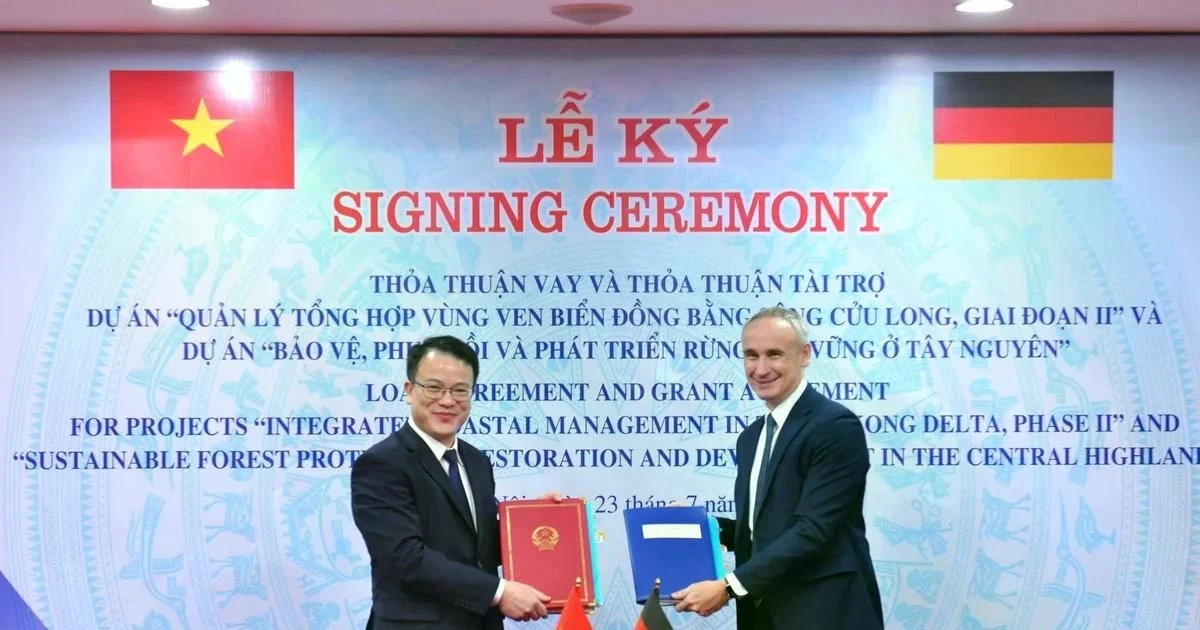
Vietnam, Germany Boost Cooperation in Climate Change Adaptation, Sustainable Forest Development
Environment
2026年7月24日
7
VietnamPlus English
Relations
🇻🇳Vietnam🇨🇳China🇯🇵Japan

General articles are free for 24 hours after publish.

Vietnam, Germany Boost Cooperation in Climate Change Adaptation, Sustainable Forest Development

Share
AI Summary

German Bundestag Vice President Bodo Ramelow visited Vietnam to discuss strengthening bilateral cooperation in climate change adaptation and sustainable forest development. German businesses expressed confidence in Vietnam's stable economy and growth prospects, anticipating expanded collaboration in sectors like IT.

German Bundestag Vice President Bodo Ramelow and his delegation visited Vietnam on June 17, holding working sessions with leaders of Hai Phong city and Quang Ninh province, and visiting Bach Mai Hospital in Hanoi. The visit aimed to further deepen cooperation between the two countries in climate change adaptation and sustainable forest development. Vice President Ramelow highlighted that German businesses operating in Vietnam consistently express satisfaction and confidence in the country's dynamic and stable economy, as well as its long-term growth prospects. This reflects the stability of Vietnam's economic policies under its one-party system and the success of efforts to attract foreign investment. The IT sector, in particular, is noted as an attractive hub for IT outsourcing due to its pool of skilled software engineers, competitive labor costs, and strong mathematical skills. Companies like FPT Software and VNG have demonstrated their competitiveness in international markets. Vietnam's National Assembly also expressed its emphasis on and desire to further strengthen cooperation with the German Bundestag. Economically, Vietnam's rice exports in June saw a significant increase, with volumes up 47.9% and values up 37.3% compared to the same period last year, indicating robust agricultural exports. Public investment disbursement has also increased against the plan, suggesting ongoing government efforts to stimulate the economy. Furthermore, Vietnam aims to complete the legal and institutional framework for an International Financial Center (IFC) in line with international standards, ensuring transparency, safety, and efficiency during the 2026-2030 period. Concurrently, an ambitious national plan aims to foster at least 10 strategic technology enterprises by 2030, each generating over $1 billion in annual revenue, employing over 5,000 workers, and investing at least 3% of annual revenue in R&D. This signifies Vietnam's aspiration to transition from a manufacturing base to an economy that prioritizes advanced technology and innovation. Regarding climate change response, Minister of Science and Technology Vu Hai Quan praised the role of the World Intellectual Property Organization (WIPO), expressing expectations for the promotion of intellectual asset commercialization. Views were also shared that advances in climate-resilient rice varieties, improved water management, digital monitoring, and carbon finance are creating opportunities for transformation in Vietnam's agricultural sector. This demonstrates Vietnam's commitment to addressing climate change challenges through science, technology, and international cooperation. Meanwhile, branded residences are playing an increasingly prominent role in Vietnam's premium property market, and Ho Chi Minh City is solidifying its position as a regional procurement hub. These developments suggest a diversification of Vietnam's economy and deepening international linkages. Source: VietnamPlus English

0

Original source

VietnamPlus English

原文を読む