Why Bees Choose Hexagonal Nests, Not Circles or Oblongs
Technology
2026年7月28日
4
Mongabay Indonesia

General articles are free for 24 hours after publish.

Why Bees Choose Hexagonal Nests, Not Circles or Oblongs

Share
AI Summary

The hexagonal structure of Indonesian honeybee nests is not accidental but is increasingly understood to be a product of natural selection and the physical properties of wax. This efficient design contributes to resource conservation and increased colony survival rates.

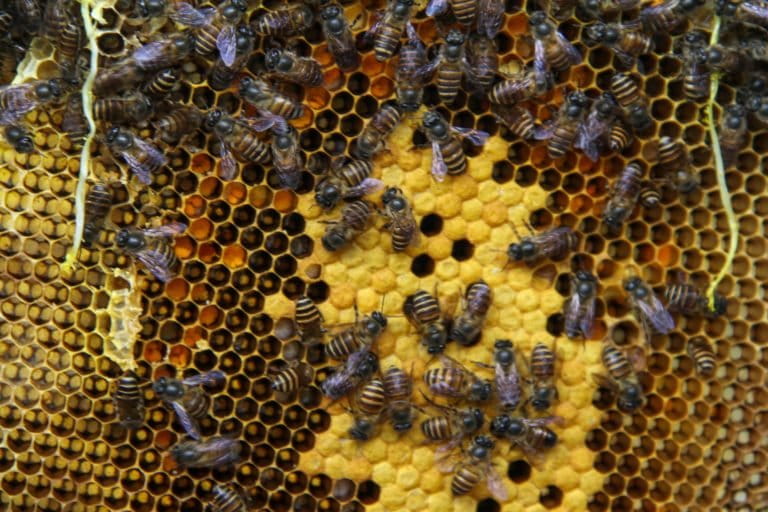
The hexagonal structure of honeybee nests, a marvel of natural architecture, has long been admired. These meticulously arranged hexagonal cells fit together seamlessly, supporting each other to form a robust structure. This intricate design often sparks questions about whether bees engineer these shapes using mathematical calculations. However, recent scientific research offers a different perspective. According to Charles Darwin's theory of evolution, the shape of bee nests is a product of natural selection. Colonies capable of building strong nests with less effort, minimal honey waste, and the most efficient use of wax have a greater chance of survival. The hexagonal shape excels in this regard, allowing for the arrangement of numerous cells without any empty space between them. However, recent scientific studies suggest that bees may not directly engineer hexagonal cells. Research by BL Karihaloo, K. Zhang, and J. Wang indicates that the initial cells are cylindrical and transform into hexagons due to the physical properties of beeswax. The heat generated by worker bees (around 45 degrees Celsius) melts the wax. When the wax at the intersection of three cells softens and flows, the originally circular walls press against each other, forming sharp angles and thus the hexagonal structure. This phenomenon is similar to what happens when a bundle of heated plastic straws, near their melting point, are pressed together and gradually form a shape resembling a hexagon. This transformation is remarkably fast. Calculations show that a cylindrical shape can change into a hexagon in as little as six seconds if the entire wax mass is heated, or approximately 36 seconds if only partially heated. Beyond purely physical factors, research also shows that bees possess the ability to adjust their nest designs when faced with imperfect construction. They can modify the inclination, size, and number of walls to ensure that new cells remain connected. These findings highlight how the efficiency and strength of bee nests are born from a clever interplay of evolutionary pressures and physical laws.

0

Original source

Mongabay Indonesia

原文を読む