General articles are free for 24 hours after publish.
Cambodia Rejects Thai Foreign Minister's Claims on Stalled Border Negotiations
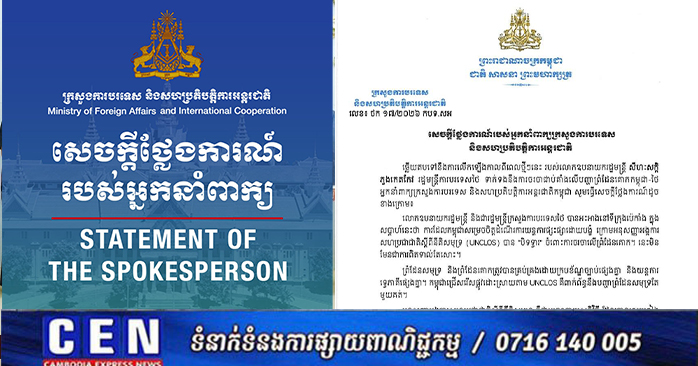
Cambodia's Ministry of Foreign Affairs spokesperson refuted Thai Foreign Minister's assertion that Cambodia's UNCLOS proceedings have "closed the door" on land border talks, stating the claims are untrue and that maritime and land border issues fall under separate legal frameworks.
The spokesperson for the Ministry of Foreign Affairs and International Cooperation of Cambodia has issued a statement refuting claims made recently by Thai Deputy Prime Minister and Foreign Minister Sihasak Phuangketkaew regarding stalled negotiations on the Cambodia-Thailand land border. In his remarks in Beijing this week, the Thai Foreign Minister asserted that Cambodia's decision to initiate a "compulsory conciliation mechanism" under the UN Convention on the Law of the Sea (UNCLOS) had "closed the door" to land border negotiations. However, Cambodia's Ministry of Foreign Affairs stated that this is not true, emphasizing that maritime and land borders are governed by different legal frameworks and bilateral mechanisms, and Cambodia's choice to pursue UNCLOS pertains solely to maritime border issues. The ministry stressed that UNCLOS is a peaceful means for resolving maritime disputes and should be treated as a guarantor of confidence, rather than causing concern for any neighboring country genuinely committed to international legal principles. It further stated that choosing a maritime solution cannot serve as a proper basis for suspending unrelated work on land border delimitation, which is already agreed upon through the Joint Commission on Land Border Demarcation, as per the Memorandum of Understanding (MOU) signed on June 14, 2000, and reaffirmed in the ceasefire agreement of December 27, 2025. Cambodia also recalled that Thailand unilaterally withdrew from the sole bilateral mechanism agreed upon for bilateral negotiations on maritime issues, despite Cambodia's direct requests not to do so. It noted that while Thailand protests Cambodia's initiation of dispute resolution under UNCLOS, Thailand itself has repeatedly shown its intention to rely on UNCLOS to resolve maritime issues. Cambodia urged Thailand to cease creating excuses for its intentional delays and return to the border demarcation process in good faith, as agreed under the terms of the 2000 MOU and the December 27, 2025 ceasefire. It asserted that there is no legal or practical reason to delay the work of the Joint Commission on Land Border Demarcation concurrently with the maritime issues under UNCLOS. This call has also been echoed internationally. On July 11, 2026, the Francophone Parliament adopted a resolution reaffirming Cambodia's sovereignty and territorial integrity, calling for de-escalation of tensions, and supporting the continuation of the border demarcation process by the Joint Commission. The international community expects Thailand to respect the 1962 and 2013 rulings of the International Court of Justice (ICJ), particularly concerning Preah Vihear Temple, and the land border demarcation in accordance with the 1904 and 1907 treaties, as acknowledged by both parties in the 2000 MOU. The indefinite postponement of land border demarcation work to permanently occupy and seize Cambodian territory illegally occupied by Thailand constitutes a serious violation of the UN Charter and the ASEAN Charter, which cannot be permitted to continue. Source: CEN Cambodia
Original source
CEN Cambodia