General articles are free for 24 hours after publish.
Cambodia Enhances Educator Training to Improve Quality, Collaborating with Universities to Boost Teacher and Administrator Capacity
Cambodia's Ministry of Education has launched professional development programs for teachers and school administrators in partnership with the Royal University of Phnom Penh. This initiative, part of the World Bank-supported GEIP-AF project, aims to enhance the quality of general education by upskilling educators nationwide.
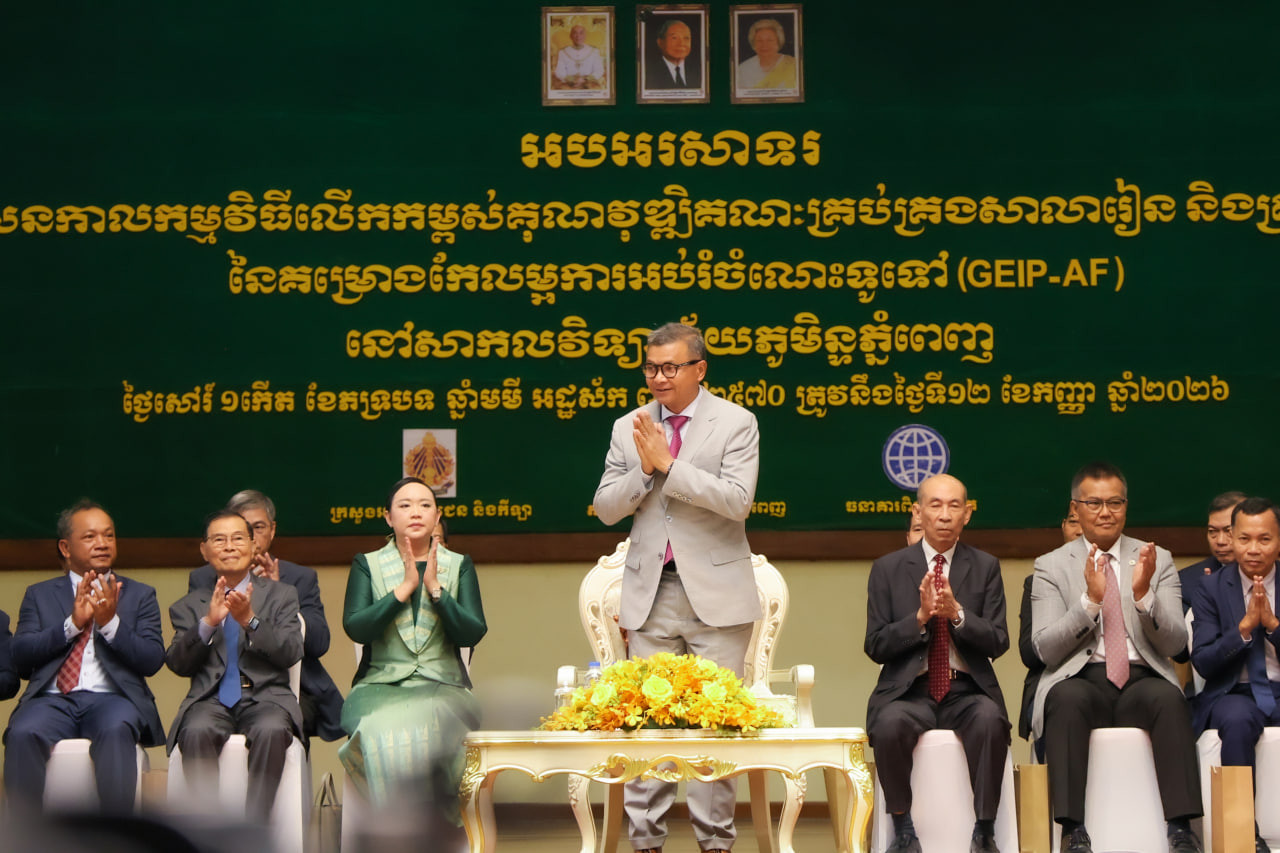
Cambodia's Ministry of Education is contributing to the improvement of general education quality through training programs aimed at enhancing the professional capabilities of educators nationwide. According to Minister Hang Chuon Naron, who also serves as Deputy Prime Minister, an agreement between the General Education Improvement Project Additional Financing (GEIP-AF) of the Ministry of Education and the Royal University of Phnom Penh (RUPP) designates RUPP's Faculty of Education as the service provider for training to strengthen the professional capacity of educational personnel across the country. The training program focuses on the School Leader Qualification Program (LUP) and the Teacher Qualification Program (TUP), targeting educational officials, master trainers, school administrators, and teachers. This initiative is being actively implemented within the framework of the General Education Improvement Project (GEIP/GEIPAF), a collaboration between the Ministry of Education, the Ministry of Economy and Finance, and the World Bank. Minister Naron made these remarks while attending the opening ceremony of the first cohort for the School Leader Qualification Program and Teacher Qualification Program under the GEIP-AF project at the Roof Building of the Royal University of Phnom Penh on September 12, 2026. He expressed pride in the successful completion of previous cohorts and noted that new training courses are ongoing for teachers and school administrators pursuing various levels of study, including Bachelor's, Master's, and Doctoral degrees. He emphasized that these achievements go beyond mere certificates, signifying shifts in mindset and leadership approaches that have led to notable successes for many target schools in meeting 'model school' standards across different educational levels. This, he stated, clearly demonstrates the genuine progress in the leadership and pedagogical competence of Cambodian educators. Furthermore, the Ministry plans to organize additional BEIP projects, leveraging the experiences and best practices from the SEIP, GEIP, and GEIP-AF projects for broader nationwide expansion. Through the GEIP-AF project, RUPP's Faculty of Education is tasked with training 200 participants for the Certificate of Higher Education in Early Childhood Education, 4,000 for the Certificate of Education for Primary Education, 600 for the Bachelor of Education for Primary Education, 1,000 for the Bachelor of School Management Qualification Program, 2,000 for the Bachelor of Teacher Professional Practice, 400 for the Master of Teacher Professional Practice, 100 for the Master of Education in the Teacher Trainer/Officer Qualification Program, and 20 for the Doctor of Education degree. For the doctoral program, the top 10 students will receive a 100% scholarship for three full years, while the next 10 highest-scoring students will self-fund their first year, with the Ministry of Education continuing to provide scholarships for the second and third years upon successful completion of the first. Minister Naron also provided key recommendations to the trainees and all stakeholders: First, all trainees should diligently study and gather new knowledge and experiences from professors and coaches to enhance their own capabilities. Second, they should directly apply the acquired knowledge and skills to school leadership and classroom teaching, aiming to achieve model school standards in their respective local schools. Third, they must maintain a spirit of cooperation, mutual support, and continuously strengthen the culture of lifelong learning to respond to the evolution of the digital society. Source: CPP Cambodia
Original source
CPP Cambodia