General articles are free for 24 hours after publish.
Bangka Island's 'Kelelak' Offers Haven for Endangered Slow Loris
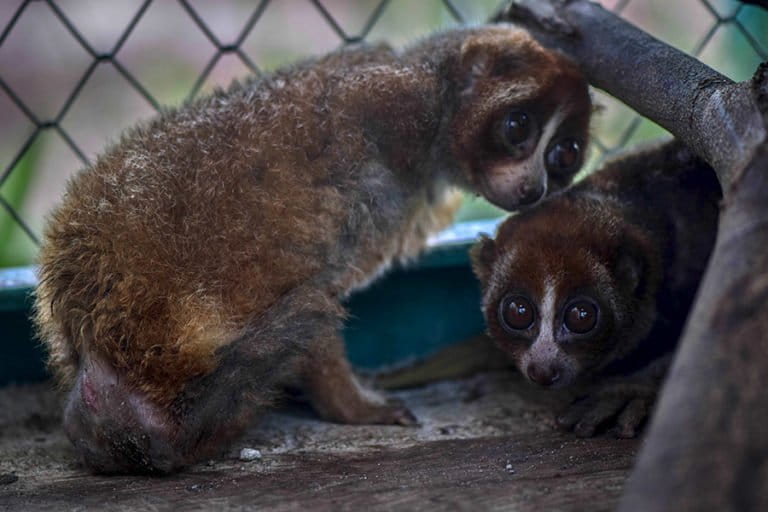
In Bangka Island, Indonesia, traditional land known as 'kelekak' is providing a crucial habitat for the endangered Bangka slow loris. However, habitat destruction due to oil palm plantations and mining poses a severe threat.
In Bangka Belitung Islands, Indonesia, a traditional land known as 'kelekak' is providing a crucial haven for the Bangka slow loris (Nycticebus bancanus), a critically endangered species. Kelekak refers to a plot of land inherited by generations, where trees yielding produce for the community grow alongside forest vegetation. Randi Syafutra, a wildlife researcher from Bangka Belitung University of Muhammadiyah, stated that within the kelekak system, communities maintain forest trees such as nyatoh, ulin, and ara. These trees form part of an environment still usable by slow lorises, whose habitats elsewhere are facing changes. During research conducted from September 2017 to November 2018, Randi found Bangka slow lorises around various types of trees, including rubber, petai, jackfruit, cempedak, banana, durian, duku, rambutan, and pelawan. "All these trees are found in kelekak," he explained. The research took place in several villages in Bangka Regency. The relationship between slow lorises and trees is not limited to their need for habitat. According to Randi, slow lorises also aid in pollination and seed dispersal of plants in nature. The animals also play a role in controlling insects that can attack productive community crops and forest plants. Thus, the presence of slow lorises is also linked to the survival of the surrounding vegetation. However, there is still no definitive data on the exact number of Bangka slow lorises living in the wild. The IUCN Red List classifies them as Critically Endangered, highlighting habitat loss due to deforestation, especially the expansion of oil palm plantations. Randi noted that the transformation of forests and kelekak into plantations, mining areas, and settlements threatens the slow loris on Bangka Island. "Generally, their population is declining and threatened due to habitat change into oil palm plantations, mining areas, and housing," he said.
Original source
Mongabay Indonesia