General articles are free for 24 hours after publish.
Malaysia's DAP to Vote on Remaining in Anwar's Unity Government
Malaysia's Democratic Action Party (DAP) will decide whether to remain in Prime Minister Anwar Ibrahim's "unity" government following poor performance in recent state elections. The party's central executive committee will convene a special national congress on August 16, where 4,000 delegates will vote on the matter.
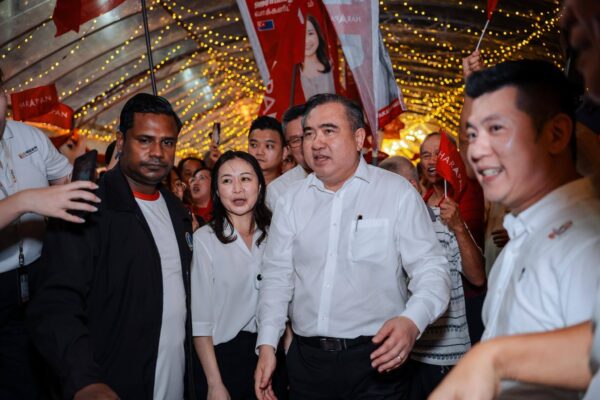
Read The Diplomat, Know The Asia-Pacific The announcement follows the Pakatan Harapan coalition’s bruising defeat in the Negeri Sembilan state election on Saturday. Anthony Loke, the secretary-general of Malaysia’s Democratic Action Party (DAP), attends a state election campaign event in Yong Peng, Johor State, Malaysia, July 3, 2026. Malaysia’s Democratic Action Party (DAP) will soon decide whether to remain in Prime Minister Anwar Ibrahim’s “unity” government, after performing poorly in a string of state elections. The DAP, which is currently the largest party in Anwar’s Pakatan Harapan (PH) coalition, holding 40 of its 77 seats in the federal parliament, has been hemorrhaging support due to the government’s perceived mishandling of corruption cases and concerns over its commitment to promised reforms. In a press conference today, the DAP’s Secretary-General Anthony Loke said that the party’s central executive committee (CEC) had decided to convene a special national congress on August 16, at which it would table a motion on whether the party should remain a part of Anwar’s administration. He said that about 4,000 DAP delegates would be given the right to decide the party’s position. “The decision will be made by the delegates, not the CEC. We will leave it to their wisdom,” Loke said, as per local media. DAP currently has five ministers and seven deputy ministers in Anwar’s cabinet. The announcement comes after PH was trounced in a state election in Negeri Sembilan on Saturday, when the coalition won just 11 of the 36 seats in the legislative assembly, down from 17 previously. The election was won by an alliance of Barisan Nasional (BN), PH’s partner at the federal level, and the pan-Malay Perikatan Nasional (PN) coalition, which collectively won 25 seats. Loke, who currently serves as minister of transport, lost his seat in the state legislative assembly, a position he had held for 13 years, prompting him to resign his post as the DAP’s chairman for Negeri Sembilan. This follows similar losses that Anwar’s coalition suffered in Johor last month and Sabah in November. While the DAP did not perform terribly in Negeri Sembilan – the party won nine of the 11 seats that it contested – it suffered more grievous setbacks in Johor and Sabah, as its predominantly urban Chinese voter base abstained or switched to other parties. The DAP, which has traditionally been associated with Malaysia’s ethnic Chinese minority but also attracts liberal and reformist voters of all races, has been impacted by the growing disillusionment with Anwar and PH. This crested last year following a string of corruption scandals, including reports of widespread misconduct at the Malaysian Anti-Corruption Commission. These have tarnished Anwar’s anti-corruption credentials and stirred up discontent among progressive supporters who since 2022 have grown frustrated with the slow implementation of promised reforms. In March, DAP announced that it would “evaluate its position” in the governing coalition for the next general election, due to its disappointment with the government’s approach to corruption and the difficulty of being forced to defend the compromises made by PH after striking an unlikely alliance with BN after the general election of 2022. In any event, the result in Negeri Sembilan has raised questions about the future of the DAP, with some Malaysian analysts suggesting that Loke, who has generally been known as a pragmatist who is willing to play the coalition game, could be challenged or eclipsed by more assertive reformists within the party. DAP national Chairman Gobind Singh Deo said on Sunday that the party accepted the result in Negeri Sembilan “with full humility,” the South China Morning Post reported. “The message from the electorate is clear,” he said. “We must and will undertake a thorough assessment of the outcome, listen carefully to the concerns of the people, and work hard to regain their confidence and support.” While the DAP says that it will continue to support PH, its defection would obviously further complicate Anwar’s political position, which is under threat from an incipient pan-Malay pact between BN and PN. As I noted yesterday, Saturday’s election in Negeri Sembilan witnessed close cooperation between the two coalitions, particularly between two of their largest respective constituent parties, the United Malays National Organization (UMNO) and the Islamist PAS. If it holds and coheres, this alliance could prove decisive at the next general election, which must be held by early 2028, but could be called earlier. Anwar has previously said that he may call a snap election if the tensions between PH and BN, which remain federal partners even as they engage in bruising contests at the state level, becomes too difficult to manage. Subscribe today and join thousands of diplomats, analysts, policy professionals and business readers who rely on The Diplomat for expert Asia-Pacific coverage. Get unlimited access to in-depth analysis you won't find anywhere else, from South China Sea tensions to ASEAN diplomacy to India-Pakistan relations. More than 5,000 articles a year. Already have an account? Log in. Sebastian Strangio is Southeast Asia editor at The Diplomat. Get briefed on the story of the week, and developing stories to watch across the Asia-Pacific.
Original source
The Diplomat Indonesia