Thai Border Fortifications Prevent Return of Displaced Cambodian Families
Diplomacy
2026年7月10日
5
Phnom Penh Post
Relations
🇰🇭Cambodia🇹🇭Thailand

Thai Border Fortifications Prevent Return of Displaced Cambodian Families

AI サマリー

Nearly a year after border conflict, dozens of Cambodian families in Pursat remain displaced due to Thai military containers and razor-wire fortifications. Residents appeal for a peaceful resolution and the return of their land, unable to return to their homes and livelihoods.

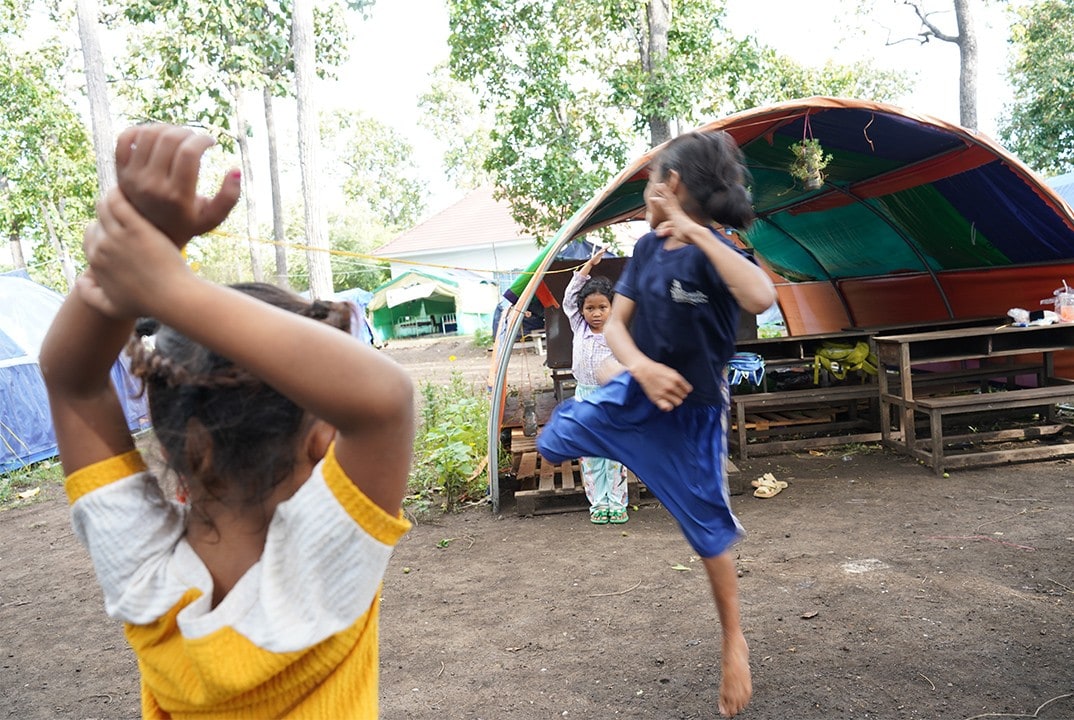
Every morning, children weave through rows of blue tarpaulin shelters, their laughter echoing across a displacement camp that has become an unlikely neighbourhood. For the children, life has adapted to the camp. For their parents, however, every day begins with the same hope: returning home. Nearly a year after fighting along the Cambodia-Thailand border forced thousands to flee western Cambodia, dozens of families in Pursat province remain displaced. Despite the ceasefire of last December, they say Thai military containers and razor-wire fortifications near their villages continue to prevent them from returning to their homes, farms and livelihoods. As of June 16, Pursat provincial authorities recorded 69 displaced families with 203 members at two evacuation centres in Pramuoy commune, Veal Veng district. Among them are 104 women and 53 children under the age of 15. Hun Sen Pramuoy High School accommodates 61 families, totalling 170 people, while another eight families, comprising 33 people, remain at Pramuoy Pagoda. The shelters, originally intended as temporary accommodation, have gradually become semi-permanent homes. Among those still waiting is Sam Sary, whose family lived in one of the homes closest to the Thai military’s newly installed razor wire barricades, in Thmar Da commune. She said her family fled during the fighting and later returned briefly, only to discover their house damaged and many belongings missing. “Because the razor wire is now so close to our house, we no longer feel safe. We never know what could happen,” she said. Sary explained that all she wants is for both governments to reach a solution that allows civilians to resume normal lives. “I appeal to both the Cambodian and Thai governments to resolve this as quickly as possible so ordinary people can return home and earn a living again,” she said. She also urged ASEAN and the international community to help restore peace. “We ask ASEAN and the international community to help Cambodia and Thailand resolve this quickly. This is Cambodian land and we simply want to live peacefully again,” she added. Recalling her first visit home after the evacuation, Sary became emotional. “When I came back after 72 hours, I cried. Seeing my house damaged and my belongings gone, I felt like I had lost everything,” she said. The situation has already drawn international attention. On March 27, Minister of Foreign Affairs and International Cooperation Prak Sokhonn led diplomatic staff and representatives of international organisations on a field visit to Thmar Da commune, where they met displaced civilians and witnessed Thai fortifications. During the visit, Sokhonn reiterated that Cambodia remains committed to resolving the border dispute peacefully through international law, existing bilateral agreements and established mechanisms, while rejecting any attempt to alter recognised boundaries through force. Yet for villagers, diplomacy has so far brought little change. Yong Raem, who has lived in Thmar Da since 1999, said the landscape has changed dramatically since Thai troops established containers and razor wire barricades after the ceasefire. “Before, people lived there with rubber plantations, durian orchards and farms. Many families had large houses. Around half the residents still cannot return,” she said. Some displaced families remain in camps, while others rent accommodation or stay with relatives. She acknowledged that fear has become part of daily life. “We live in fear day and night. Before, we still had work and some income. Now there is nothing. Our income has dropped to zero,” she said. According to Raem, Thai troops moved deeper into the area only after the ceasefire came into effect. “They entered after the ceasefire. Even though the shooting stopped, the encroachment continued,” she said. The conflict has also reshaped childhood. Nine-year-old Mach Rasmey, now studying Grade Three in the camp, said he misses his home. “I miss my house, my school and my relatives. I haven’t seen them for a long time,” he told The Post. When asked what he would do if allowed to return tomorrow, his answer was immediate. “I want to raise chickens and ducks again, plant crops and go back to school,” he said. Although he now attends three classes each day at the camp, he said life there is incomplete. “Here I can study, but I can’t farm or do anything else. At home we had land, crops and animals,” he explained. When asked what prevents his family from returning, he replied: “Thailand has surrounded our home.” Consequences span generations. Not far from the displacement camp stands another reminder of the conflict’s consequences. The once-important Chey Chumnas Bridge remains shattered, with twisted steel bars protruding, where traffic once crossed freely. Thai military containers and barbed-wire fortifications continue to dominate parts of the frontier. For 60-year-old Li Mao, displacement has meant losing far more than a house. Before the conflict, she earned a living growing vegetables, bananas and sugarcane, selling produce daily to support her family. “Without land, we have no income. Living on someone else’s land is never the same as living on your own,” she said. She now survives on occasional labour work earning around 30,000 riel a day, barely enough to cover daily expenses. Like many others in the camp, her request is simple. “We want our land back. If the containers are removed and we regain our land, we can rebuild our homes and farm again,” she said. As children continue playing beneath blue tarpaulins, the adults remain caught between a ceasefire and a home they still cannot reach. Nearly a year after fleeing, they say they are no longer simply waiting for peace. They are waiting to go home.

多角的分析

経済的影響

タイ軍による国境封鎖は、カンボジア側の農作物や家畜の生産・販売活動を直接的に阻害し、住民の主要な収入源を断っている。これにより、地域経済は停滞し、避難民の生活は困窮を極めている。長期化すれば、地域全体の経済的自立を損なうだけでなく、食料安全保障にも影響を与える可能性がある。復興には、インフラ整備と並行して、失われた生産活動の再開支援が不可欠となる。

投資家心理

国境地帯における軍事的な緊張と、それに伴う住民の避難生活は、投資家にとって直接的なリスク要因となる。特に、農業や林業、観光業など、国境付近で事業を展開する企業は、操業停止やサプライチェーンの寸断、労働力不足に直面する可能性がある。タイとの関係改善や紛争終結の見通しが立たない限り、この地域の新規投資は消極的にならざるを得ず、既存投資家も慎重な姿勢を崩せないだろう。

社会的影響

タイ軍による国境封鎖は、ポル・ポト州の住民の生活基盤を根底から覆している。自宅や農地に戻れないだけでなく、収入源を失い、避難キャンプでの生活を強いられている。子供たちの教育機会も限定的であり、精神的なストレスも大きい。住民は土地の返還と平和な生活の回復を強く願っており、この問題の長期化は、社会的な不安定化を招くリスクを孕んでいる。

市民の声

国境封鎖により、ポル・ポト州の住民は、文字通り「家」と「生計」を失っている。停戦しても、タイ軍のコンテナや有刺鉄線が故郷への道を塞いでいるため、安心して帰ることができない。子供たちはキャンプで教育を受けているが、本来の生活とはかけ離れている。住民たちは、土地を取り戻し、再び農業や商売ができるようになることを切に願っている。国際社会からの支援だけでなく、両国政府による早期かつ実質的な解決が強く求められている。

背景・歴史的文脈

カンボジアとタイの国境紛争は、過去にも断続的に発生している。特に、2008年から2011年にかけて、プレアビヒア寺院周辺で両国軍が衝突し、多くの住民が避難を余儀なくされた。今回のポル・ポト州での問題も、こうした歴史的背景と無関係ではない。国境線の確定が曖昧な地域が存在すること、そして両国間の政治的・経済的な駆け引きが、紛争の火種となりやすい構造があると考えられる。停戦合意後もタイ軍が国境付近にコンテナや有刺鉄線を設置し、実効支配を広げようとする動きは、カンボジアの領土保全に対する懸念を深めている。

原文ソース

Phnom Penh Post

原文を読む