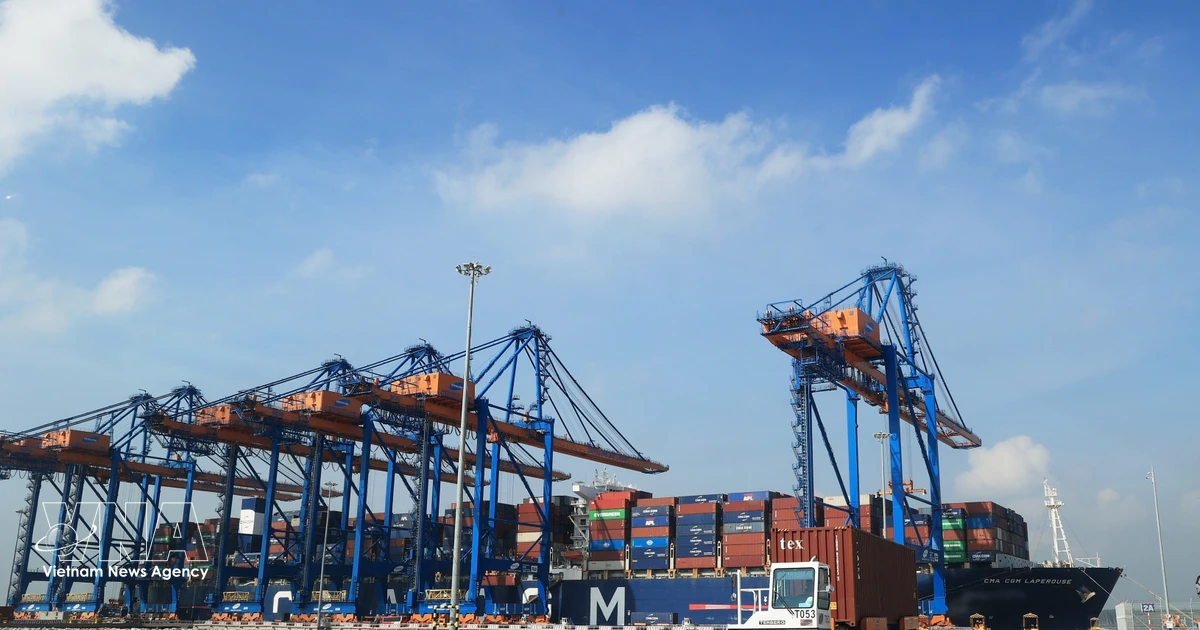
Vietnam's Economy Faces Macroeconomic Balancing Act Amid Strong Growth
Economy
2026年8月3日
5
VietnamPlus English

General articles are free for 24 hours after publish.

Vietnam's Economy Faces Macroeconomic Balancing Act Amid Strong Growth

Share
AI Summary

Vietnam's economy is experiencing strong export growth, fueled by free trade agreements like the CPTPP and EVFTA. However, maintaining macroeconomic balance, including inflation and financial stability, presents a significant challenge. Experts emphasize the necessity of institutional reforms and quality investment for sustained growth.

Vietnam's economy is currently grappling with the challenge of maintaining macroeconomic stability amidst impressive growth. Driven by new-generation free trade agreements (FTAs) such as the CPTPP and EVFTA, key sectors like textiles, footwear, and agricultural, forestry, and fishery products are experiencing robust export growth. The CPTPP has significantly expanded Vietnam's market access to North America, the EU, and the Asia-Pacific, acting as a major export driver. It has also encouraged investment into Vietnam by promoting regional production networks and clearer rules of origin. The EVFTA, meanwhile, underscores the rapid acceleration of economic integration once market access barriers were removed, with nearly half of all EU-Vietnam trade over the past three decades occurring under this agreement. The business landscape in 2025 indicates that the enterprise sector continued to demonstrate resilience amid fluctuations in both domestic and international business environments. However, experts caution that the figures recorded in the first half of 2026 reflect only positive short-term results. Long-term success will depend not only on the growth pace but also on the quality and resilience of the economy and the sustainability of its growth engines. Deputy Minister of Industry and Trade Nguyen Sinh Nhat Tan projects that Vietnam's total trade may exceed $1 trillion USD in 2026, supported by the effective utilization of FTAs. This suggests Vietnam's increasing importance in global supply chains. However, inflationary pressures and currency exchange rate fluctuations remain concerns for economic stability. The current trading band of +/- 5% sets the ceiling rate for commercial banks at 26,626 VND/USD and the floor rate at 24,090 VND/USD. For sustained growth, experts emphasize the need to create institutions, funding channels, and support systems that allow businesses to develop at different stages. Achieving the target of 2 million active enterprises by 2030 would then signify not just a numerical milestone, but the emergence of a more resilient engine of growth. Furthermore, Dutch businesses have welcomed Vietnam's reform agenda and expressed strong interest in expanding collaboration in areas such as finance, international financial services, semiconductors, artificial intelligence, logistics, ports, shipbuilding, water management, renewable energy, and green transition. This indicates Vietnam's efforts to deepen international cooperation and explore new avenues for economic development. Vietnam's agricultural exports reached $36 billion USD in the first half of 2026, up 6% year-on-year. While overall growth remained below the government's double-digit target, several products showed strong performance and significant export potential. The biggest risk facing the real estate market is liquidity, while the biggest risk associated with technology lies with its users. Technology can only deliver its full value when it addresses practical market and human needs. Central Retail Vietnam plans to continue investing in its supermarket network and increase the share of Vietnamese products in its distribution system. The group will also deepen support for farmers, cooperatives, and producers across the supply chain, from cultivation and harvesting to packaging and product standardization. Copyright, VietnamPlus, Vietnam News Agency (VNA)

0

Original source

VietnamPlus English

原文を読む