General articles are free for 24 hours after publish.
China Blasts Philippine Vessels with Water Cannons Anew Amid South China Sea Tensions
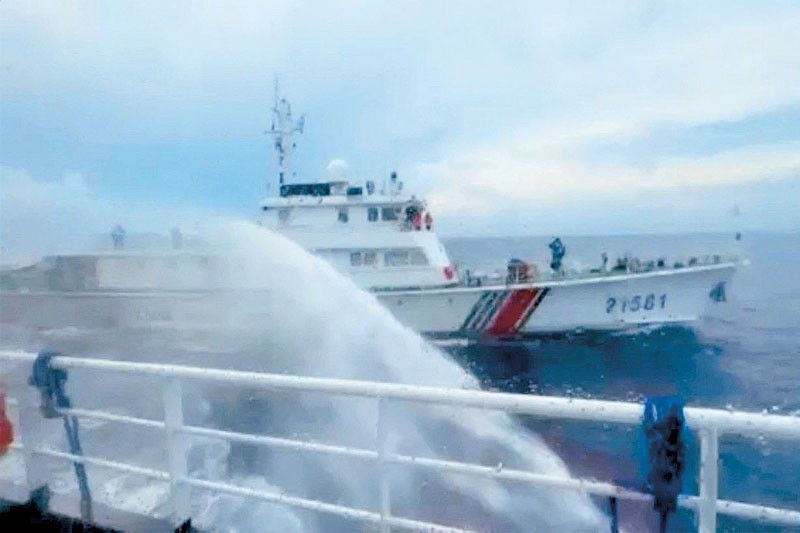
China Coast Guard (CCG) vessels again used water cannons against Philippine Coast Guard (PCG) and Bureau of Fisheries and Aquatic Resources (BFAR) ships assisting Filipino fisherfolk near Scarborough Shoal (Panatag Shoal). The Philippines condemned China's actions, raising concerns over escalating tensions in the South China Sea.
MANILA, Philippines — China again blasted yesterday with water cannon vessels of the Philippine Coast Guard and Bureau of Fisheries and Aquatic Resources (BFAR) that were assisting Filipino fisherfolk in Panatag (Scarborough) Shoal. According to the PCG, the vessels were supporting the Kadiwa ng Bagong Bayaning Mangingisda program by providing fuel subsidies and other assistance to fisherfolk in the vicinity of Panatag Shoal. A China Coast Guard (CCG) vessel, with bow number 3107, initially blasted its water cannon at the BRP Cape San Agustin at 6:26 a.m. during a maritime patrol. “Prior to the incident, (Cape San Agustin) was being shadowed by no fewer than six CCG vessels, alongside Chinese maritime militia vessels operating in the area,” PCG spokesman for the West Philippine Sea Rear Admiral Jay Tarriela said. Tarriela said at 7:35 a.m., another CCG vessel directed its water cannon and fired at BFAR’s BRP Datu Paduhinog during its patrol of the shoal. The Chinese vessel came within approximately seven meters of the port bow of the Datu Paduhinog, risking a collision, he said. “It is worth noting that the CCG vessel had deliberately switched off its Automatic Identification System, concealing its identity in violation of international regulations on safety of navigation,” Tarriela said. After 18 minutes, the PCG reported the Datu Paduhinog was directly hit by CCG 21581’s water cannon, followed by two more direct attacks at around 8 a.m. Another water cannon was fired at BRP Datu Cabaylo from approximately 300 meters, according to the PCG. It also monitored Chinese maritime militia vessel 00318 pulling a rope approximately 100 meters at the rear of BRP Datu Sumakwel, posing a hazard to its navigation. Up to 10 Philippine ships stood against 15 CCG and maritime militia vessels, the PCG noted. Tarriela said the Philippine vessels maintained their presence in the area to continue their operations despite the “illegal, coercive, aggressive and deceptive actions” of China. “The PCG strongly condemns the dangerous and unprofessional actions of the China Coast Guard,” he said. United States Secretary of State Marco Rubio said a US Coast Guard vessel was in the region during the July 20 baton attack at Ayungin Shoal and helped the injured Philippine Navy personnel. “(A) US Coast Guard vessel… actually helped stand between the two sides and allowed the individual who was injured to be rescued and brought back for medical treatment,” Rubio said to media on Thursday. “So we’re already here, we’re already present, we have a role and we’re not going to abandon our allies,” he said. Rubio said the US will live by the Mutual Defense Treaty with the Philippines, and Washington is committed to supporting its treaty partners. The US condemned China’s “dangerous” and “aggressive” actions after CCG crew struck and wounded a Philippine Navy personnel stationed on the BRP Sierra Madre in Ayungin Shoal on Monday, calling Beijing’s pattern of provocation “troubling.” The Association of Southeast Asian Nations (ASEAN) and China are making significant progress toward concluding a Code of Code in the South China Sea by the end of the year, Foreign Affairs Secretary Ma. Theresa Lazaro said. She said discussions on the South China Sea focused on advancing negotiations on the COC, with the 11 member-states of ASEAN and China demonstrating the political will to complete the agreement within the year. “On the South China Sea, what was given attention is the code of conduct that ASEAN and China are geared towards… hopefully the conclusion of the code of conduct,” Lazaro said at a press conference following the four-day 59th ASEAN Foreign Ministers’ Meeting (AMM) and Related Meetings on Thursday. A regional code of conduct aims to prevent conflicting territorial claims in the South China Sea from erupting into violent confrontations. Lazaro, who chaired this year’s AMM, said negotiations have accelerated with meetings every month since January. “And this is now part of the political will that we intend to finish this code of conduct by the end of the year,” she added. Lazaro said one of the key areas of progress is the growing consensus on the principle of self-restraint, which forms part of the agreement’s terms of reference. Negotiations have also continued on the COC’s geographical scope, legal nature and its relationship with the 2002 Declaration on the Conduct of Parties in the South China Sea. Lazaro stressed that the proposed COC remains anchored on the 1982 United Nations Convention on the Law of the Sea (UNCLOS), respects the rights of third parties and seeks to establish rules governing conduct and behavior at sea.- Pia Lee-Brago, Bella Cariaso
Original source
Philstar Nation