General articles are free for 24 hours after publish.
BIR Audits: What Triggers Them and How to Respond
The Bureau of Internal Revenue (BIR) in the Philippines is implementing risk-based selection criteria for business audits. Even compliant businesses can be audited, not necessarily due to suspected wrongdoing, but as a "question" requiring record-based explanations, according to experts.
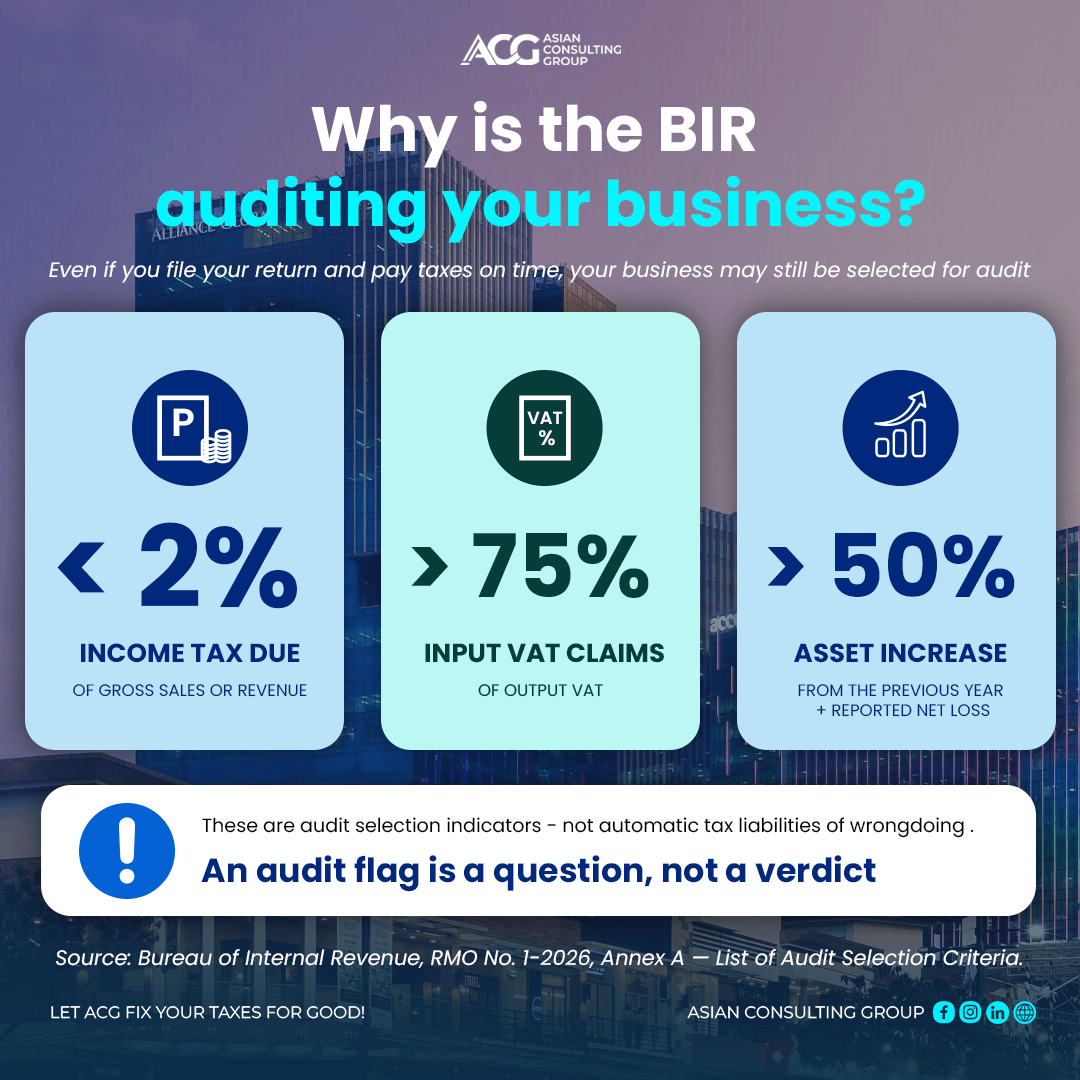
In this first installment of a three-part series, the Philippine Tax Whiz explains why compliant businesses can still be selected for audit, what the BIR’s financial indicators mean, and how taxpayers can respond without compromising their integrity. 1. I filed my returns and paid my taxes. Why is the BIR still auditing my business? Filing and paying on time does not automatically exempt your business from an audit. But receiving an audit notice does not mean the Bureau of Internal Revenue (BIR) has caught you cheating, either. Revenue Memorandum Order (RMO) No. 22-2026 sets out selection criteria that include certain transactions, discrepancies, and financial indicators—even when there may be a legitimate explanation. Think of an audit flag as a question, not a verdict. Your records should help answer it. 2. Businesses have always been audited. What changes under this program? The order consolidates earlier reforms, including risk-based selection, digital case records, anonymized assignment of cases, and the Single-Instance Audit Framework. Generally, one electronic Letter of Authority, or eLA, should cover all applicable internal revenue tax types for one taxable year, subject to the rules and exceptions. For business owners, the goal is fewer fragmented or duplicate audits. It does not mean you can never receive a replacement authority or be audited for another year. 3. How was my business selected? Is it just random? The order distinguishes mandatory cases from priority cases. Mandatory cases arise from specified circumstances, including certain refund claims, validated discrepancies, and indicators of substantial underdeclaration. They require approval by the appropriate Regional Director or Large Taxpayer Service authority, generally without prior approval by the BIR commissioner. Priority cases generally undergo system-assisted selection using risk criteria, with centralized approval by the Commissioner. In practical terms, a business claiming a refund and one flagged for possible underreporting may both face examination—but for different reasons. Understanding that reason helps you prepare the right records and explanation. 4. What numbers in my returns could put my business on the audit list? Among the priority indicators are: Income tax due below 2% of gross sales or revenues. Input Value-Added Tax (VAT) claims exceeding 75% of output VAT. Assets increasing by more than 50% from the previous year while the business reports a net loss. Other indicators include a drastic decline in sales or VAT payments, substantial sales with a net loss, discrepancies in VAT carryovers, and operating for more than five years from inception without an audit. These are selection criteria—not new tax rates or automatic findings that you owe more. 5. Does the 2% indicator mean I must pay income tax equal to 2% of my sales? No. The indicator is not a minimum payment requirement. Suppose your annual sales are ₱10 million and your income tax due is ₱150,000. That is 1.5%, below the indicator. It does not automatically mean you owe another ₱50,000. Your correct tax still depends on the applicable law, taxable income, allowable deductions, and other relevant circumstances. A business can have substantial sales but thin margins. The important question is whether its records support the figures—not whether it can pay extra just to reach the indicator. 6. I bought inventory or equipment. Should I worry about having high input VAT? Not automatically. A high input VAT ratio may have a legitimate business explanation. If your output VAT is ₱120,000 and your input VAT claimed is ₱96,000, the ratio is 80%. That exceeds the indicator, but it does not impose a 75% cap or automatically disallow ₱6,000. Inventory buildup or equipment purchases may explain the amount, subject to the rules on creditable input VAT and proper documentation. The practical question is: Can you substantiate the purchases and explain why your input VAT is high? Risk scoring should prompt that examination, not replace it. 7. My business enjoys tax incentives. Does that automatically make us an audit target? No. The order includes taxpayers enjoying exemptions or incentives among mandatory-case categories, but expressly states that they are not automatically subject to audit. Selection and validation must be supported by applicable criteria, verifiable data, or indicators of noncompliance. An incentive legally granted to your business should not, by itself, be treated as evidence of wrongdoing. Investors deserve predictable rules, and taxpayers deserve an examination based on evidence. 8. What should I do if an audit notice arrives—and will “settling” with the examiner prevent another audit? Start by understanding the authority and scope of the audit. Organize your records, reconcile your returns, and address discrepancies with supporting documents and qualified advice. Be clear about what “settling” means. Paying a properly established tax liability through official channels is very different from handing money to an examiner to make a problem disappear. No matter how diligently you file and pay, bribing an examiner does not buy protection from the next audit. It can keep your business trapped in a cycle of unofficial demands while leaving the underlying issues unresolved. An annual tax review can help identify gaps before a notice arrives. If an audit is already underway, the goal should be to manage it through clear documentation, sound advice, and negotiation without compromises or under the table. Businesses looking for guidance on either can learn more at www.acg.ph. Put your records in order. Keep your integrity intact. An audit should be resolved through evidence, not an envelope. – Rappler.com Mon Abrea, CPA, MBA, MPA (Harvard) is a global tax policy expert and Chief Tax Advisor of Asian Consulting Group (ACGlobal). He advises governments, multinational enterprises, and international organizations on tax policy, investment competitiveness, and fiscal reform. He is the author of Reimagining the World Without Corruption and Why Invest in the Philippines? CREATE MORE Edition, and has represented the Philippines in policy dialogues at the OECD, World Bank, and other international forums. Below are some related Ask the Tax Whiz columns on this issue:
Original source
Rappler Business