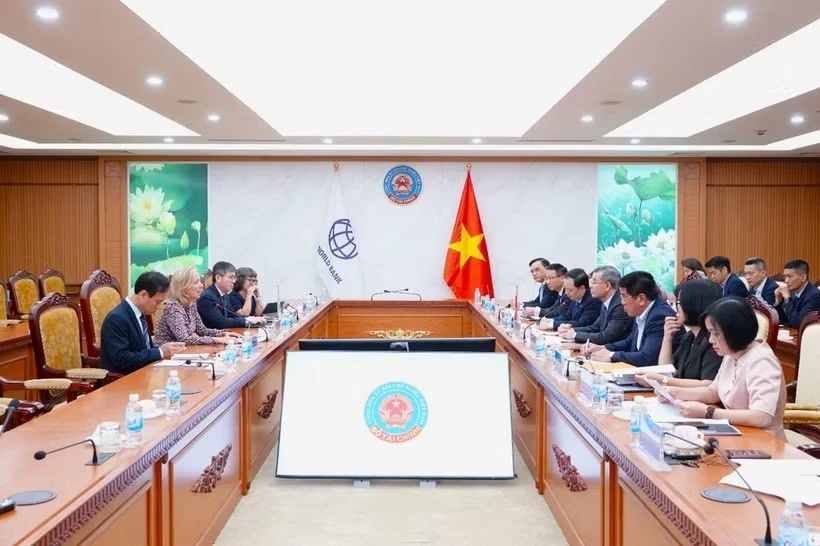
Vietnam, World Bank Prepare 2026-2030 Lending Project Pipeline
Business
2026年7月29日
4
VietnamPlus English

General articles are free for 24 hours after publish.

Vietnam, World Bank Prepare 2026-2030 Lending Project Pipeline

Share
AI Summary

Vietnam's Ministry of Finance and the World Bank are preparing a lending project pipeline for 2026-2030, seeking support for water security, dam safety, and climate adaptation. Vietnam has reached upper-middle-income status and aims for sustainable economic growth.

The Vietnamese Ministry of Finance and the World Bank are preparing a lending project pipeline for the period 2026–2030, marking a significant step in deepening international cooperation and ensuring sustainable economic growth. Vietnam hopes to receive support in accessing concessional financing, particularly from the World Bank, for research programs and investment projects related to water security, dam and reservoir safety, and climate adaptation, Deputy Prime Minister Ho Quoc Dung stated. These areas are considered crucial for the nation's sustainable development. According to the World Bank's latest update, Vietnam's gross national income (GNI) per capita reached $4,970 in 2025, exceeding the institution's threshold of $4,636 for upper-middle-income economies. This figure reflects the steady growth of the Vietnamese economy. Alongside economic expansion, Vietnam is prioritizing environmental conservation. The introduction of Decree No. 180 on forest carbon sequestration and storage services is a prime example. The latest transaction in this area generated $56.5 million in revenue from the transfer of 11.3 million tonnes of CO2 emission reductions at a price of $5 per tonne, demonstrating Vietnam's commitment to balancing climate action with economic benefits. Furthermore, Vietnam is actively engaging within the World Trade Organization (WTO) framework to enhance its competitiveness in international trade. Efforts include ratifying the first phase of the Agreement on Fisheries Subsidies, negotiating entry into the expanded Information Technology Agreement (ITA2), and preparing for its next Trade Policy Review scheduled for late 2026. These initiatives aim to strengthen Vietnam's role in global supply chains and promote adherence to international standards. The importance of foreign direct investment (FDI) in driving economic growth is also being re-emphasized. Resolution No. 10-NQ/TW, issued by the Politburo in 2026, identifies FDI as "an important component of the national economy" and "a key driver of economic development and international integration." A transparent legal environment coupled with attractive incentives is expected to attract a new wave of investment, transforming the marine economy into a primary engine for Vietnam's double-digit growth ambition. Vietnam's economic narrative for 2026 is not solely about faster GDP growth but also encompasses higher productivity, industrial upgrading, stronger capital formation, and a more prominent role in Asia's strategic economic landscape. Strategies revolving around investment in integrated logistics infrastructure, multimodal transport expansion, and digital transformation acceleration are intended to reduce logistics costs, enhance competitiveness, and support sustainable growth in external trade.

0

Original source

VietnamPlus English

原文を読む