General articles are free for 24 hours after publish.
New Frog Species Discovered on Indonesia's Mount Merapi, Identified by Distinct 'Click' Sound
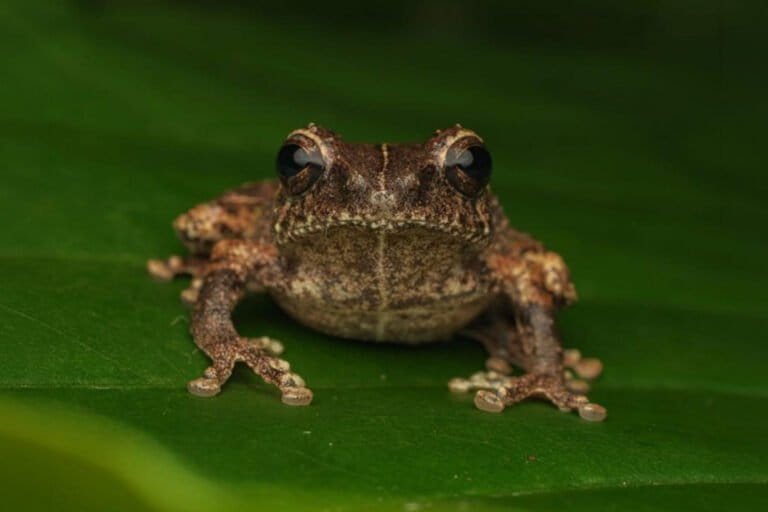
A new frog species, Philautus candrageni, measuring about two centimeters, has been discovered on Indonesia's Mount Merapi. Its distinct short, high-pitched 'click' sound was instrumental in differentiating it from existing species. This finding highlights Indonesia's rich biodiversity and underscores the importance of future conservation efforts.
A new frog species, measuring approximately two centimeters, has been discovered on Indonesia's Mount Merapi. This tiny amphibian, characterized by its distinct short, high-pitched 'click' sound, has been named Philautus candrageni. The discovery was made serendipitously by a research team from the National Research and Innovation Agency (BRIN), several universities, and the Herpetological Society of Indonesia during a review of the taxonomy of the frog genus Philautus on Java Island. The team employed an integrative approach, combining morphological characteristics, sound recordings, and molecular analysis. Field research was conducted in Central Java from 2017 to 2025, covering Mount Ungaran, Mount Merapi, and the Menoreh Mountains. Initially, 32 individuals were identified as the existing species Philautus aurifasciatus. However, phylogenetic and morphological analyses revealed that the findings comprised P. aurifasciatus, P. jacobsoni, and one undescribed taxon from Mount Merapi. Sound recordings further solidified the distinctions. The mating call of P. candrageni is short, has a relatively high frequency, and typically consists of a single note, with short intervals between calls, resulting in a rapid tempo. These characteristics differ from the calls of P. aurifasciatus and P. pallidipes. This discovery brings the total number of Philautus species in Java to four. The other three are P. jacobsoni from Mount Ungaran, P. pallidipes from Mount Gede Pangrango, and P. aurifasciatus from Mount Tangkuban. Notably, P. pallidipes and P. jacobsoni have not been sighted for a long time, with P. jacobsoni even feared to be extinct in the wild. The name 'candrageni' is derived from the ancient name for Mount Merapi in the classical Javanese manuscript Serat Pustaka Raja Purwa. This finding underscores the rich biodiversity of Indonesia, particularly within unique ecosystems like volcanic regions, and highlights the ongoing importance of scientific exploration for conservation.
Original source
Mongabay Indonesia