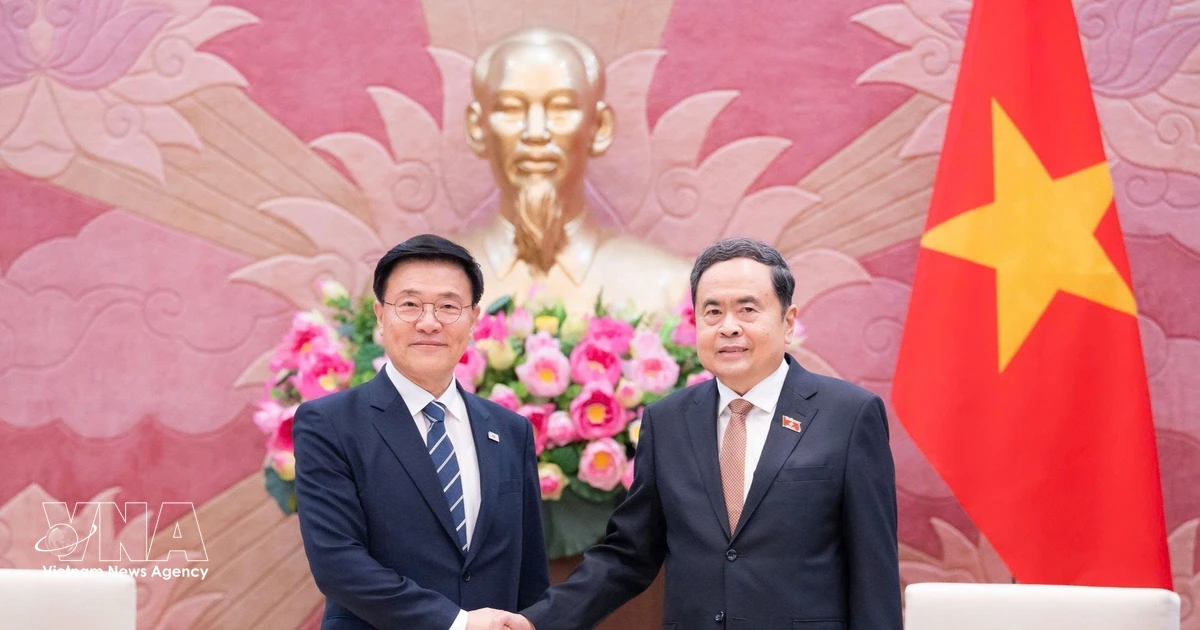
Vietnam Eyes RoK's Innovation Experience for AI, Semiconductor Cooperation
Vietnamese Prime Minister Le Minh Hung expressed expectations for achieving bilateral trade targets with South Korea (RoK) and strengthening cooperation in AI and semiconductors. Korean universities aim to train specialized human resources in collaboration with Vietnam, anticipating accelerated technological innovation and economic growth.
Prime Minister Le Minh Hung has highlighted Vietnam's keen interest in leveraging the innovation experience of the Republic of Korea (RoK) to bolster bilateral cooperation, particularly in the fields of artificial intelligence (AI) and semiconductors. During discussions, PM Hung urged both nations to continue promoting high-level exchanges and to broaden defense and security cooperation. He emphasized the importance of achieving the bilateral trade target of $100 billion by 2026 and $150 billion by 2030 in a balanced and sustainable manner. Sung Eun-hyun, Vice President of Hoseo University in South Korea, stated that her institution is transforming into a specialized training hub for semiconductors and AI. The university is actively seeking to expand cooperation with Vietnamese universities and colleges, aligning with Vietnam's strategic goals for digital economic development and human resource cultivation in advanced technology sectors. Both sides concurred that in the rapidly evolving global media landscape reshaped by digital technology and AI, increased exchanges of information, management know-how, and professional practices among journalism associations are critical for the development of the press in each country. Furthermore, PM Hung called on Canada to widen its market access for Vietnamese goods, especially agro-forestry-fishery products. He also stressed the need for enhanced cooperation in training a skilled workforce in emerging technologies such as AI, quantum technology, and semiconductors. This initiative is crucial for Vietnam's efforts to diversify its economy and elevate its position in global value chains. Vietnam consistently offers full support to foreign investors, including those from Australia, for long-term business operations. This reflects the country's ongoing commitment to attracting foreign investment as a key driver of economic growth. Within the Vietnamese political landscape, a leader chairing the fifth conference of the National Assembly Party Committee stressed the necessity for the committee to continuously improve its leadership capacity to meet the increasingly demanding tasks set for 2026 and throughout the current tenure. This underscores the focus on strengthening governance within Vietnam's one-party system while simultaneously driving economic advancement. In Hanoi, the unveiling of a master plan was described not merely as a development blueprint but as a strong message of action, demonstrating the city's determination to translate the resolutions of the 14th National Party Congress and the 18th Hanoi Party Congress into reality, in line with Party General Secretary and State President To Lam’s directive for swift, correct, effective, and thorough implementation. Emphasis was also placed on strengthening coordination among Party diplomacy, State diplomacy, and people-to-people diplomacy. This approach highlights Vietnam's strategic view of diplomacy as a means to directly create new opportunities, conditions, and drivers for development, moving beyond mere expansion of relations or resource attraction. Vietnam's two-tier local administration model is expected to yield increasingly positive results for both the State and its citizens, driven by continuous institutional improvements, more effective resource allocation, optimal placement of officials, and further advancements in digital transformation. The awarding of the UN peacekeeping medal to all 63 members of a Vietnamese hospital unit serving in a UN peacekeeping mission was recognized as a significant source of pride, acknowledging their dedication and contribution. This highlights Vietnam's commitment to international peace and security. Information Source: VietnamPlus English
多角的分析
ベトナムは、AIや半導体といった先端技術分野への投資を加速させることで、経済成長の新たなエンジンを模索している。韓国との協力強化は、技術移転や人材育成を通じて、ベトナムの産業構造高度化に寄与すると考えられる。特に、グローバルバリューチェーンにおけるベトナムの地位向上と、輸出依存型経済からの脱却を目指す上で、これらの分野の発展は不可欠である。貿易目標の引き上げは、両国間の経済関係の深化を示すものだが、持続可能な成長のためには、国内産業の育成と技術力の向上が鍵となる。
ベトナムは、AIや半導体分野への投資を誘致し、技術革新を推進することで、外国からの直接投資(FDI)をさらに引きつけようとしている。韓国の大学との提携は、高度な専門人材の育成を約束するものであり、これは長期的な投資環境の安定化に繋がる。PM Le Minh Hungの発言は、外国投資家に対するベトナム政府の積極的な姿勢を示しており、特に技術集約型産業への投資機会が増加することを示唆している。しかし、規制緩和や知的財産権保護といった、投資家が重視する要素のさらなる改善が求められるだろう。
AIや半導体分野の発展は、ベトナム国内の雇用構造に変化をもたらす可能性がある。高度な専門知識を持つ人材への需要が高まる一方で、既存の産業における雇用が減少するリスクも考えられる。ソン・ウニョン副学長のコメントは、ベトナムの大学との連携による人材育成に焦点を当てており、これは将来の労働力市場のニーズに応えるための重要なステップとなる。また、メディア分野におけるデジタル技術とAIの影響に関する言及は、情報へのアクセスや表現の自由といった側面で、市民社会に影響を与える可能性がある。
ベトナム国民、特に若年層にとっては、AIや半導体といった先端技術分野での学習機会の増加は、将来のキャリアパスを広げる可能性を秘めている。韓国の大学との連携による専門人材育成は、より高度で付加価値の高い仕事へのアクセスを可能にする。しかし、これらの分野へのアクセスや教育機会の均等性が確保されない場合、新たな格差を生む可能性も否定できない。また、メディアのデジタル化は、情報消費のあり方を変え、市民が情報に触れる方法に影響を与えるだろう。
背景・歴史的文脈
ベトナムは、ドイモイ政策以降、経済成長を最優先課題とし、外国からの直接投資(FDI)を積極的に誘致してきた。特に近年は、米中貿易摩擦を背景としたサプライチェーン再編の恩恵を受け、製造業を中心に目覚ましい経済成長を遂げている。しかし、その成長は依然として輸出と製造業に依存しており、より付加価値の高い産業への転換が国家的な課題となっている。AIや半導体といった先端技術分野への注力は、この課題を克服し、持続的な経済成長を実現するための戦略的選択であり、韓国のような技術先進国との連携はその実現に向けた重要な一歩である。
原文ソース
VietnamPlus English