General articles are free for 24 hours after publish.
South Korea and France Agree to Deepen Security Ties, Coordinate on Hormuz Strait Stability
South Korean President Lee Jae-myung and French President Emmanuel Macron agreed to deepen defense cooperation and coordinate on Hormuz Strait security during a summit in Paris. New agreements on AI, nuclear energy, and trade were also reached.
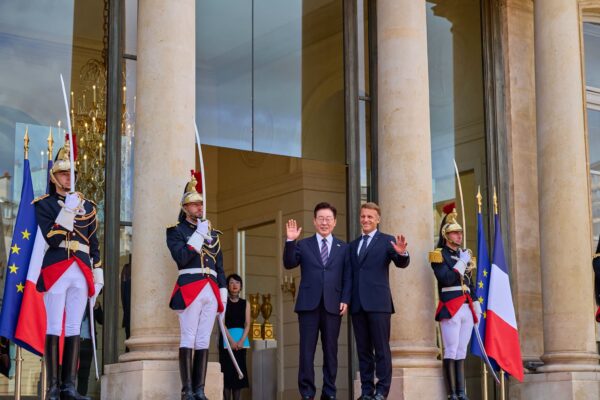
Read The Diplomat, Know The Asia-Pacific South Korea and France agreed to advance defense cooperation and coordinate on Hormuz Strait security following a summit in Paris. South Korean President Lee Jae-myung and French President Emmanuel Macron wave before entering Élysée Palace for a summit, Paris, France, Sep. 8, 2026. South Korean President Lee Jae-myung and French President Emmanuel Macron pledged on September 8 to deepen defense cooperation and coordinate on securing free passage through the Hormuz Strait. Their summit was the centerpiece event of Lee’s two-day state visit to France, which also produced new agreements on artificial intelligence, nuclear energy, and trade. Lee laid a wreath at the Tomb of the Unknown Soldier beneath the Arc de Triomphe and took part in an official welcome ceremony before a one-on-one lunch with Macron at the Élysée Palace. An expanded summit followed, and the two leaders then addressed reporters together. “We agreed to achieve a genuine leap forward in defense and security cooperation in order to jointly respond to the uncertainties of the international order,” Lee said in the joint press conference after the summit, adding that the two governments would move quickly toward signing a reciprocal military logistics support agreement. South Korea and France also signed an amended protocol to their existing pact on protecting military secrets, expanding the list of French officials with access to classified material and tightening rules on its handling. Hormuz Strait security featured prominently in the talks. “South Korea and France agreed to continue close coordination so that freedom of navigation in the Strait of Hormuz and the stability of global supply chains can be restored as soon as possible,” Lee said. Meanwhile, Seoul officials cautioned that the discussion should not be read as a decision on troop deployment. South Korea has been weighing a range of contributions, including military options, but officials say no decision has been made. Any deployment, even of a small number of personnel, would require National Assembly approval under South Korean law. On the economic side, Lee said the countries agreed to pursue $20 billion, or about 27 trillion won, in two-way trade by 2030. Roughly 20 Korean and French companies took part in a business roundtable on new investment opportunities, and trade promotion agencies KOTRA and Business France signed a cooperation document meant to expand support for companies entering each other’s markets. The visit also produced a private investment agreement between Samsung Electronics and French AI startup Mistral, announced alongside government-level memorandums on artificial intelligence, semiconductors, and quantum technology. Samsung led a 3 billion euro funding round for Mistral, valuing the company at more than 21 billion euro. The investment gives Samsung a strategic stake as the two work on an in-house AI model for the Korean firm’s chipmaking operations. Nuclear cooperation advanced too. Lee said the countries would sign further documents on nuclear research and fuel supply to push forward next-generation reactor development and diversify long-term supply chains, building on a nuclear fuel cycle cooperation agreement KHNP and French firm Orano signed during Macron’s April visit to Seoul. The two governments also agreed to open a high-level dialogue channel for private-sector nuclear cooperation. Biotechnology cooperation also expanded. The Korea Research Institute of Bioscience and Biotechnology signed three memorandums of understanding with French research institutions and companies covering eco-friendly materials, climate-resilient crops, and quantum-computing-assisted drug discovery, agreements Lee said would help Korean biotech firms gain a foothold in the European market. Lee added that the two sides modernized a bilateral aviation agreement dating to 1974, concluding talks that began in 2016. The updated pact adds fair-competition protections for consumers, expands code-sharing routes, strengthens mutual assistance during emergencies, and sets environmental standards for flight operations. The countries also expanded people-to-people exchange programs. An agreement widening eligibility for their working holiday program, reached in April, takes effect October 1, and Korean teaching assistants will be dispatched to France starting in October under a language-exchange agreement also signed in April. The two sides also signed a memorandum expanding research ties between Korean scholars and Paris-Saclay University, whose mathematics and physics researchers have produced 12 Fields Medalists, along with a police cooperation agreement targeting transnational crime. On Ukraine, Lee said France has played a central role in rallying European support for ending the war and restoring peace. He added that South Korea has backed Ukraine in various ways and would keep working with the international community on its recovery and reconstruction. Lee also thanked Macron for inviting South Korea to this year’s Group of Seven summit, saying the invitation allowed Seoul to add its voice to discussions on rebuilding international solidarity and restoring balanced, sustainable economic growth. He pledged that South Korea would keep contributing responsibly to challenges facing the international community through its cooperation with the G7. Macron, in turn, reaffirmed French support for Lee’s approach to the Korean Peninsula. The two leaders agreed to keep cooperating on regional peace and stability, citing close links between security in Northeast Asia and in Europe. Macron also criticized North Korea’s military support for Russia’s war in Ukraine, saying Paris and Seoul share a commitment to upholding an international order based on law. The peninsula was a recurring theme of Lee’s visit. Le Monde published a written interview with Lee on September 6 in which he said he wants to serve as a “pacemaker” in reviving dialogue between the United States and North Korea. Lee’s hope is that North Korea-U.S. diplomacy could lead to concrete and effective measures to halt Pyongyang’s nuclear buildup. The president acknowledged that “the wall of distrust built up over many years” cannot be torn down overnight. Still, he said he would keep working toward peaceful coexistence, a concept he laid out last month in his Liberation Day address. The September 8 summit came five months after Macron’s state visit to Seoul in April, when the two governments upgraded their relationship to a global strategic partnership. This year also marks the 140th anniversary of diplomatic ties between South Korea and France. Before arriving in Paris, Lee spent two days in southern France. He and Macron co-chaired the inaugural Lumière Summit on Monday at the Maeght Foundation in Saint-Paul-de-Vence, a gathering on the future of film and video that drew about 150 participants from more than 30 countries. The two gover
Original source
The Diplomat Indonesia