General articles are free for 24 hours after publish.
Lao Chili Farmers Secure New Market Access Through FAO-Supported Business Matching
Lao chili producers have signed Letters of Interest (LoIs) with Chinese and South Korean buyers following an FAO-supported business matching event. The initiative aims to boost farmer incomes and exports through financial support for GAP certification and cold-chain infrastructure.
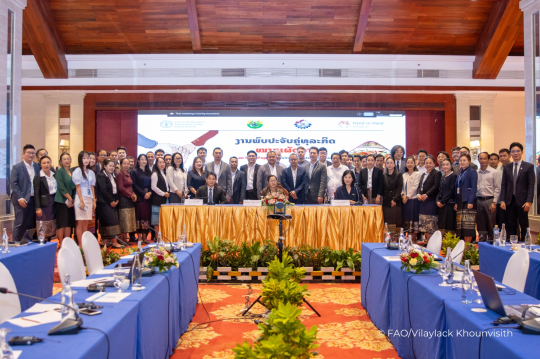
The Ministry of Agriculture and Forestry (MAE) of Lao PDR has unlocked new market access opportunities for Lao chili producers through a business matching event supported by the Food and Agriculture Organization of the United Nations (FAO). The event brought together Lao chili producers, processors, and exporters with verified buyers and investors from the People's Republic of China and the Republic of Korea. During the event, two Letters of Interest (LoIs) were signed between an international private-sector partner, a Lao producer group, and the Department of Planning and Cooperation of MAE, demonstrating a commitment to developing a chili pepper production and trade partnership. This signifies the Lao government's focus on the development of the chili sector. Deputy Minister of MAE, Chanthakhone Boualaphanh, stated, "Chili peppers are part of our identity, deeply tied to our food culture and the livelihoods of our farmers. The Ministry will lead the design and piloting of a traceability system for registered production areas and packing houses, which is a critical step in translating our agreements with China into actual export volumes." Deputy Minister of Industry and Commerce, Manothong Vongsay, added, "We recognize that Lao exporters and small and medium-sized enterprises need concrete support to turn interest into trade. We will co-lead the launch of a dedicated SME and green-finance mechanism for our chili sector, designed to help producer groups cover the costs of Good Agricultural Practices (GAP) certification, post-harvest infrastructure, and cold-chain facilities." FAO Representative in Lao PDR, Kyung-Mee Kim, commented, "FAO remains committed to walking this path with the Lao Government, from evidence to opportunity and market access. FAO has provided technical assistance at every stage, including supporting the rapid value chain analysis, delivering province-level extension on GAP standards and pesticide residue limits, and helping structure the smallholder finance mechanism." The business matching event represents the culminating external, demand-side step of a two-stage process under the FAO Hand-in-Hand Initiative. It builds on a previous Stock-Taking Consultation, which established a national production baseline and identified export capacity and compliance gaps. Targeted investment facilitation during the event highlighted priority entry points along the value chain, including pre- and post-harvest infrastructure, processing, cold-chain facilities, and market linkage services. The initiative prioritizes models that benefit smallholder producers, young farmers, and women-led producer groups. A post-event tracking mechanism has been established, where a designated focal point from MAE will monitor progress on all signed LoIs over a 90-day period, with technical support from FAO. Under Laos's one-party system, government-led agricultural development plans are a crucial pillar of economic growth. Close ties with China and Vietnam offer trade and investment opportunities, while also highlighting challenges for Laos's economic independence and domestic industry development. This initiative to expand chili exports is a significant step in the economic context of how Laos can enhance the value of its agricultural products and strengthen export competitiveness amidst these international relations.
Original source
KPL Laos News