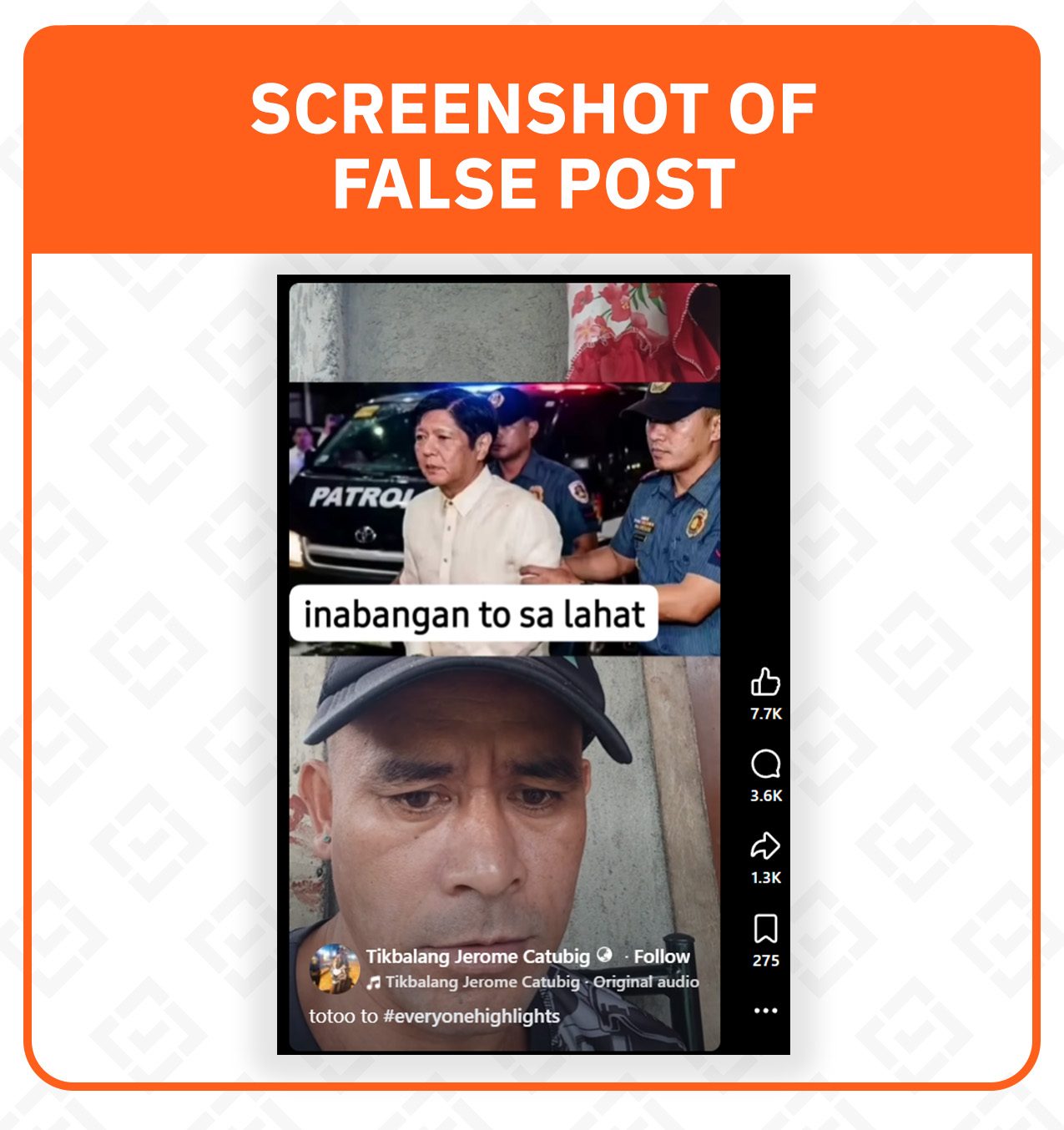
Fact Check: AI-Generated Photo Claims Marcos Jr. Arrested
A photo claiming President Ferdinand Marcos Jr. was arrested, circulating on social media, has been debunked as AI-generated. Marcos Jr. continues his official duties, and no arrest has occurred.
A photo claiming President Ferdinand Marcos Jr. has been arrested by police, circulating on social media, has been debunked as false by Rappler's fact-check. The post, published on Facebook on July 10, has garnered significant views, reactions, comments, and shares. The post features an image of the President with police, handcuffed, raising questions like "Is this true?" and "What happens if the President is gone?" Some users have commented, believing the President was arrested for drug use. However, President Marcos Jr. has not been arrested. As a sitting president, he enjoys immunity from suit while in office and cannot be investigated or prosecuted for any criminal offense. The Supreme Court has reaffirmed this privilege in past rulings. A reverse image search for the photo yielded no similar results, and multiple AI detection tools have confirmed it was artificially generated. Detection tools such as Sight Engine scored it with a 99% AI-generation probability, while Truth Scan, ZeroGPT, and DeepAI each gave it a 95% score. Furthermore, contradicting the arrest claims, the President has been carrying out his official duties. He visited the Navotas Fish Port Complex on July 11 and Benoni Port in Camiguin on July 13. He is also currently in Singapore for a working visit from July 14 to 16, aimed at strengthening bilateral relations with Singapore, which will be the next chair of ASEAN. President Marcos Jr. has recently been engaged in other official duties, including a visit to Canada from July 1 to 4 for discussions on defense and security with the Canadian Prime Minister. In March, he also attended events in New York, including the UN General Assembly. Rappler has previously fact-checked similar false claims and AI-generated videos concerning President Marcos Jr. Source: Rappler Philippines
多角的分析
AI生成技術の進展は、偽情報の拡散を容易にし、経済活動における信頼性リスクを高めている。特に、政治指導者に関する虚偽情報は、市場の不確実性を増幅させ、短期的な経済的混乱を引き起こす可能性がある。フィリピン経済は、国内外からの投資に依存しており、このような情報操作は投資家の信頼を損ない、資本流出を招くリスクも孕む。
AI生成による偽情報は、投資家にとって重大なリスク要因となる。政治的安定性や指導者の信頼性に関する誤った情報は、市場のボラティリティを高め、投資判断を誤らせる可能性がある。特に、フィリピンのような新興市場では、情報へのアクセスと正確性が投資家の意思決定に不可欠であり、AIによる偽情報はその基盤を揺るがす。
SNS上でのAI生成された偽情報の拡散は、市民の政治的判断を誤らせ、社会的な分断を深める危険性がある。大統領の逮捕というセンセーショナルな虚偽情報は、一部の市民に信じられ、政治的混乱や不信感を生む可能性がある。これは、フィリピンの民主主義プロセスにおける情報リテラシーの重要性を浮き彫りにしている。
SNSで大統領逮捕のAI写真が拡散されたことは、市民、特に情報リテラシーが十分に高くない層に、誤った認識を植え付ける可能性があります。大統領の公務遂行状況や、AI技術の進化による偽情報生成の容易さを理解していない人々は、この虚偽情報を信じ、政治への不信感を募らせるかもしれません。これは、日々の生活における政治への関心や信頼に直接影響を与えかねません。
背景・歴史的文脈
フィリピンでは、SNSが政治情報伝達の主要な手段となっており、偽情報や誤情報の拡散が長年問題となっている。特に、過去の選挙期間中や政治的緊張が高まる時期には、AI技術を活用した画像や動画による偽情報が散見される。マルコス大統領の父、フェルディナンド・マルコス元大統領時代からの権力闘争や、政治的対立を背景に、SNS上での情報操作は、世論形成や政治的影響力行使の手段として頻繁に用いられてきた。今回のAI生成写真も、こうしたフィリピンの政治的文脈の中で発生した事象と言える。
原文ソース
Rappler Philippines