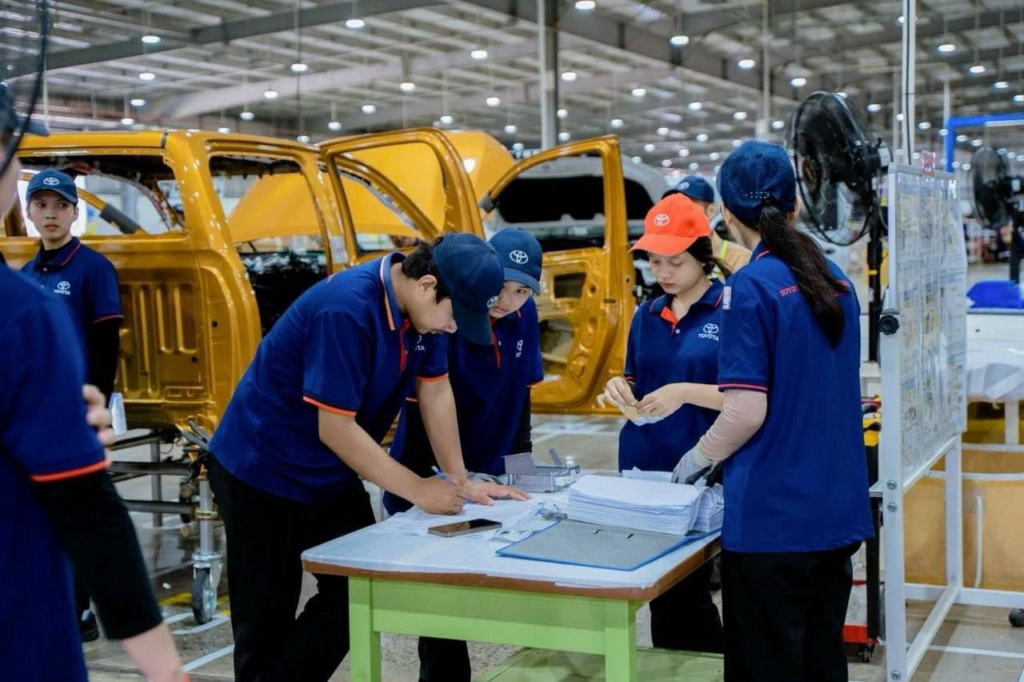
Toyota Cambodia: 77% of Auto Assembly Staff Recruited from TVET Graduates
Toyota has announced that 77% of its auto assembly plant staff in Cambodia are recruited from Technical and Vocational Education and Training (TVET) graduates. This highlights the contribution of Cambodian youth to modern industry, with the company also collaborating on technician training with JVC.
Toyota Motor Corporation has announced that 77% of its automotive assembly plant staff in Cambodia are recruited from Technical and Vocational Education and Training (TVET) graduates, aged between 18 and 23 years old. This indicates that Cambodian youth are playing a significant role in building the future of modern industry in the country. During the launch ceremony for the assembly and manufacturing of new Toyota models at the Toyota plant in the Phnom Penh Special Economic Zone on July 2nd, Mr. Harda Shigeru, Director of Toyota (Cambodia) Co., Ltd., stated that these skilled Cambodian youths are becoming a crucial driving force for Toyota's operations in Cambodia. The company has seen a substantial increase in production, from 40 units per month to over 400 units per month in the last two years. In addition to its investment in Cambodia, Toyota is also collaborating on technical training programs for Cambodian youth in partnership with the JVC Institute of Technology. The objective of this collaboration is to enhance the quality of automotive mechanic training to meet modern industrial standards. According to Mr. Atsushi Ueno, Ambassador Extraordinary and Plenipotentiary of Japan to Cambodia, Toyota signed a Memorandum of Understanding (MoU) with JVC in March to establish a Toyota Training Center, which will train automotive engineers for Cambodian youth. Ambassador Ueno observed that the productivity of Cambodian youth who have received training and are working at the Toyota factory has increased by up to three times. He expressed his hope that, "Engineers trained at this center and factory will become a significant driving force contributing to the development of the entire automotive industry in Cambodia." Deputy Prime Minister Sun Chanthol, First Vice Chairman of the Council for the Development of Cambodia (CDC), stated that the government places high importance on investments that create high added value and transfer specialized technology to the Cambodian people. He noted that Cambodian youth have demonstrated their capability to perform high-level technical work effectively when provided with proper training. Deputy Prime Minister Sun Chanthol further added, "This is precisely the type of strategic investment project that the Royal Government of Cambodia always prioritizes and warmly welcomes. It not only involves investment to establish factories but also actively contributes to building an industrial ecosystem, developing human resources, and jointly building a long-term future with Cambodia." He expressed confidence that the launch of the Toyota Training Center will promote the development of Cambodian mechanic and automotive skills to keep pace with global trends. As of now, Cambodia has 11 factories for the production, assembly, and manufacturing of automobiles, producing approximately 37,900 vehicles annually. To date, around 173,473 vehicles have been produced, sold, and are in circulation within Cambodia. Source: Kampuchea Thmey Local
多角的分析
トヨタ自動車がTVET卒業生を主要な人材源としていることは、カンボジアの製造業におけるスキルギャップの縮小と、若年層の雇用創出に貢献していることを示唆する。TVETプログラムへの投資は、自動車産業だけでなく、関連産業への波及効果も期待できる。生産台数の増加は、国内経済への貢献度を高める要因となるだろう。しかし、サプライチェーンの国内化や、部品製造業の育成といった、より広範な産業エコシステムの構築が今後の課題となる。
トヨタのような大手自動車メーカーが、現地で育成した若年労働者の活用を拡大している事実は、カンボジアへの長期的な投資環境の安定性を示唆する。特に、技術移転と人材育成へのコミットメントは、他の製造業企業にとっても魅力的な要素となり得る。ただし、インフラ整備の遅れや、法制度のさらなる整備は、投資リスクを低減させる上で引き続き重要である。
TVET卒業生が主要な雇用源となっていることは、カンボジアの若年層にとって、安定した職業訓練と雇用機会が提供されていることを意味する。これは、貧困削減や社会格差の是正に間接的に貢献する可能性がある。一方で、地方から都市部への人口移動や、訓練を受けた若者の都市部への集中といった社会的な課題も生じうる。彼らのキャリアパスや、地域社会への貢献のあり方についても、長期的な視点での支援が求められる。
トヨタ工場で働くTVET卒業生は、安定した収入を得ることで、自身の生活水準の向上と家族への貢献を期待できる。彼らは、専門的なスキルを習得し、将来的なキャリアアップの機会を得ることで、社会的な地位の向上も目指せるだろう。しかし、都市部での生活費の上昇や、長時間労働といった側面も考慮する必要がある。彼らの声が、より良い労働条件や地域社会の発展に繋がることが期待される。
背景・歴史的文脈
カンボジアでは、経済成長に伴い、製造業、特に自動車産業の発展が近年注目されている。しかし、長年の紛争の影響もあり、高度な技術を持つ人材が不足しているという課題を抱えてきた。これに対し、カンボジア政府は、職業訓練(TVET)の拡充を教育政策の柱の一つに据え、産業界と連携した人材育成を推進してきた。日本は、ODA(政府開発援助)や民間投資を通じて、カンボジアのインフラ整備や産業育成に長年貢献しており、特に自動車産業においては、技術移転や人材育成の面で重要な役割を果たしてきた。トヨタ自動車のTVET卒業生の積極的な採用は、こうした政府の政策と国際協力の成果が具体化した一例と言える。
原文ソース
Kampuchea Thmey Local