General articles are free for 24 hours after publish.
Vietnam Releases Socio-Economic Figures for First Seven Months of 2026: Signs of Slowing Growth
Vietnam's government has released socio-economic figures for January-July 2026. While inflation remains controlled, concerns about slowing economic growth are rising due to sluggish export-import growth and reduced productivity in some sectors.
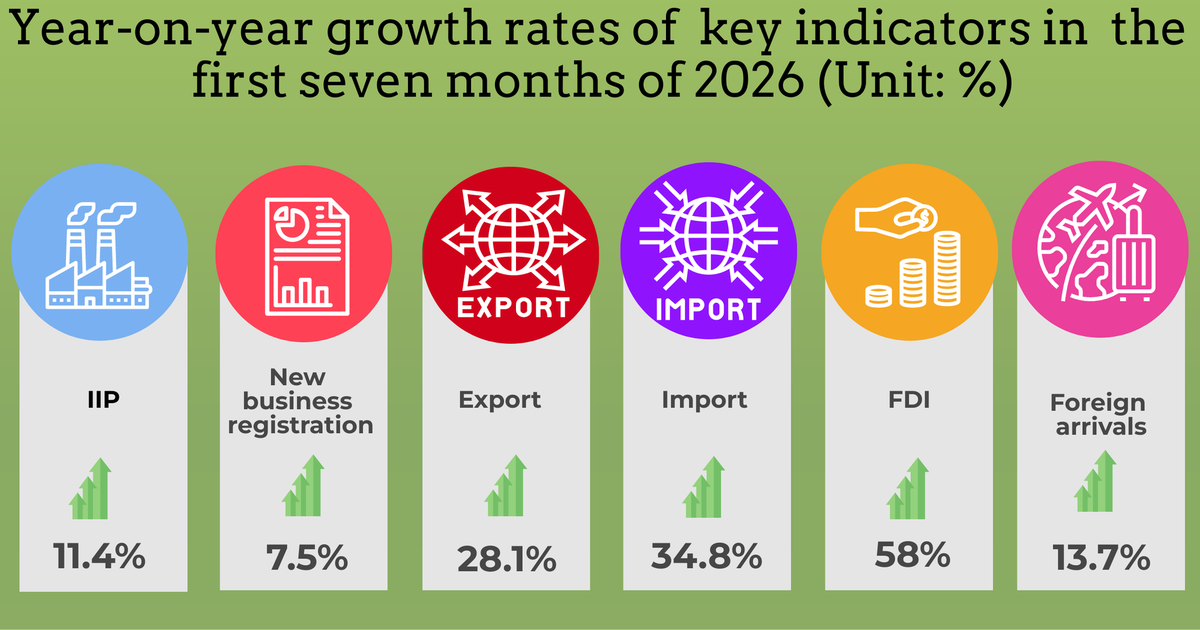
The Vietnamese government has released its socio-economic statistics for the first seven months of 2026, covering the period from January to July. The data indicates that while the country has managed to keep inflation under control, there are emerging signs of a slowdown in economic growth. This is attributed to factors such as sluggish performance in export-import activities and a decline in productivity within certain industrial sectors. Key figures show that the Consumer Price Index (CPI) has been maintained within the government's target range, reflecting the success of its price stabilization policies. However, the global economic landscape, marked by uncertainty and reduced demand from major trading partners, has begun to impact Vietnam's trade figures. Both exports and imports have experienced a slower growth rate compared to the corresponding period in the previous year. Furthermore, industrial production data reveals that output in several key manufacturing segments has stagnated. This slowdown in production is a significant concern, as it directly affects the overall economic growth trajectory. Vietnam's economy has relied heavily on its manufacturing and export sectors for its rapid expansion in recent years. The government acknowledges these challenges and is emphasizing strategies to mitigate the impact of external factors. These include efforts to stimulate domestic consumption, accelerate industrial restructuring towards higher value-added activities, and attract more investment into advanced sectors. The focus is on ensuring resilient and sustainable economic development. Historically, Vietnam's economic progress has been closely linked to its export-oriented industrialization strategy. The current global economic climate, including shifts in supply chains and geopolitical tensions, poses a complex environment for this model. The country's political system, a one-party state led by the Communist Party, prioritizes economic stability and growth as a cornerstone of its governance and public support. In its foreign relations, Vietnam maintains a delicate balance, particularly with its large neighbor, China. While economic interdependence is substantial, strategic concerns, especially regarding maritime disputes in the South China Sea, continue to shape bilateral interactions. The released socio-economic data will likely inform future policy adjustments aimed at navigating these multifaceted domestic and international dynamics.
Original source
Bao Chinh Phu