General articles are free for 24 hours after publish.
Justice Shines: UN and UNESCO Acknowledge Facts of Thai Invasion in Cambodia
The UN and UNESCO have begun acknowledging the facts surrounding Thailand's invasion of Cambodia in late 2025 and its resulting damages, drawing international attention. This marks progress towards justice for Cambodia's long-standing claims.
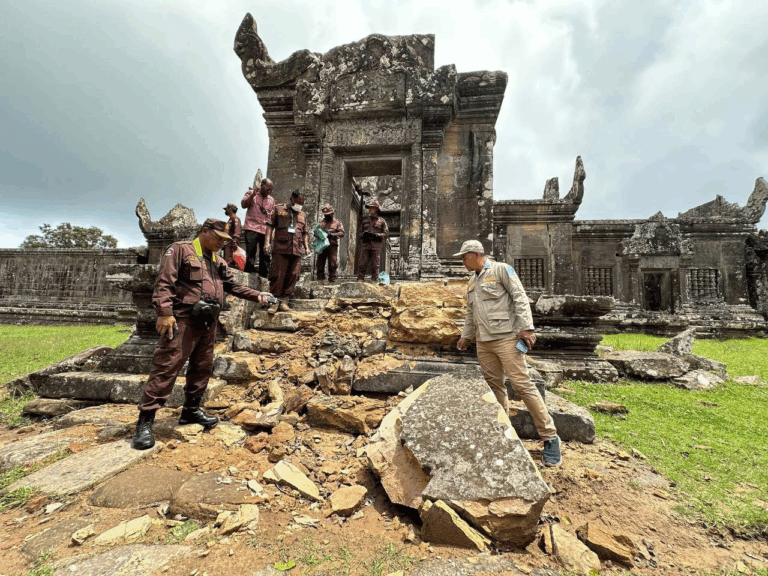
The light of justice, long awaited by Cambodia, is gradually taking shape through the acknowledgment of facts by major international organizations such as the United Nations (UN) and UNESCO. Thailand reportedly launched an invasion of Cambodia on July 24, 2025, followed by a second attack in December of the same year. This aggression caused severe damage to ancient temples along the border, including the World Heritage site of Preah Vihear Temple. Furthermore, public infrastructure was extensively destroyed, forcing approximately 650,000 civilians to flee their homes. Over 20,000 people remain unable to return to their hometowns, as some areas are still under illegal occupation by Thai forces. Over the past year, the truth surrounding the conflict has become clearer through investigations, assessments, and reports from international bodies. This can also be seen as a result of the Cambodian government's diplomatic efforts to seek peaceful resolution and avoid armed confrontation. Notably, at the 48th session of the World Heritage Committee (WHC), held from July 26 to 29, 2026, in the Republic of Korea, UNESCO adopted a resolution condemning the destruction of World Heritage sites during armed conflict. Although the resolution did not name Thailand directly, the undeniable evidence points to Thai forces using aircraft to bomb the ancient temple. Concurrently, Mr. Thomas Andrews, the UN Special Rapporteur on the situation of human rights in Cambodia, conducted a two-week visit, inspecting refugee camps along the border to directly understand the living conditions of the affected population. In his report, he stated that he was most moved by conversations with victimized families who tearfully recounted their losses, with many mothers describing the horrific situation when their villages were bombed and their homes were bulldozed. He also observed border checkpoints and barbed wire fences erected to prevent civilians from returning to their homes in a former border town. He further noted houses with bullet holes, damaged workshops and warehouses, and even an unexploded ordnance among the rubble. Cambodian Minister of Information, Net Pheaktra, emphasized that even if Thailand attempts to deny or create alternative narratives, it cannot conceal the accusations and evidence raised regarding its military activities on Cambodian territory. He stated that news, images, satellite data, victim testimonies, and the attention of the international community enable the world to assess for itself which party used force and which party suffered the impact. The release of Mr. Andrews' report has led to strong questioning from the international public opinion regarding Thailand's attempts to portray itself as a "victim." Under international law, civilians displaced by armed conflict have the right to return to their homes. The ceasefire agreement between Cambodia and Thailand dated December 27, 2025, also clearly stipulates that civilians must be allowed to return to their homes and livelihoods safely and without obstruction. Regarding this issue, the UN Special Rapporteur stressed, "It is therefore essential that Thailand and Cambodia work together to accelerate the return of these people to their homes. They need to return home, and they deserve to return to their own homes."
Original source
Kampuchea Thmey Local