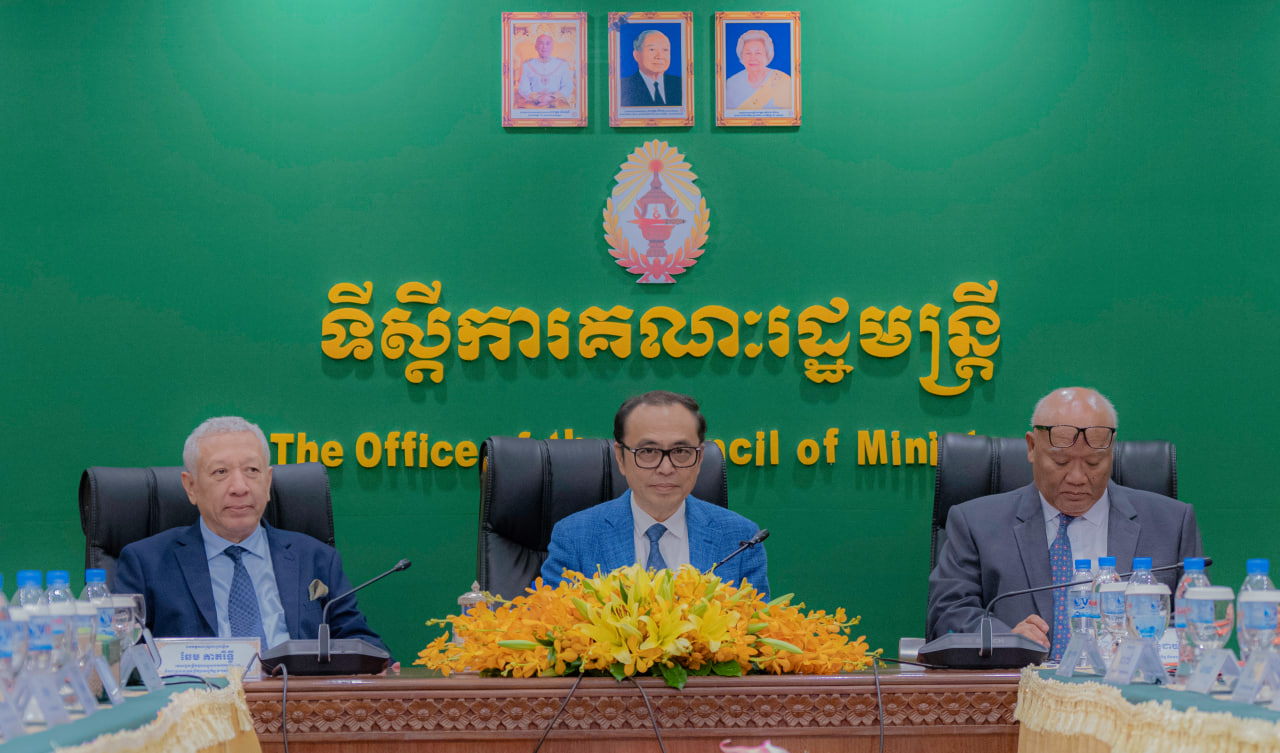
Cambodia Establishes Research Network to Enhance Policy-Making
Politics
2026年7月23日
5
CPP Cambodia

General articles are free for 24 hours after publish.

Cambodia Establishes Research Network to Enhance Policy-Making

Share
AI Summary

Cambodia signed an MoU on July 22, 2026, to establish the Cambodia Research Network (CRN) with 31 institutions, including major universities. The initiative aims to respond to global megatrends and promote evidence-based policy-making.

Cambodia signed a Memorandum of Understanding (MoU) on July 22, 2026, to establish the "Cambodia Research Network (CRN)" between the Prime Minister's Office and 31 research institutions, including major universities. This initiative aims to strengthen policy-making capabilities to address complex global trends, rapid technological advancements, climate change, and emerging security risks, ensuring the nation's development. Speaking at the signing ceremony, Deputy Prime Minister and Minister in Charge of the Prime Minister's Office, Vongsey Vissoth, highlighted the global megatrends facing Cambodia, including geopolitical and economic competition, the rapid evolution of digital technology and artificial intelligence (AI), climate change, and new forms of security risks, both traditional and non-traditional, such as cybersecurity, pandemics, and transnational crime. He also touched upon the border situation between Cambodia and Thailand. He emphasized the necessity of improving leadership and policy-making methodologies to foster robust and sustainable national development. Therefore, Cambodia requires high capabilities in foresight, response, flexibility, and innovation. To ensure "National Resilience," it is crucial to link evidence-based research with the formulation, monitoring, and evaluation of national policies. The 7th mandate government, led by Prime Minister Hun Manet, has launched the "Pentagonal Strategy Phase 1" and other major national strategies to transform Cambodia into a high-income country and achieve the "Cambodia Vision 2050." The establishment of CRN is seen as a significant step toward this goal. The Deputy Prime Minister outlined five key work areas, five priority sectors, and five strategic directions (5+5+5) for the effective operation of CRN. The five work areas include building a network connecting government institutions and research institutions, human resource development and knowledge sharing, linking research to policy formulation and implementation, establishing an online platform for information sharing, and creating a common data system. The five priority sectors are geopolitics, economy, society-culture-history, technology, and governance. Furthermore, five strategic guidelines were proposed, focusing on ensuring the quality and integrity of research, breaking down silos, orienting research towards practical needs while ensuring independence and freedom, strengthening institutional sustainability, and promoting research and partnerships between the government, private sector, and research institutions. The concept of establishing CRN was conceived by the Prime Minister's Office within the framework of the Socio-Economic and Cultural Council at the beginning of the 7th mandate, and after more than two years of deliberation, a common vision and draft strategic plan have been finalized. The establishment of CRN is not merely a ceremonial signing of an MoU but marks "the beginning of a new chapter" in pooling intellectual resources, enhancing the efficiency of national budget and resource allocation, and responding promptly to major national challenges. Deputy Prime Minister Vongsey Vissoth reiterated the government's and the Prime Minister's Office's commitment to continuously support, facilitate, and pave the way for CRN's operations in all forms. He expressed strong confidence that the 31 member institutions will become a robust "intellectual pillar," acting as a driving force for national economic and social growth, embodying the spirit of "thinking together, acting together, and taking responsibility together" to ensure Cambodia's sovereignty, territorial integrity, sustainable development, and resilience. The MoU for the establishment of CRN is intended to create a collaboration framework that will serve as "a new historical turning point" in gathering intellectual capital, knowledge, and expertise from Cambodian researchers both domestically and abroad. This signing also aims to strengthen and promote evidence-based research cooperation, contributing scientific and timely inputs to policy formulation, review, monitoring, and evaluation, strategic forecasting, and scenario planning, thereby serving the cause of protecting, recovering, and building the motherland.

0

Original source

CPP Cambodia

原文を読む