General articles are free for 24 hours after publish.
Vietnam Sets Ideological Strategy Goals to 2030 with Vision Beyond
The Communist Party of Vietnam has outlined specific ideological strategy goals for 2030 and a long-term vision beyond 2045, adapted for the new era. The strategy appears aimed at domestic stability and development, alongside strengthening its international influence.
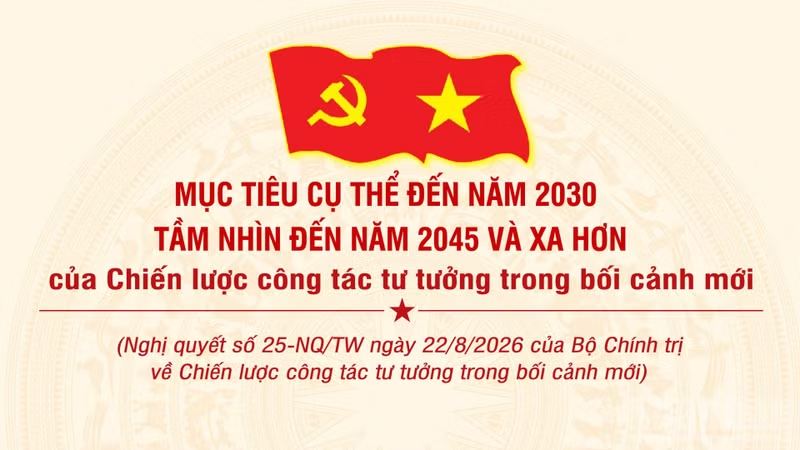
The Communist Party of Vietnam has formulated specific goals for its ideological strategy up to 2030 and a long-term vision extending beyond 2045, in line with Resolution No. 25-NQ/TW dated August 22, 2026, concerning the ideological strategy in the new context. [Infographic] General goals of the ideological strategy in the new context [Infographic] Guiding viewpoints on the ideological strategy in the new context [Infographic] 8 groups of main tasks and solutions in the ideological strategy in the new context The overarching objective of this strategy is to ideologically support the Party's line of building and developing the Socialist Republic of Vietnam, fostering national unity and patriotism among the people. Emphasis is placed on reforming public consciousness and maintaining/enhancing trust in the Party's leadership to address challenges arising from the development of the socialist-oriented market economy and deepening international integration. Key guiding principles underscore that ideological work is a crucial component of the Party's cause, essential for defending socialist values and Vietnam's national interests. The strategy also acknowledges the need to innovate ideological work methods in response to modern developments like the advancement of information technology and globalization. Eight main groups of tasks and solutions have been identified. These include strengthening ideological education, optimizing propaganda activities, cultivating a healthy culture in society, countering information manipulation by hostile forces both domestically and internationally, and providing ideological guidance to the youth. Through these measures, the Party aims to achieve ideological unity among the people and ensure social stability and sustainable development. Under Vietnam's one-party system, ideological strategy serves as a vital tool for maintaining the regime's legitimacy and promoting social cohesion. While rapid economic growth in recent years has improved living standards, it has also introduced new challenges such as widening social disparities and diversifying values. In this context, the Party seeks to align public consciousness with its objectives and maintain social stability through its ideological strategy. Furthermore, amidst a complex relationship with China, Vietnam strives to protect its independence and sovereignty while maintaining and expanding its influence in the ASEAN region. The ideological strategy is expected to play a significant role in bolstering national patriotism and strengthening national unity within this diplomatic framework.
Original source
Nhan Dan