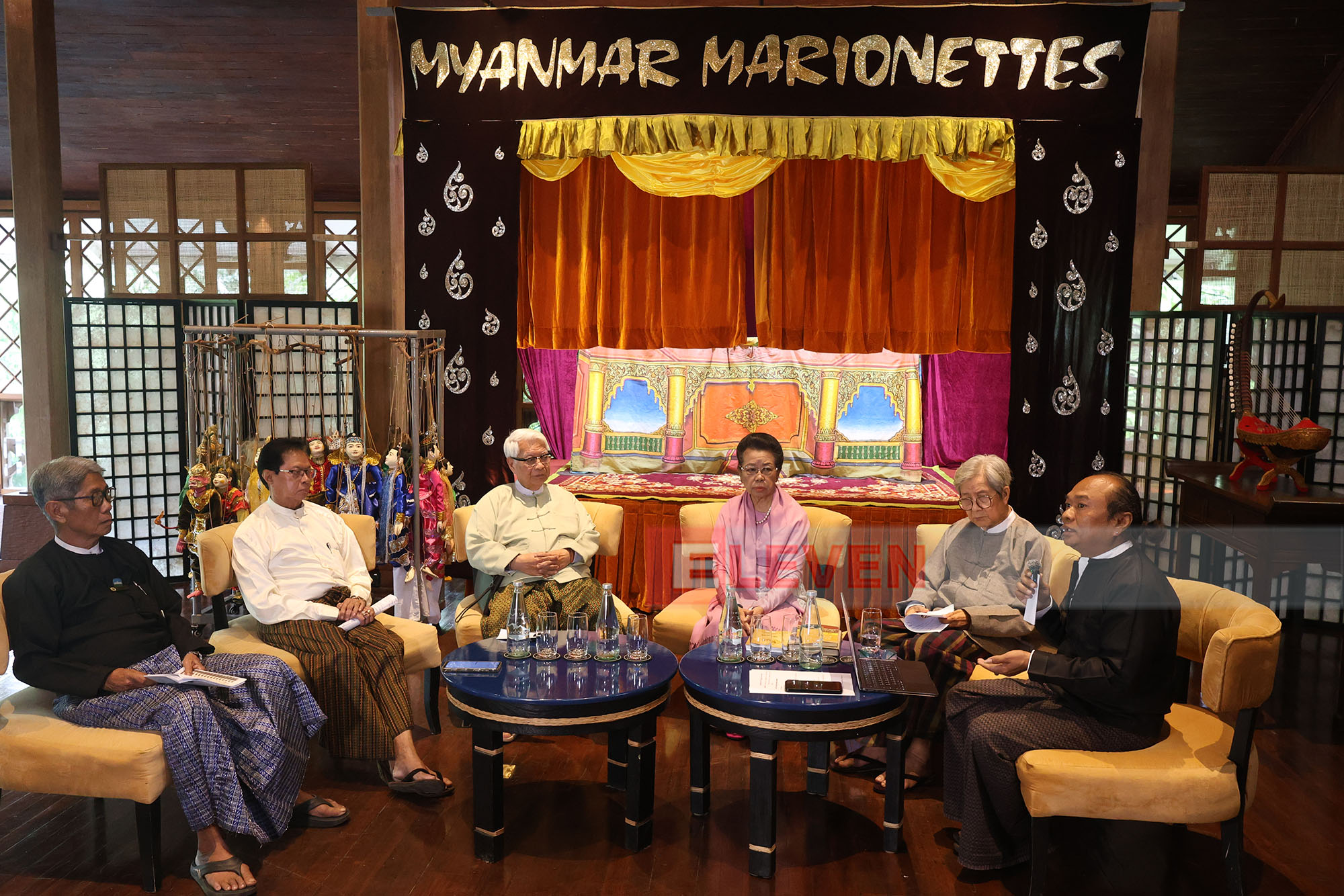
Myanmar Puppetry Roundtable Discussion Held Aiming for Long-Term Sustainability and Strength of Puppetry Art
Culture
2026年7月21日
2
Eleven Media

General articles are free for 24 hours after publish.

Myanmar Puppetry Roundtable Discussion Held Aiming for Long-Term Sustainability and Strength of Puppetry Art

Share
AI Summary

Aiming for the long-term sustainability and strength of puppetry, a traditional cultural art of Myanmar, the Myanmar Puppetry Roundtable Discussion was held on July 20 at the Governor’s Residence on Taw Win Road in Dagon

Aiming for the long-term sustainability and strength of puppetry, a traditional cultural art of Myanmar, the Myanmar Puppetry Roundtable Discussion was held on July 20 at the Governor’s Residence on Taw Win Road in Dagon Township, Yangon. “As the theatrical arts are developing and succeeding with great momentum, puppetry has become disheartened. Puppetry has lost face and cannot hold its head high. The masters of puppetry have also passed away. As only myself and U Shwe Kyi remain as the oldest, it is disheartening. Therefore, in my later years, before handing over the position of Chairperson of the Puppetry Committee to someone else, I wish to do as much as I can. When I want to fulfill my responsibilities, I thought about what would be a good starting point, and I thought that by initiating a puppetry roundtable discussion like this with the media, people would remember, ‘Oh, there is also puppetry,’ with the idea that people would recall it. That is why I decided to organize this event today,” said Daw Ma Ma Naing, Chairperson of the Myanmar Puppetry Committee. At the Myanmar Puppetry Roundtable Discussion, experts such as Daw Ma Ma Naing, Chairperson (Myanmar Puppetry Committee), U Aung Soe U, Literary, Film, and Law Expert (Patron – Puppetry Committee), U Htain Latt, National Literary Award Winner (Patron – Puppetry Committee), U Myat Soe Hlaing, Vice-Chairman (Myanmar Writers Association – Central) (Patron – Puppetry Committee), and U Ye Htut (Thanlyin Maung Win Wa), Head of Department (Retired), Department of Performing Arts, University of Culture and Arts (Yangon), discussed the issues. “In ancient times, it was initially called ‘Rup-son,’ but later, during the reign of King Singu, when it was performed in the royal palace, fearing that it might disrespect the king’s authority, it was performed not on the stage but in a ground-level circular arena. At that time, the puppets of puppetry gained the right to perform on the stage, and it came to be called ‘A-myint-tha-bin’ (high-stage performance). Therefore, according to the height of the place, puppetry was called ‘A-myint-tha-bin,’ and the theatrical performance, which was still in the ground-level circular arena era, was called ‘A-nin-tha-bin’ (low-stage performance). After that, puppetry developed remarkably, and during the Konbaung Dynasty, it was truly at its peak and most successful period. However, after King Thibaw was captured, during the period when puppetry declined, theatrical performance, from the ground-level circular arena, underwent reforms and improvements, and as theatrical performance gradually developed, puppetry gradually declined. Despite various efforts through different eras, the current state of puppetry is as everyone can see. It is not very prominent. In some countries, puppetry is also a ‘Dying Art’ globally, meaning it is fading away. However, in our Myanmar, it is even worse. In our country, the number of puppeteers can be counted on one’s fingers. How many masters of puppetry are left now can be counted on one’s fingers. In those countries, there are many puppetry troupes and many puppeteers. In their countries, everything is available, and there are many organizations. With many supporters and organizations providing such support, even though puppetry is a fading art, in our Myanmar, the situation is a bit worse. Therefore, I am dissatisfied with this and am making efforts like this,” said Daw Ma Ma Naing, Chairperson of the Myanmar Puppetry Committee.

0

Original source

Eleven Media

原文を読む