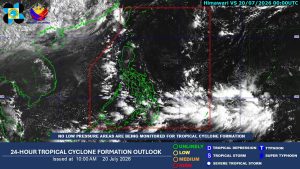
Two Tropical Cyclone-Like Vortices Expected to Form in Philippine Area
Environment
2026年7月20日
3
BusinessWorld Nation

General articles are free for 24 hours after publish.

Two Tropical Cyclone-Like Vortices Expected to Form in Philippine Area

Share
AI Summary

The Philippine Atmospheric, Geophysical and Astronomical Services Administration (PAGASA) forecasts the formation of two tropical cyclone-like vortices (TCLVs) in the coming days and weeks, with one having a moderate chance of developing into a tropical cyclone.

Two tropical cyclone-like vortices (TCLVs) are expected to form in the coming days and weeks, with one having a low to moderate chance of developing into a tropical cyclone (TC), according to the Philippine Atmospheric, Geophysical and Astronomical Services Administration (PAGASA). TCLV 1 is anticipated to emerge over the eastern boundary of the Tropical Cyclone Advisory Domain (TCAD) during Week 1, covering July 16 to 22. PAGASA stated in its latest Tropical Cyclone Threat Potential Forecast that the system has a low to moderate chance of developing into a tropical cyclone during the forecast period. In Week 2, from July 23 to 29, PAGASA projects TCLV 1 to move towards the northeastern portion of the TCAD and the Philippine Area of Responsibility (PAR). The system is expected to maintain its low to moderate chance of developing into a tropical cyclone. During the same Week 2 period, TCLV 2 is forecast to emerge over the eastern portion of the TCAD and may enter the PAR. It has a low likelihood of developing into a tropical cyclone during this period. "Therefore, the TC threat potential is less likely over Week 1 and likely over Week 2," PAGASA said. The agency added that changes in the forecast pattern will be closely monitored and updates will be issued as needed. The potential formation of tropical cyclones in the Philippine Area of Responsibility (PAR) is a recurring concern for the nation. These weather systems can bring significant rainfall, strong winds, and storm surges, leading to widespread damage to infrastructure, agricultural losses, and potential displacement of communities, particularly in coastal and low-lying areas. The PAGASA's forecasts are crucial for early warning systems and disaster preparedness efforts across the archipelago.

0

Original source

BusinessWorld Nation

原文を読む